
Athenea del Castillo and the manifesto she refused to sign
Athenea del Castillo, Real Madrid player, refused to sign the women's national team manifesto. Her decision reignited the debate over the role of…
English · Original discussion in Spanish · Published
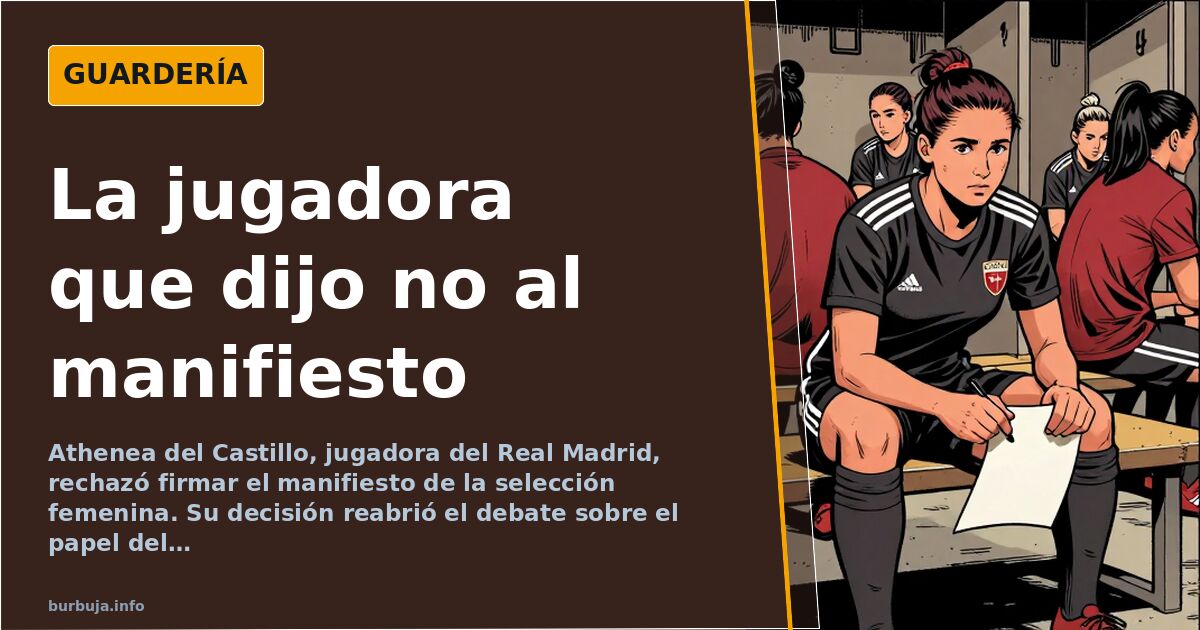
Athenea del Castillo: the player who said no to the manifesto
In 2023, Spanish women's football experienced an earthquake that went beyond sport. A non-consensual kiss during the World Cup celebration, a rebellious national team, a manifesto and a player who decided not to sign it. Athenea del Castillo, Real Madrid forward, became the face of a controversy that still lingers.
Her decision not to sign the document demanding changes in the federation and to focus exclusively on football placed her in the crossfire. To some, she was a traitor to the cause. To others, the only one who remained true to her profession. The discussion, as often happens, drifted into less edifying territory.
Who is Athenea del Castillo
Athenea del Castillo is a player for Real Madrid Femenino and the Spanish national team. Her public profile has always been that of a discreet footballer, far from the media spotlight surrounding other teammates. That discretion, however, became her condemnation when the conflict erupted.
The player refused to sign the manifesto that a group of internationals had drafted to demand structural reforms in the Royal Spanish Football Federation (RFEF). Her argument, as inferred from public debate, was simple: she wanted to focus on playing football. A stance that, in the context of a national team at war, sounded almost revolutionary.
The manifesto that divided women's football
The document, driven after the non-consensual kiss during the World Cup celebration, called for deep changes in the federation. Most players signed it. Athenea del Castillo did not. That refusal made her the target of both criticism and praise in equal measure.
Some claim her stance stemmed from professional or personal jealousy within the locker room. Others defend that she was simply exercising her individual freedom. The controversy is framed in a broader context: that of women's football seeking its place in a historically masculinized sports ecosystem.
Audience and sponsorship figures have grown, but so have internal tensions. The national team, world champions, seemed more like a soap opera than a team. Factions, rumors and leaks fueled a narrative that had little to do with sport.
The debate on feminism in sport
Athenea del Castillo's decision peine a recurring debate: should athletes take an ideological stance or limit themselves to competing? The question has no easy answer. Part of the analysis holds that players have an inescapable social responsibility. Another current defends that sport should be a neutral space, removed from political disputes.
In the middle, figures like Athenea del Castillo become involuntary symbols. Her refusal to sign the manifesto was interpreted as a political stance, even though she never expressed it in those terms. The label of "feminism that represents me" that certain sectors pinned on her added more fuel to the fire.
The case has also served to highlight the national team's internal tensions. More than a team, some describe the group as a soap opera with opposing factions. Coexistence in a divided locker room is, at the very least, complicated.
The controversy over her image
Beyond the manifesto, public conversation drifted into less edifying territory. The player's physical appearance became the subject of comments, comparisons and assessments that had little to do with her athletic performance. It is a recurring pattern in women's sport: female players are evaluated for their looks with a frequency their male colleagues do not experience.
The phenomenon is not new, but the virality of social media has amplified it. Comments about her legs, her body or her attractiveness mixed with sports analysis in an indigestible soup. The boundary between criticism and excess blurred completely.
The context of Spanish women's football
Spanish women's football is experiencing a moment of sustained growth. Stadium attendance has increased, television rights have risen in value and sponsorship has entered strongly. But growth has also brought conflicts. The Spanish national team, world champions in 2023, has been the stage for those tensions.
The non-consensual kiss case, the resignation of called-up players and the subsequent reorganization of the team marked a tumultuous year. In that context, the figure of Athenea del Castillo represents a paradox: a player who wanted to stay on the sidelines of the conflict and ended up being one of its most recognizable faces.
With women's football in full expansion, the question about the athlete's role as a social actor remains unanswered. Athenea del Castillo chose silence and the game. The noise, however, has not abandoned her. And the debate over whether a footballer should be something more than a footballer continues.
In 2023, Spanish women's football experienced an earthquake that went beyond sport. A non-consensual kiss during the World Cup celebration, a rebellious national team, a manifesto and a player who decided not to sign it. Athenea del Castillo, Real Madrid forward, became the face of a controversy that still lingers.
Her decision not to sign the document demanding changes in the federation and to focus exclusively on football placed her in the crossfire. To some, she was a traitor to the cause. To others, the only one who remained true to her profession. The discussion, as often happens, drifted into less edifying territory.
Who is Athenea del Castillo
Athenea del Castillo is a player for Real Madrid Femenino and the Spanish national team. Her public profile has always been that of a discreet footballer, far from the media spotlight surrounding other teammates. That discretion, however, became her condemnation when the conflict erupted.
The player refused to sign the manifesto that a group of internationals had drafted to demand structural reforms in the Royal Spanish Football Federation (RFEF). Her argument, as inferred from public debate, was simple: she wanted to focus on playing football. A stance that, in the context of a national team at war, sounded almost revolutionary.
The manifesto that divided women's football
The document, driven after the non-consensual kiss during the World Cup celebration, called for deep changes in the federation. Most players signed it. Athenea del Castillo did not. That refusal made her the target of both criticism and praise in equal measure.
Some claim her stance stemmed from professional or personal jealousy within the locker room. Others defend that she was simply exercising her individual freedom. The controversy is framed in a broader context: that of women's football seeking its place in a historically masculinized sports ecosystem.
Audience and sponsorship figures have grown, but so have internal tensions. The national team, world champions, seemed more like a soap opera than a team. Factions, rumors and leaks fueled a narrative that had little to do with sport.
The debate on feminism in sport
Athenea del Castillo's decision peine a recurring debate: should athletes take an ideological stance or limit themselves to competing? The question has no easy answer. Part of the analysis holds that players have an inescapable social responsibility. Another current defends that sport should be a neutral space, removed from political disputes.
In the middle, figures like Athenea del Castillo become involuntary symbols. Her refusal to sign the manifesto was interpreted as a political stance, even though she never expressed it in those terms. The label of "feminism that represents me" that certain sectors pinned on her added more fuel to the fire.
The case has also served to highlight the national team's internal tensions. More than a team, some describe the group as a soap opera with opposing factions. Coexistence in a divided locker room is, at the very least, complicated.
The controversy over her image
Beyond the manifesto, public conversation drifted into less edifying territory. The player's physical appearance became the subject of comments, comparisons and assessments that had little to do with her athletic performance. It is a recurring pattern in women's sport: female players are evaluated for their looks with a frequency their male colleagues do not experience.
The phenomenon is not new, but the virality of social media has amplified it. Comments about her legs, her body or her attractiveness mixed with sports analysis in an indigestible soup. The boundary between criticism and excess blurred completely.
The context of Spanish women's football
Spanish women's football is experiencing a moment of sustained growth. Stadium attendance has increased, television rights have risen in value and sponsorship has entered strongly. But growth has also brought conflicts. The Spanish national team, world champions in 2023, has been the stage for those tensions.
The non-consensual kiss case, the resignation of called-up players and the subsequent reorganization of the team marked a tumultuous year. In that context, the figure of Athenea del Castillo represents a paradox: a player who wanted to stay on the sidelines of the conflict and ended up being one of its most recognizable faces.
With women's football in full expansion, the question about the athlete's role as a social actor remains unanswered. Athenea del Castillo chose silence and the game. The noise, however, has not abandoned her. And the debate over whether a footballer should be something more than a footballer continues.
Summary of a discussion on Burbuja.info - Foro de economía, actualidad y política., translated from Spanish and reviewed before publication. Read the full discussion (110 replies).
More summaries
-
Real Madrid (Spain) vs state-backed clubs and Super League
Real Madrid leads the fight against state-backed clubs and the Super League, reshaping European football's financial and tactical balance.
-
Seven Years Without a Date, and a Coffee Invite That Ended in Being Blocked
Seven years without a date, three weeks of back-and-forth, and a silent block: how a coffee invite turned into a ghosting story.
-
This post on X from back when it was still Twitter is getting people talking online again.
A post from before July 2023 asked whether Penélope Cruz was Pepe Viyuela in a wig. The joke is doing the rounds again.
-
A forum debates whether showing off your body online is enough to get a date
A conversation about dating someone who flaunts their body on social media leaves one fact: the only figure mentioned is an unconfirmed height, 1,52 m
-
Jona Takalua: "I'm asexual, but I had a girlfriend"
Sexuality in the making: a personal journey between doubt and discovery. A personal account details the complex process of...
-
70s and 60s music: the repertoire that survives on cassette
The 70s and 60s music repertoire that survives on cassette tapes is still being searched for on YouTube: Rainbow, Boney M, ballads and disco