
Housing crisis pushes Vox to 20% threshold, leaving PP with no room
Metroscopia polling shows Vox nearing 20% support driven by housing issues, while the PP remains stagnant and the left loses ground.
English · Original discussion in Spanish · Published
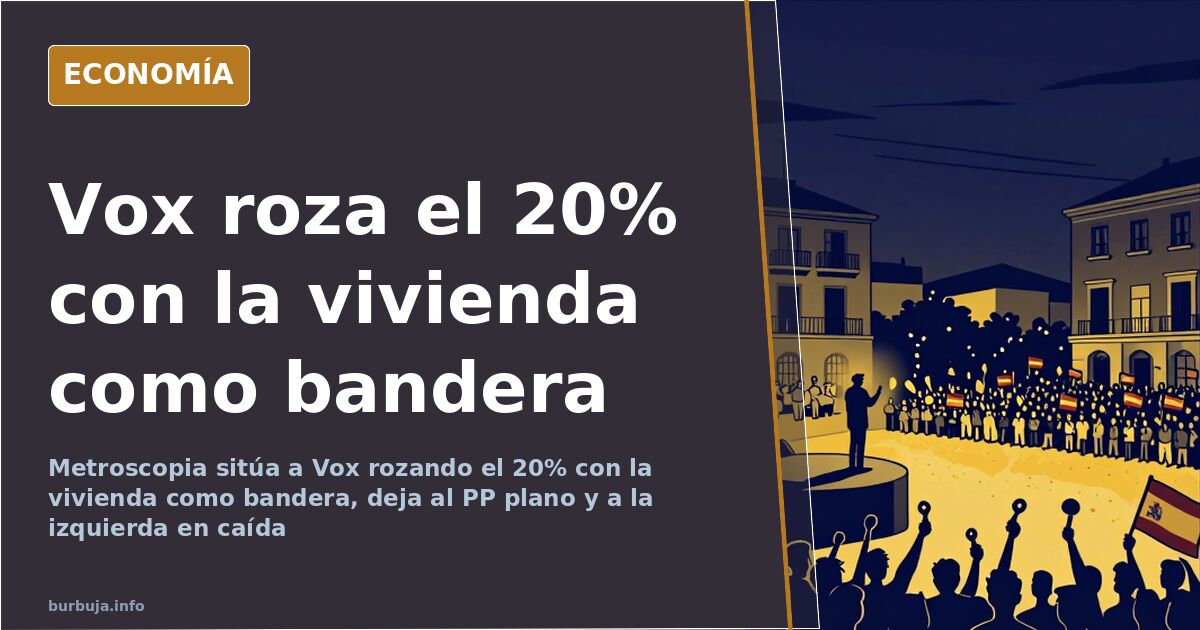
Vox nears 20% on housing as PP stalls
The converted commercial space now serving as a dormitory is common in tense areas: ten or twelve people piled up among dampness and rodents, as reported when tracking the phenomenon. On this literal ground, the electoral battle is being fought that the latest Metroscopia survey portrays without embellishment: Vox nearing 20% voting intention, the PP staying put, and the left losing height. Housing has ceased to be a management issue and has become the axis organizing the vote.
This is not an isolated figure. There is a 20% threshold that functions within the Spanish electoral system, and reaching it changes a party's category. It is important to understand why this issue has become so explosive.
What the survey says and why the pollster is debated
Metroscopia carries its history: it is the firm that has traditionally worked for El País, and that link is recalled whenever it publishes a result that does not fit the left's narrative. The distrust, in any case, is transversal. It circulates naturally that there are little lies, lies, big lies, and surveys, and there is reason to those who repeat it: until votes are counted, each pollster can count what interests them.
The relevant point is not the decimal. The relevant point is the direction: Vox installed at the 20% frontier, the PP flat, and the left block ceding. In an issue where much of the population perceives that nothing has been done for over a decade, this movement has a fairly earthly explanation.
Why housing has become the number one problem?
The most repeated diagnosis marks three dates. In 2011 there were already serious symptoms: evictions, mortgage defaults, families running out of money. But supply was abundant. Banks could offer sarracena, prices fell due to excess stock and falling demand. The problem was harsh, although solvable.
The second inflection point arrives in 2017, when the available stock begins to run out. The first pressure came from tourist rentals, which drove prices up in areas with demand. And the third date is 2020: after the pandemic, the volume of incoming foreign population tensions a supply that no longer had room for more. This is the framework where two narratives rarely spoken intersect: the one attributing pressure to demographics and the one attributing it to speculation and large holders.
The overturned decree and the bill no one wants to pay
In the political arena, the rental package died with the votes of PP, Vox, and Junts, and each block tells it in its own way. One part maintains that overturning these decrees is what has prevented stopping the escalation; another, that this would have further complicated supply and driven up prices. The result, for now, is the same for everyone: neither one nor the other, and the entire problem still standing.
Behind the noise are figures that allow no interpretation. 600 billion more in debt with interest growing, 2.3 million people living on the Minimum Vital Income and 600,000 more public employees. The argument repeated is always identical: when the debt problem explodes, a part of the electorate will demand radical and immediate solutions to maintain their standard of living, and those solutions will no longer be available.
Population, rentals, and the calculations that do not add up
That is where the issue becomes poisoned. Calculations circulate according to which cutting benefits to the non-nationalized population would be enough for hundreds of thousands of people to leave the country, and with legal guarantees for owners and express evictions, two million homes would enter the rental market without laying a single brick. These estimates are sustained without endorsement from any official body and mix two different things: migration policy and land policy.
The diagnosis on supply, however, does have broad technical consensus: without liberalized land and without changing building regulations, new stock does not appear. This consensus breaks as soon as someone asks who must pay for the party and who must leave for the distribution to balance.
What happens when a party reaches 20% of the vote?
The Spanish electoral law has an unintuitive behavior. Below 20% of the vote, the system disadvantages medium-sized parties; from then on, it begins to favor them. It is an effect of the distribution formula by constituencies, which rewards formations with vote spread across the territory and punishes those concentrated.
The example cited is Unidos Podemos: around 20% of the vote and almost exactly 70 seats, 20% of the chamber, twice in a row. Ciudadanos and Vox, when they have stayed below that line, have converted their percentage of votes into a smaller percentage of seats. If the polls are correct and Vox crosses the threshold, the parliamentary map is no longer the same and with it, possible majorities.
And here comes the disconcerting figure. The party that capitalizes the anger over housing offers as a solution a package where the most cited piece is not a land policy, nor a construction plan, nor a tax reform: it is a figure of people who would leave. No one has validated it. It is sustained that it would work.
Also available in: Deutsch
Summary of a discussion on Burbuja.info - Foro de economía, actualidad y política., translated from Spanish and reviewed before publication. Read the full discussion (150 replies).
More summaries
-
Spain's PP rules out bringing back the 'sun tax'
Alberto Nadal, the PP's deputy secretary for the Economy, stated in 2026 that the party is dropping the so-called sun tax and instead proposes scrapping the 7% levy on electricity generation.
-
Vox leader Abascal rejects interview with Jimenez Losantos
Abascal reportedly refuses an interview with Jimenez Losantos amid growing tensions between Vox and Spanish right-wing media.
-
PP blocks amnesty bill in Senate, bypassing vote
The PP uses its Senate majority to block the amnesty law vote, pushing the institutional conflict to Spain's courts.
-
The witchcraft hoax about migrant boats stoking hatred
A video with CapCut AI watermarks claims that migrants kill women on boats over witchcraft. Some link it to tribal beliefs, others deny it.
-
Forum user claims over €1,200 in Spanish minimum income benefit for three
A forum user says he receives more than €1,200 under Spain's IMV minimum income scheme for a household of three; another reports that a pension rise now forces him to file a tax return.
-
Spain's 'patera flats' hit breaking point: two bunk beds per room
More than half of foreign nationals in Spain arrived after 2020. Overcrowding in 'patera flats' is becoming normalised as the housing crisis worsens.