
Spain's 'patera flats' hit breaking point: two bunk beds per room
More than half of foreign nationals in Spain arrived after 2020. Overcrowding in 'patera flats' is becoming normalised as the housing crisis worsens.
English · Original discussion in Spanish · Published
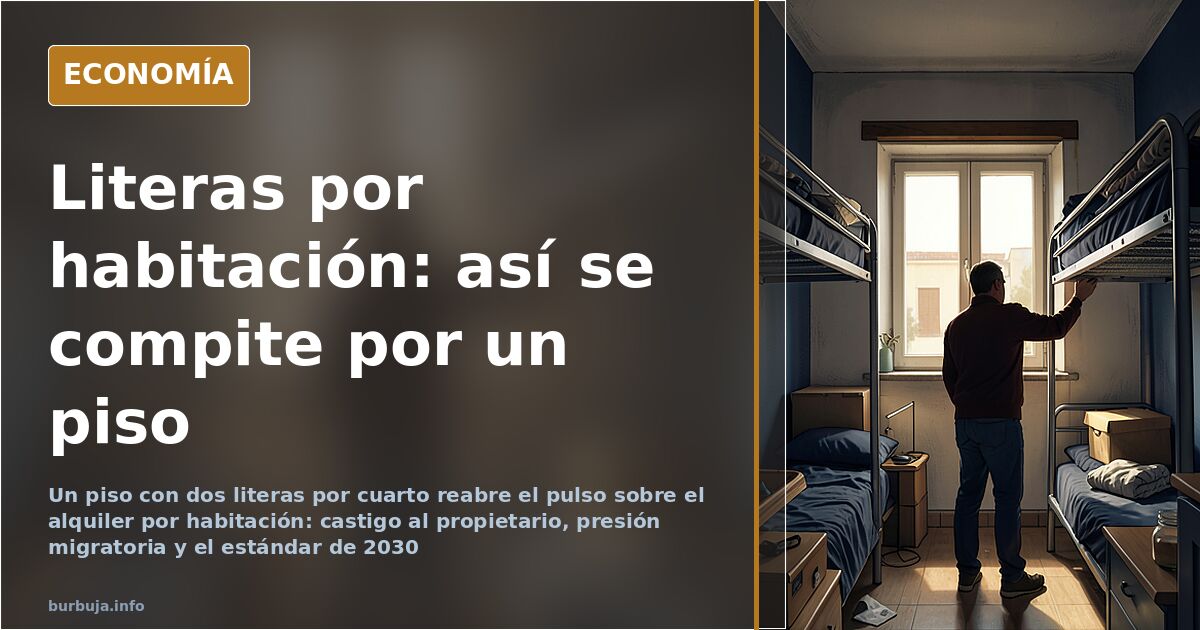
Two bunk beds per room: the overcrowding that is now the norm in Spain
Housing standards in Spain are deteriorating at a pace not even the most pessimistic observers anticipated. In 2026, with the housing crisis running out of control, some people no longer talk about shared flats, but about rooms with two bunk beds and entire families crammed together. The image of a first-world flat with running water and heating, but no table to eat at, has become the new floor of existence for thousands of people. Meanwhile, the public debate remains stuck on the surface.
The conversation soon turned to political responsibility. Some argue that migratory pressure is the triggering factor, while others point to a structural problem that has been brewing for decades. Available data show that more than half of foreign nationals in Spain arrived after 2020, coinciding with Pedro Sánchez's return to government. But correlation is not causation, and serious analysis requires looking beyond the easy headline.
Overcrowding as a symptom, not a cause
The phenomenon of 'patera flats' — overcrowded apartments housing newly arrived migrants — is not new, but its normalisation is. What was once a condemnable exception has become a tolerated practice, if not directly encouraged by the lack of alternatives. The argument that these flats are not the root of the problem but a consequence of it is gaining ground among those who analyse the market dispassionately: if they did not exist, the pressure on the market would be the same or greater. Demand does not disappear because supply is banned; it simply shifts to even worse conditions.
The root cause, therefore, lies not in overcrowding itself, but in the absence of sufficient housing for a demand concentrated in large cities. Spain lives off services, and services concentrate where there is population. Madrid, Barcelona and Valencia absorb the bulk of activity, while the rest of the country faces galloping depopulation. The result is a labour market that forces people to live where there is no affordable housing, and an administration that has failed to correct that inertia.
Depopulation as the other side of the same coin
The country has an unchecked depopulation problem while simultaneously concentrating jobs in three or four hubs. That is not just poor management; it is a complete absence of state planning. The extra profit from producing cheaply in hyper-populated areas is then squandered on sustaining regions that are emptying out, with services that are increasingly expensive to maintain. Without doctors, police or schools across wide areas, the circle closes: more people leave, fewer services remain, and everything concentrates further in the same spots.
Legal insecurity makes the picture worse. Supply is restricted because landlords do not trust tenants, and renters are left with no options. Patera flats are the escape valve of a system that offers nothing else. And meanwhile, the political debate entrenches itself in blaming migrants or the government of the day, without addressing the structure that makes it possible.
The replacement narrative and political noise
On the political front, the rhetoric has heated up. Anti-immigration European leaders have accused Sánchez of wanting to replace the population to stay in power. These remarks were made at a coordination meeting ahead of the European Council, and reflect growing tension in the EU. In Spain, that narrative finds an echo among those who see mass immigration as a tool used by elites to keep wages low and maintain electoral clienteles.
But serious analysis cannot stop at the slogan. Immigration has been favoured by economic elites at various points in history, and that is nothing new. What matters now is that the country lacks a housing policy capable of absorbing the migratory flow without degrading living conditions. That is a responsibility shared by decades of governments that preferred the easy headline to the structural solution.
The future: between prediction and caution
Given these circumstances, it is reasonable to expect overcrowding to consolidate unless the tide turns. Migratory pressure is not going to disappear, and housing is not built overnight. The most plausible prediction is that living standards in large cities will continue to deteriorate, with or without patera flats, while the rest of the country empties out. But caution is warranted: the economy has an adaptive capacity that often confounds analysts, and public policy, however slow, can correct inertia if there is genuine will.
What is beyond doubt is that the debate on housing and immigration will remain a political battleground. And that the data, often uncomfortable, are the only thing that can stop the discussion from becoming an exchange of slogans. The question is not just how much housing is missing, but what kind of country we want to build with what there is.
Also available in: Deutsch
Summary of a discussion on Burbuja.info - Foro de economía, actualidad y política., translated from Spanish and reviewed before publication. Read the full discussion (56 replies).
More summaries
-
Sánchez Halts EU Summit for Energy Break to Force Pause
Sánchez leaves the European Council in Brussels after Germany and the Netherlands blocked Spain's energy proposal, pausing the summit.
-
Sánchez hits back at the EU amid the Ceuta crisis
Sánchez's letter to the EU amid the Ceuta crisis escalates the standoff: Italy, Finland and Denmark call for suspending Schengen access, while the Commission rules it out.
-
Marc Vidal: Economic Guru or Charlatan?
Marc Vidal faces widespread criticism for monetizing doom-mongering, though his stance on CBDCs earns him support.
-
Sánchez answers Broncano's question about his sex life
Spain's PM Sánchez told Broncano: "it's not just about f***ing, you also make love." The remark has drawn mockery on social media.
-
How Franco seized Morocco and the Army of Africa in July 1936
The 18 July 1936 military coup collapsed across much of Spain, but Franco took control of Morocco and the Army of Africa. That command laid the groundwork for his rise to power.
-
Spanish Navy video resurfaces on YouTube, sparking AI propaganda debate
A Spanish Navy video that has been on YouTube for a decade fuels suspicion that AI has infantilised institutional propaganda and reignites debate about the vote.