
Hotel requesting CVV by email: Is this normal?
A customer reports a non-Spain hotel asking for card details and CVV via email. Most users advise against sharing this sensitive information.
English · Original discussion in Spanish · Published
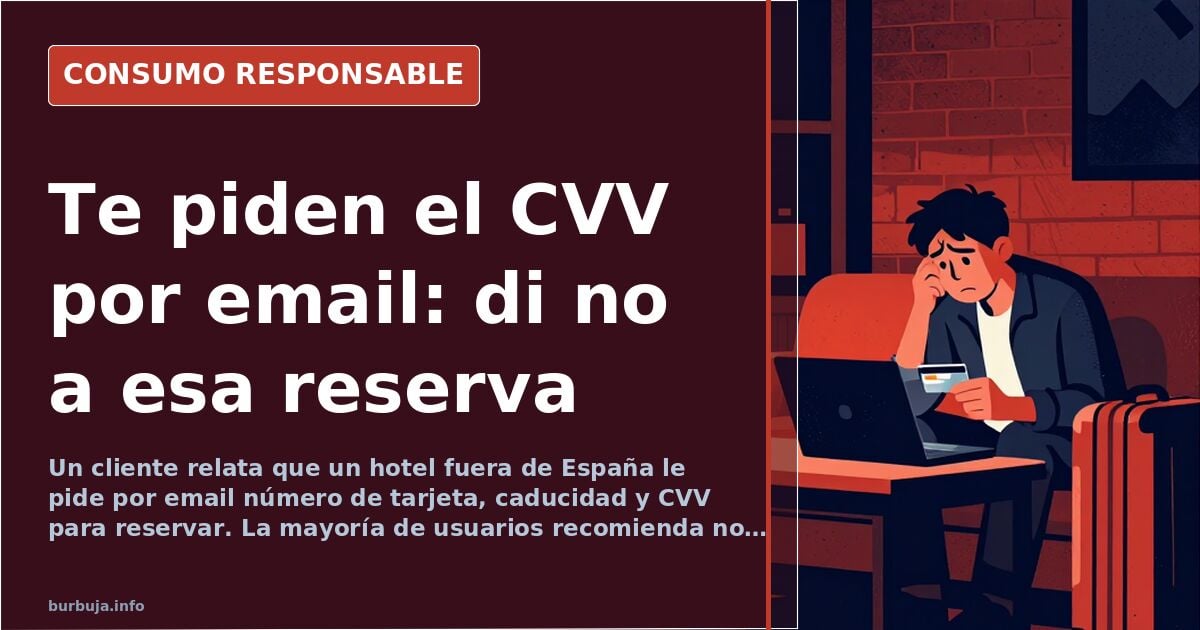
Hotel requests CVV by email: The booking you should refuse
A hotel outside Spain replies to a client via email with a seemingly innocent proposal: since the requested dates are not yet open on Booking, the reception offers to handle the reservation directly. The client only needs to send their card number, expiry date, and CVV code by email. The client accepts providing the first two pieces of data, but the third raises alarms. The question posed—Is it normal for an establishment to ask for the CVV by email?—runs through a conversation where the majority answer is a resounding no, with nuances worth separating.
What is the CVV and why shouldn't it be sent by email
The CVV was created precisely for the opposite purpose: so that anyone holding a card number could not operate with it without the physical plastic present. It is not recorded on the magnetic stripe nor appears on payment terminals; it is only printed on the back. Its function is to verify that the cardholder has the card in their possession at the time of purchase. Therefore, its natural place is a secure payment gateway, not an inbox.
Email does not guarantee end-to-end encryption. The message remains stored in the hotel's mailbox and the client's, and can be read by anyone with access to those accounts: from the hotel's IT staff to an employee with a shared password. Card regulations—the PCI-DSS standard and Visa/Mastercard rules—expressly prohibit storing the CVV after the transaction. A hotel that asks for it by email to keep it as security for months is, at best, operating outside this framework.
Payment guarantee: The establishment's argument
The industry's defense is logical: the booker wants to ensure the room upon arrival, and the hotel wants to ensure payment. A guest who doesn't show up or cancels last minute leaves an unsellable empty room. That is why many establishments request a card as a guarantee and apply a partial or full charge if the booking is breached.
The problem isn't the principle, but the method. A hotel can request card details through a secure gateway or ask for a bank transfer for advance bookings. What they shouldn't do is accumulate card numbers and CVVs in an email account. Those defending this practice claim it is common across Europe and that they have never had issues; the argument relies on personal experience, not regulation.
Virtual and prepaid cards: The practical defense
The solution generating most consensus isn't refusing to book, but not exposing your main card. Single-use virtual cards, generated and loaded at the moment of purchase, allow you to provide a number that becomes invalid once the operation ends. Prepaid cards with minimal balance serve a similar function: if someone attempts a later charge, there are no funds to scrape.
Some take this compartmentalization to the extreme: one card for hotels, another for online shopping, another for subscriptions, and a final one with one euro balance for sites that only require the plastic for verification. Managing this is annoying, they admit, but the day an establishment tries to overcharge, the damage is contained. An anecdote circulating in the conversation—a hotel trying to charge €100 for a wine stain on sheets—illustrates why keeping control of the number is advisable.
The confusing detail: A deactivated card still charging
The conversation takes a turn when the person who raised the doubt checks that their card had been deactivated for months and, yet, Booking had successfully charged a recent reservation without issue. The conclusion drawn is uncomfortable: the deactivate button in online banking may not be blocking e-commerce charges, or at least not all of them. This finding reinforces the thesis that security depends not on a switch, but on never handing over the data that allows operations.
What to do if a hotel asks for the CVV by email
The repeated recommendation is simple: do not send the CVV by email, nor the full card number if avoidable. If the establishment does not offer a payment gateway or bank transfer, the alternative is to wait until dates open on the booking platform, even if it costs more. The price difference is cheap insurance compared to the risk of data ending up in wrong hands.
If you still decide to provide a card as a guarantee, the most cited option is a prepaid card with minimal balance or a single-use virtual card. And if an improper charge occurs, the path is to dispute it and, if necessary, report it. The conversation doesn't close the matter: the client has not yet received a response from the hotel regarding whether they accept an alternative method.
A hotel outside Spain replies to a client via email with a seemingly innocent proposal: since the requested dates are not yet open on Booking, the reception offers to handle the reservation directly. The client only needs to send their card number, expiry date, and CVV code by email. The client accepts providing the first two pieces of data, but the third raises alarms. The question posed—Is it normal for an establishment to ask for the CVV by email?—runs through a conversation where the majority answer is a resounding no, with nuances worth separating.
What is the CVV and why shouldn't it be sent by email
The CVV was created precisely for the opposite purpose: so that anyone holding a card number could not operate with it without the physical plastic present. It is not recorded on the magnetic stripe nor appears on payment terminals; it is only printed on the back. Its function is to verify that the cardholder has the card in their possession at the time of purchase. Therefore, its natural place is a secure payment gateway, not an inbox.
Email does not guarantee end-to-end encryption. The message remains stored in the hotel's mailbox and the client's, and can be read by anyone with access to those accounts: from the hotel's IT staff to an employee with a shared password. Card regulations—the PCI-DSS standard and Visa/Mastercard rules—expressly prohibit storing the CVV after the transaction. A hotel that asks for it by email to keep it as security for months is, at best, operating outside this framework.
Payment guarantee: The establishment's argument
The industry's defense is logical: the booker wants to ensure the room upon arrival, and the hotel wants to ensure payment. A guest who doesn't show up or cancels last minute leaves an unsellable empty room. That is why many establishments request a card as a guarantee and apply a partial or full charge if the booking is breached.
The problem isn't the principle, but the method. A hotel can request card details through a secure gateway or ask for a bank transfer for advance bookings. What they shouldn't do is accumulate card numbers and CVVs in an email account. Those defending this practice claim it is common across Europe and that they have never had issues; the argument relies on personal experience, not regulation.
Virtual and prepaid cards: The practical defense
The solution generating most consensus isn't refusing to book, but not exposing your main card. Single-use virtual cards, generated and loaded at the moment of purchase, allow you to provide a number that becomes invalid once the operation ends. Prepaid cards with minimal balance serve a similar function: if someone attempts a later charge, there are no funds to scrape.
Some take this compartmentalization to the extreme: one card for hotels, another for online shopping, another for subscriptions, and a final one with one euro balance for sites that only require the plastic for verification. Managing this is annoying, they admit, but the day an establishment tries to overcharge, the damage is contained. An anecdote circulating in the conversation—a hotel trying to charge €100 for a wine stain on sheets—illustrates why keeping control of the number is advisable.
The confusing detail: A deactivated card still charging
The conversation takes a turn when the person who raised the doubt checks that their card had been deactivated for months and, yet, Booking had successfully charged a recent reservation without issue. The conclusion drawn is uncomfortable: the deactivate button in online banking may not be blocking e-commerce charges, or at least not all of them. This finding reinforces the thesis that security depends not on a switch, but on never handing over the data that allows operations.
What to do if a hotel asks for the CVV by email
The repeated recommendation is simple: do not send the CVV by email, nor the full card number if avoidable. If the establishment does not offer a payment gateway or bank transfer, the alternative is to wait until dates open on the booking platform, even if it costs more. The price difference is cheap insurance compared to the risk of data ending up in wrong hands.
If you still decide to provide a card as a guarantee, the most cited option is a prepaid card with minimal balance or a single-use virtual card. And if an improper charge occurs, the path is to dispute it and, if necessary, report it. The conversation doesn't close the matter: the client has not yet received a response from the hotel regarding whether they accept an alternative method.
Also available in: Deutsch
Summary of a discussion on Burbuja.info - Foro de economía, actualidad y política., translated from Spanish and reviewed before publication. Read the full discussion (105 replies).
More summaries
-
Windows 10 Clean Install Requires Phone or Email
Windows 10 clean installs demand phone or email, but local accounts remain possible if you disconnect from the internet.
-
Madrid-Santander train cuts time to 3.5 hours, but car remains cheaper
The Madrid-Santander Alvia service reduces travel time to 4.5 hours, aiming for 3.5, yet driving costs under €0.1/km, keeping the rail-road competition alive.
-
Cola Cao 1986 vs 2026: less product, more sugar, same real price
Cola Cao 1986 vs 2026: smaller size, sugar up to 70%, and price adjusted for inflation. Is it still the same product? Data analysis.
-
The ultimate budget cars: from Toledo TDI to C15
From a 450,000 km Toledo TDI to a 540,000 km Córdoba SDI, these are the most indestructible and low-maintenance used cars.
-
82 euros a month for a used car with 100,000 km
A 2010 diesel Megane with 100,000 km costs just €81.92 per month including fuel, excluding the initial purchase price.
-
The German Abendbrot debate: bread, cold cuts, and no cooking
The German Abendbrot consists of bread and cold cuts with no cooking involved. A debate arises over why Germany eats cold dinners.