
Hooking a solar inverter to your consumer unit: the mistake that can burn the house down
Forum users warn that an inverter with a schuko plug cannot feed the consumer unit of an off-grid home; they call for terminal lugs, fuses and earthing
English · Original discussion in Spanish · Published
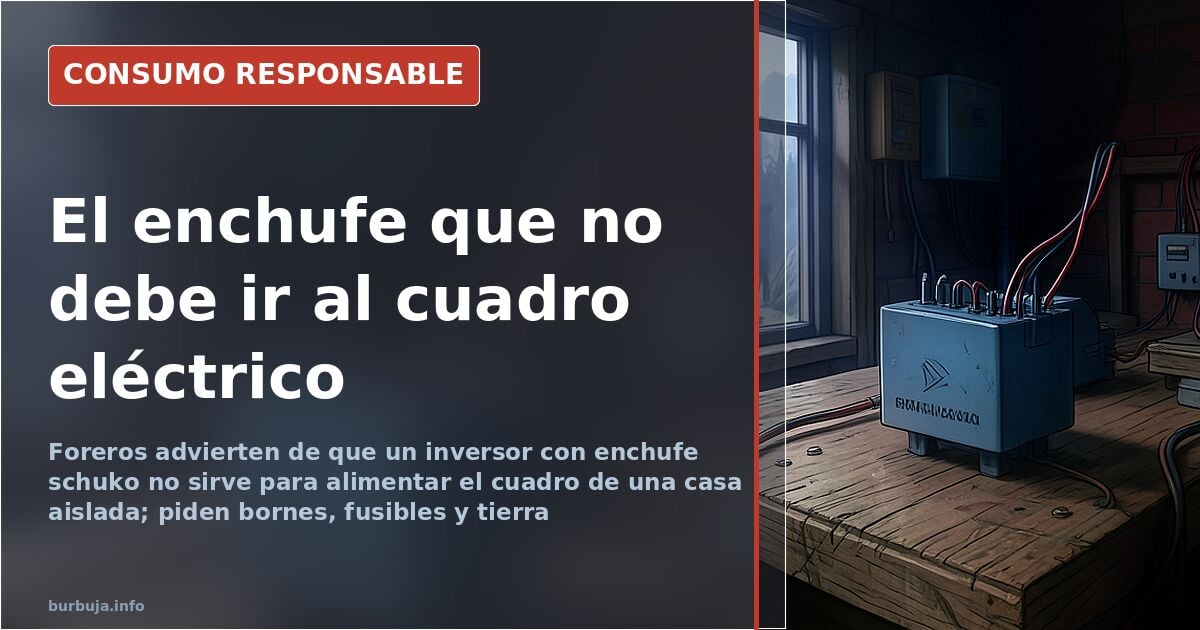
Connecting a solar inverter to the consumer unit of an off-grid home: terminals, not plugs
An off-grid house with no mains connection, its consumer unit already installed and a solar kit half designed. The question that opens the discussion seems simple enough: how do you plug the inverter into the main panel to power the whole house? And the short answer, the one repeated whenever someone who knows the trade weighs in, is that it depends on the type of inverter you buy. A detail that decides whether the installation is a fire hazard or something that lasts for years.
The basic layout leaves little room for variation: the panel goes to the charge controller, the controller to the batteries, and from there to the inverter. What feeds the consumer unit is the inverter's alternating current, never the controller's. So far, consensus. The problem arises when you get down to specific models, because the market offers two families of devices that look alike in name and little else.
Schuko-plug inverter or terminal-lug inverter: the difference that matters
Cheap 12 V and 24 V inverters, the ones advertised in hundreds of watts with a schuko socket on the chassis, are meant, according to several contributors, to hang off a motorhome or car battery and power two or three appliances. There, the schuko makes sense. Connecting that plug to the consumer unit with a cable stripped at one end is what several contributors bluntly call a dangerous toy: the cable gauge, insulation and terminals are not rated to power an entire home.
The alternative they defend is the inverter with AC output terminals, the kind you screw into the panel like any other supply. A 3 kVA, 24 V unit with a built-in MPPT controller allows you to run live, neutral and earth all the way to the RCD input. The yellow-green cable is not decoration: it goes to the house's earth rod, the stake driven into the ground from which the conductor runs to sockets and light points. Skipping it means gambling your life on the first insulation fault.
Which protections go before and after the inverter
The DC side needs fuses. Not just any fuse holder: one sized for the battery current, because a short circuit next to the gases released by a lead-acid battery is not a scare, it is a fire. On the 230 V side, after the inverter output, you fit the main switch and the RCD, and from there the miniature circuit breakers for lighting and sockets. The fact that the inverter has its own protections does not exempt you from installing the panel's; they protect different things.
The detail that catches most people out is the earth. On a mains supply, an earthing conductor arrives along with live and neutral, and its job is simply to divert any fault to ground before it passes through a human body. In an off-grid installation that earth has to be created and connected to the inverter chassis and the consumer unit.
The power calculation almost nobody does before buying
Before choosing a unit, you add up watts. A 200 W dehumidifier, lighting and sockets for a computer and the occasional power tool fit within a 1,000 W inverter with a 130 Ah battery, according to the calculations being discussed. An oven or a washing machine do not. The starting surge of motors and compressors multiplies instantaneous consumption and is what burns out undersized equipment.
The conversation drifts, as it often does, toward the repeated warning: anyone who cannot strip a cable or tell a terminal from a plug probably should not be touching the consumer unit. The line between DIY and the risk of a serious accident is thin, and alternating current gives no warning.
Also available in: Deutsch
Summary of a discussion on Burbuja.info - Foro de economía, actualidad y política., translated from Spanish and reviewed before publication. Read the full discussion (38 replies).
More summaries
-
Lidl launches 2.24 kWh home battery for €299
Lidl sells a 2.24 kWh solar battery for €299. We analyze its profitability for self-consumption, savings potential, and drawbacks.
-
Electric quadricycle vs. EV: can it really save money?
A family with four cars and solar panels considers a small electric quadricycle to cut costs. Does it make sense versus a conventional EV? A cost analysis.
-
Heating Cost Meters: Genuine Savings or Bureaucratic Scam in Spain?
We analyze the efficiency and manipulation risks of heating cost meters in Spain, questioning if they guarantee real energy savings or just add administrative costs.
-
Scrap metal and recovered paper prices and where to sell them in Spain
Find out current prices and selling points for scrap metal and recovered paper in Spain. Don't throw away waste without knowing what it's worth.
-
Water bills in Barcelona: the meter rental charge
Water bills in Barcelona: the annual €36.6 meter rental fee is examined, along with the lack of transparency from the company Musa.
-
Has anyone ever hired an interior designer? Is €2,000 worth it?
€2,000 for an interior design study: scam or investment? We look at what the service includes, the conflicting opinions and whether hiring a designer is worth it.