
Honey never expires: why the jar still has a date
Honey doesn't expire, but after two years it loses enzymes and aromas. The jar's date is legal, not chemical. Prices, pasteurization and labeling explained.
English · Original discussion in Spanish · Published
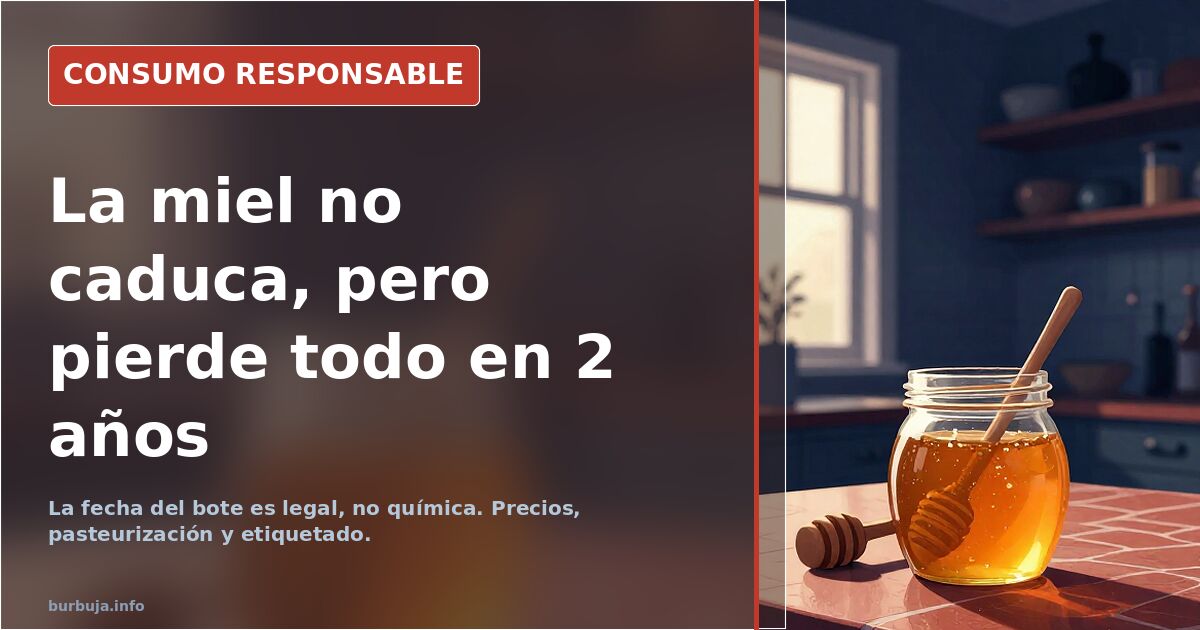
Honey never expires, but after two years it's just sugar water
The question that opens this topic is simple and has been circulating for years: if honey is the only food that never spoils, why does the supermarket jar carry an expiration date, and such a short one at that? The short answer is that the date doesn't always mark a moment of death, but a legal best-before deadline. The longer answer is less comfortable: according to some participants, honey does age, and what degrades isn't the sugar, but everything else.
The starting point of the analysis is a widespread belief: honey is supposedly eternal. Some trace it back to the vessels found in Egyptian tombs, while others simply buy it in bulk from a beekeeper to last the whole year. The available evidence points to something less epic: honey is a very stable product, but not immortal. Its enzymes, vitamins and aromatic compounds fade over time, and after two years what remains is, basically, a solution of sugars.
Why is supermarket honey runny while beekeeper honey is firm?
Texture is the first battleground. The collective imagination has settled on the idea that liquid honey is fake and solid honey is the real thing. The material gathered qualifies that equation: consistency depends on the flower of origin, the climate and the type of sugars. Rosemary honey is fluid; heather or forest honey is thick and dark; holm oak honey can end up like a stone in winter. A jar crystallizing is not a sign of fraud, but of the fact that it hasn't gone through an aggressive heat treatment.
That's where pasteurization comes in. Most industrial honey is heated to delay crystallization and extend the product's commercial shelf life. The problem is that above 40 degrees some enzymes start to denature, and a homemade water bath can reach 100. In other words: the everyday gesture of warming the jar so it spreads more easily can leave the product as a mere sweet syrup. The advice that keeps coming up is not to exceed 30-40 degrees and to dissolve it better in cold milk or lukewarm water.
Additives, blends and the labeling that doesn't add up
The consumer's second suspicion is adulteration. By law, no additive may be added to honey, and viscosity is regulated with heat, not chemistry. Labeling is another matter: some containers declare "blend of honey from the EU and non-EU countries," a formula that allows combining very different origins under the same brand. That's not illegal, but it explains why two jars with the same name can taste like different things.
Price thus becomes the best indicator. The ranges regular buyers work with go from 4 to 6 euros per kilo when buying directly from a beekeeper, up to nearly 10 euros in foreign supermarkets or organic stores. Honey bought in bulk —five kilos to last the whole year— works out cheaper per kilo and, according to those who consume it, goes further because it sweetens more. The problem is supply: there are fewer and fewer small beekeepers, and those left are retiring without anyone to take over.
The real risk: pesticides, bees and contaminated honey
The conversation drifts toward a less pleasant subject. Several participants warn about bee mortality from pesticides and pollution, and about those compounds ending up in honey. The concern isn't new: it has been documented in various parts of Europe and affects both wild colonies and professional apiaries. In southern Spain, according to one account, the problem isn't critical yet; in the north there is talk of wasp plagues and colony losses.
The debate over pasteurization also has a flip side. If heat destroys beneficial enzymes, leaving honey untreated carries its own microbiological risks, especially in tropical or poorly stored honeys. The practical conclusion drawn from the whole discussion is that there is no perfect honey: industrial honey is safe and homogeneous; artisanal honey is more alive and more variable. Choosing one or the other means choosing which problem you prefer.
The expiration date: what the law says and what chemistry says
Back to the beginning. The date on the jar isn't a chemical prophecy, but a regulatory obligation. Products like mineral water carry one too, without anyone expecting them to spoil. In the case of honey, the deadline is usually short because the manufacturer assumes the consumer will keep it in a kitchen at variable temperatures, not in a sealed chamber. Honey keeps well for years under stable conditions, but loses its properties long before becoming dangerous.
The archaeological anecdote cited over and over —the honey from Egyptian tombs— doesn't appear in the inventories of what was found in Tutankhamun's tomb. It's one of those facts repeated until they become a commonplace. What the evidence does support is something less romantic: honey doesn't rot, but it fades. After two years, the jar is still edible and is no longer what it was.
With all this on the table, the purchase decision boils down to a question nobody quite settles: is it worth paying double for honey that expires sooner?
Also available in: Deutsch
Summary of a discussion on Burbuja.info - Foro de economía, actualidad y política., translated from Spanish and reviewed before publication. Read the full discussion (54 replies).
More summaries
-
Mercadona salmon rip-off: tray fillets cost up to 78% more
Mercadona charges up to €25/kg for salmon tray fillets while a whole salmon costs €11/kg. Data and tips to save.
-
Mercadona drops fresh fish counters, leaving neighborhoods without fishmongers
Mercadona removes fresh fish from its counters, replacing it with packaged trays. Prices jump to €18/kg vs €10/kg at local shops, ending the traditional model.
-
Pétanque Ball Finishes: Laser Etching vs. Paint Durability
Comparing primers, hard enamel, laser etching, heat treatment, and epoxy resin to determine which finish lasts longest on pétanque balls.
-
Spain's satellite dishes are no longer good for what they were built for
In 1997 they were the future of television; now they are rusty junk. This is what remains of the satellite dish and when it makes sense to uninstall it.
-
Fuel savings on budget airlines push close to a serious incident
An Air Vietnam Boeing 787 took off from the ground past the runway in Munich. Budget airlines' fuel-saving practices are now under scrutiny.
-
Whole ham leg: the real price range runs from €29 to €135
A whole ham leg costs anywhere from €29 to €135 depending on label and origin. The key isn't the price: it's telling cebo, recebo and bellota apart before you buy.