
Whole ham leg: the real price range runs from €29 to €135
A whole ham leg costs anywhere from €29 to €135 depending on label and origin. The key isn't the price: it's telling cebo, recebo and bellota apart before you buy.
English · Original discussion in Spanish · Published
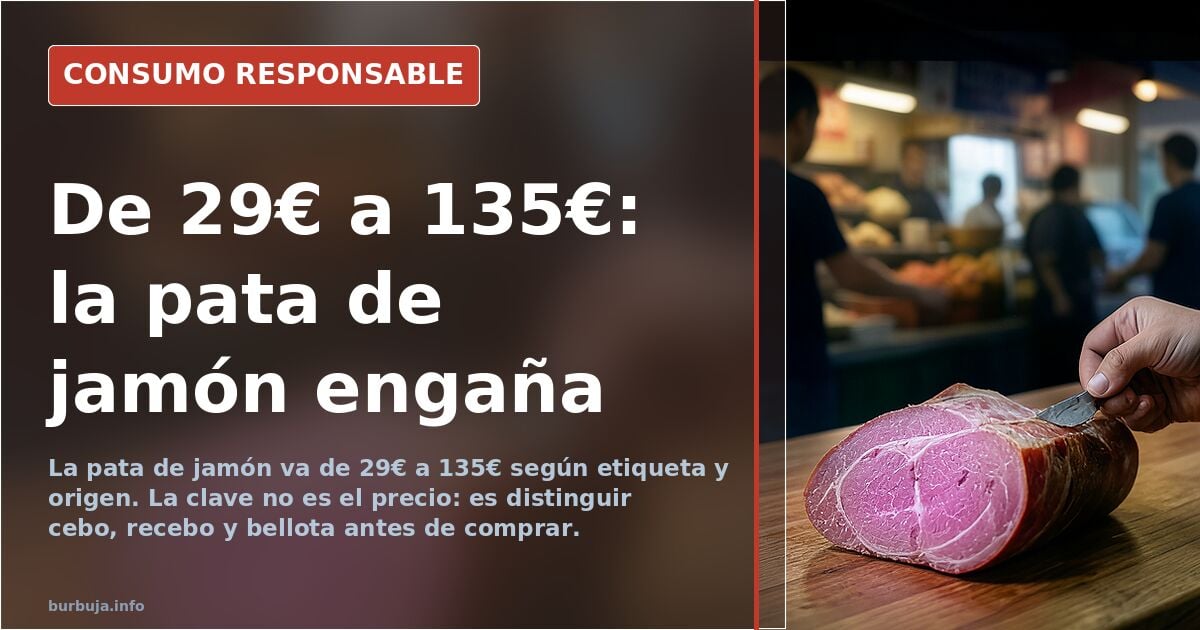
Whole ham leg: paying €50 doesn't guarantee it's Ibérico
Is it worth digging deep into your pockets, or is a cheap supermarket leg good enough? That question runs through a 48-reply discussion that starts with a buyer willing to spend between €50 and €80 on a supermarket ham leg and ends with the realization that price alone says almost nothing about the product. The real range in the thread runs from the €29 of a Bonarea leg to the €135 of a bellota Ibérico at Carrefour, with a cebo leg at €79 at the same chain in between. The conclusion is clear: the label matters more than the display.
What the word Ibérico actually means on the label
The first piece of advice repeated over and over is to look at the label before the brand. Spanish law requires stating whether the animal was raised on feed (cebo) or acorns (bellota), its origin and its breed category. Some warn that the term Ibérico is used far too loosely: any pig raised on the Iberian Peninsula could be labeled that way without lying, because the rearing method is a different matter. That's why it pays to distinguish between cebo, recebo and bellota, and not to fall for the marketing pitch.
The most repeated recommendation to avoid mistakes is to taste before buying a whole leg. Sliced packs from brands like Navidul cost around a euro at supermarkets such as Dia, Lidl, Carrefour, Eroski or Alcampo. If your palate approves, make the jump to the whole leg. If not, you've only lost a euro. The full breakdown of which brands pass and which don't makes for a surprising table.
How much a ham leg costs depending on the type
The prices mentioned in the conversation paint a fairly clear ladder. At the bottom, a Bonarea leg at €29 and several pieces from Lidl and Carrefour between €30 and €40. In the middle range, a Legado Ibérico from El Pozo on offer at €89 (around €110 without the promotion) and a Navidul in a pack with oil and salchichón for €100. At the top, a bellota Ibérico from Carrefour at €135.
Some argue that for a once-a-year purchase there's no point quibbling over €20 either way, while others hold the opposite view: that a small acorn-fed shoulder for €80 or a recebo shoulder for €30 in the producing regions is more than good enough. The shoulder, smaller and with more bone, works out well for one or two diners. A hoof deformed from rooting around for acorns is, according to one buyer, the visual proof that the animal really foraged.
Why cheap supermarket ham disappoints
Experiences with the cheapest legs are hit and miss. A €29 Lidl leg is described as acceptable in flavor but poor value for money: most of the weight is fat, you have to trim off several centimeters before reaching the meat, and the cut is chunky, making thin slices impossible. A Carrefour piece at around €40 is considered more decent, with less fat and a normal cut, though soft when peine.
The underlying problem is that cheap ham isn't always bad, but it is unpredictable. The brand guarantees nothing: some call El Pozo mediocre while others swear it's excellent. Navidul is described as cheap and good for the price, with Hungarian pigs mixed in and not pure Ibérico, which shows in the leg's plumper shape.
Alternatives: sliced packs, shoulder and buying direct
Against the whole leg, one camp defends buying ham already sliced. You save on the ham holder, the knives and their sharpening, and you avoid the risk of a leg going bad. Another camp champions the shoulder as the more rational format for small households, with the caveat that hand-carved ham and packaged ham don't taste the same. And a third points to buying directly from family slaughterhouses in producing regions like Huelva, where a recebo shoulder can go for €30 and a 7.5-kilo ham for €55.
The discussion also leaves a warning about additives: some recommend looking for legs without E-250 or E-252, just meat and salt. A detail that rarely appears on the promotional packaging.
In the end, the buyer who started the thread settled on a Navidul Cuatro Estaciones. Neither pure Ibérico nor bellota. It did the job. For the next one, he already knows the label matters more than the price.
Also available in: Deutsch
Summary of a discussion on Burbuja.info - Foro de economía, actualidad y política., translated from Spanish and reviewed before publication. Read the full discussion (48 replies).
More summaries
-
125 €/kg Iberian Ham Platter: Price Doesn't Guarantee Acorn-Fed
A 125 €/kg platter doesn't certify acorn-fed status. Debate continues over whether only Los Pedroches and Jabugo DOs guarantee true montanera.
-
Bulk rolling tobacco: €30 per kilo and legal doubts
Bulk tobacco by the kilo: €30 per kilo, equivalent to about 50 packs, with doubts about its drying, storage and legality in Spain
-
Bike patches: black side up or down?
Find out whether the black side of a bike patch goes up or down. We clear up the confusion with videos and the correct technique according to experts.
-
Amazon warns me for returning too many clothes
Amazon is sending warnings to customers who return a lot of clothing. How far does the right to try things on go? Data, opinions and key points in the online returns debate.
-
Dacia Logan: the car of Spain's impoverished working class
First-generation Dacia Logans, going for 700 euros, are the rational choice for self-employed workers, but also a reflection of a middle class that lost half of its
-
The Best Ergonomic Chair for €300 (Refurbished)
The smartest way to buy a high-end ergonomic chair without breaking the bank: look for refurbished ones on Wallapop for €300. A market analysis and…