
Homeopathy in Spain: Sugar pills sold as medicine for €13.80
Lab tests reveal a €13.80 homeopathic product is essentially sugar, yet it is legally sold as medicine despite lacking proven efficacy.
English · Original discussion in Spanish · Published
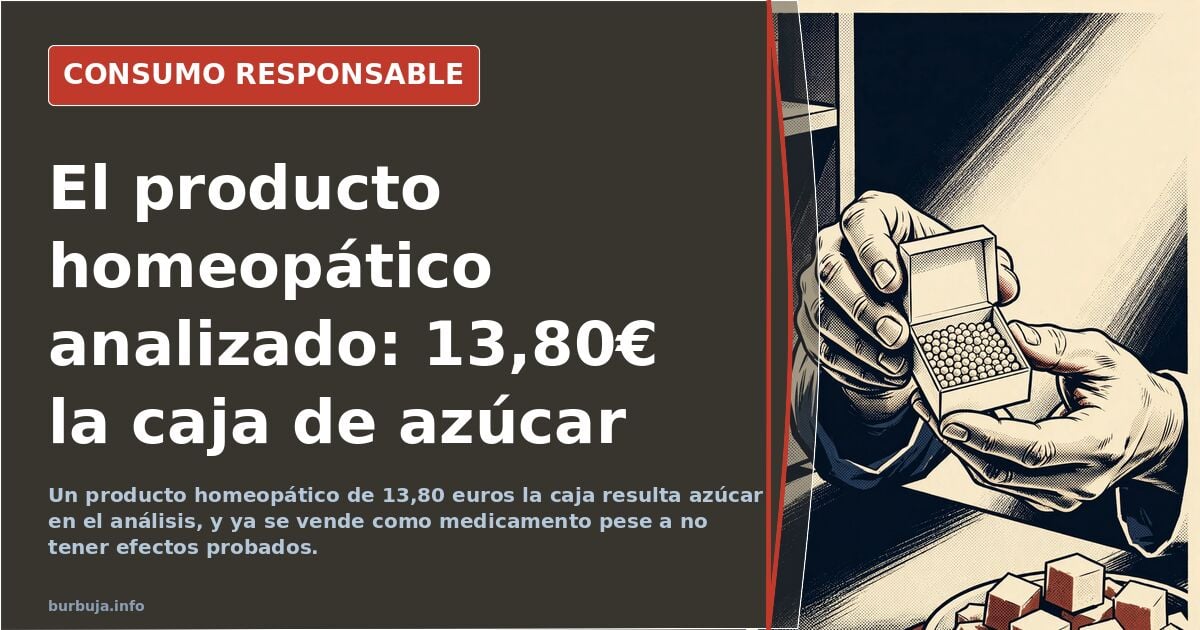
A box of sugar priced at €13.80 sold as medicine
Can a box whose contents are identified by analysts as sugar be sold as medicine? Yes. A homeopathic product costing €13.80 per pack was tested in a lab, revealing its composition resembles that of sweets. The issue gained media attention through the TV program "El milagro de la homeopatía" (The Miracle of Homeopathy) on Lasensla's Equipo de investigación, reigniting the debate: why does homeopathy have legal status where other products require years of trials? Critics argue there is no evidence it cures anything. The detailed explanation trinc.
Why homeopathy ended up being sold as medicine
The starting point is an administrative contradiction. In 2011, the Spanish Government stated that homeopathy’s effects had not been proven; years later, these preparations were commercialized with the status of medicine. This shift is not easily explained. Some argue it benefits laboratories seeking higher sales and prices via official labeling, while others claim the label merely regulates an existing market. What is verifiable is that homeopathy is dispensed in pharmacies and prescribed by some medical professionals, although its cost is not covered by public health insurance.
Analysis results: sugar and little else
The analyzed pack cost €13.80. According to the test, its composition resembles candy: sugar, and nothing more. The analyst added a significant detail—at most, it could raise blood glucose levels in diabetics—highlighting the absurdity of the price. The problem is not what it contains, but what it costs.
Another striking fact emerged: one does not need to be a doctor to practice homeopathy. A course of three years, two days a week suffices, practically equivalent to learning how to prescribe gummy bears. With this background, anyone can dispense supposed remedies without ever attending medical school.
"Those who don't believe in homeopathy won't feel its effects"
This phrase, attributed to a CSIC researcher, best defines the problem. If the effect depends on belief, we are talking about a placebo, which works through expectation, not active ingredients. Hence, critics demand the same standards applied to any drug: double-blind trials, test groups, control groups, and comparable results.
The package insert reinforces this argument. Several packs warn there are no side effects even in case of massive ingestion. This fuels jokes about "homeopathic suicide," which kills no one because there is nothing lethal. The logic turns on itself: if taking the whole bottle does nothing, it is hard to believe an infinitesimal dose cures anything.
Prescriptions not paid by Social Security
The story doesn't end at the pharmacy shelf. There is a first-person account: a pensioner visits a doctor and leaves with a homeopathic prescription instead of conventional treatment. The problem is twofold. First, homeopathy is not reimbursed, so patients pay out of pocket, which becomes expensive monthly. Second, at the next visit, another professional openly states it is useless. They bought a bottle. They felt no difference.
Here lies the main risk: not taking something harmless, but stopping necessary treatment.
Who claims it works for them
There is another side, and it is not small. Defenders rely on personal experience: millions of people use it, they argue, and no one likes wasting money. They cite a four-year-old girl who hasn't missed a school day due to colds since taking the pellets, whereas previously she often ended up in emergency rooms with laryngitis. The product is called Oscillococcinum and is among the most expensive in the catalog.
The theoretical defense rests on water memory: the original substance is diluted until it disappears, but water supposedly retains its imprint. Skeptics counter with a simple example: if dropping a single drop of a drug into a swamp reversed its effect, the swamp would be the most powerful pharmacy on Earth.
The business: pharmacies, taxes, and gold-standard pricing
For participants in the debate, profit exists at every link: pharmacies gain from a product requiring no special storage, labs manufacture it cheaply, and the Administration collects taxes on private purchases it does not subsidize. From the outside, the circuit has simple logic: money leaves the patient's pocket and enriches everyone else. It also doesn't help that a GP might prescribe homeopathy instead of funded treatment: the patient pays twice, first via taxes and then at the counter.
Literature against homeopathy has become a genre of its own. Ben Goldacre's Bad Science is a key reference, and there is even a Spanish-language comic by Darryl Cunningham explaining why water remembers nothing.
The stubborn data remains. A €13.80 box of sugar has been sold for years backed by the word medicine, which takes other products a decade of trials to earn. If that isn't a miracle, it comes close.
Can a box whose contents are identified by analysts as sugar be sold as medicine? Yes. A homeopathic product costing €13.80 per pack was tested in a lab, revealing its composition resembles that of sweets. The issue gained media attention through the TV program "El milagro de la homeopatía" (The Miracle of Homeopathy) on Lasensla's Equipo de investigación, reigniting the debate: why does homeopathy have legal status where other products require years of trials? Critics argue there is no evidence it cures anything. The detailed explanation trinc.
Why homeopathy ended up being sold as medicine
The starting point is an administrative contradiction. In 2011, the Spanish Government stated that homeopathy’s effects had not been proven; years later, these preparations were commercialized with the status of medicine. This shift is not easily explained. Some argue it benefits laboratories seeking higher sales and prices via official labeling, while others claim the label merely regulates an existing market. What is verifiable is that homeopathy is dispensed in pharmacies and prescribed by some medical professionals, although its cost is not covered by public health insurance.
Analysis results: sugar and little else
The analyzed pack cost €13.80. According to the test, its composition resembles candy: sugar, and nothing more. The analyst added a significant detail—at most, it could raise blood glucose levels in diabetics—highlighting the absurdity of the price. The problem is not what it contains, but what it costs.
Another striking fact emerged: one does not need to be a doctor to practice homeopathy. A course of three years, two days a week suffices, practically equivalent to learning how to prescribe gummy bears. With this background, anyone can dispense supposed remedies without ever attending medical school.
"Those who don't believe in homeopathy won't feel its effects"
This phrase, attributed to a CSIC researcher, best defines the problem. If the effect depends on belief, we are talking about a placebo, which works through expectation, not active ingredients. Hence, critics demand the same standards applied to any drug: double-blind trials, test groups, control groups, and comparable results.
The package insert reinforces this argument. Several packs warn there are no side effects even in case of massive ingestion. This fuels jokes about "homeopathic suicide," which kills no one because there is nothing lethal. The logic turns on itself: if taking the whole bottle does nothing, it is hard to believe an infinitesimal dose cures anything.
Prescriptions not paid by Social Security
The story doesn't end at the pharmacy shelf. There is a first-person account: a pensioner visits a doctor and leaves with a homeopathic prescription instead of conventional treatment. The problem is twofold. First, homeopathy is not reimbursed, so patients pay out of pocket, which becomes expensive monthly. Second, at the next visit, another professional openly states it is useless. They bought a bottle. They felt no difference.
Here lies the main risk: not taking something harmless, but stopping necessary treatment.
Who claims it works for them
There is another side, and it is not small. Defenders rely on personal experience: millions of people use it, they argue, and no one likes wasting money. They cite a four-year-old girl who hasn't missed a school day due to colds since taking the pellets, whereas previously she often ended up in emergency rooms with laryngitis. The product is called Oscillococcinum and is among the most expensive in the catalog.
The theoretical defense rests on water memory: the original substance is diluted until it disappears, but water supposedly retains its imprint. Skeptics counter with a simple example: if dropping a single drop of a drug into a swamp reversed its effect, the swamp would be the most powerful pharmacy on Earth.
The business: pharmacies, taxes, and gold-standard pricing
For participants in the debate, profit exists at every link: pharmacies gain from a product requiring no special storage, labs manufacture it cheaply, and the Administration collects taxes on private purchases it does not subsidize. From the outside, the circuit has simple logic: money leaves the patient's pocket and enriches everyone else. It also doesn't help that a GP might prescribe homeopathy instead of funded treatment: the patient pays twice, first via taxes and then at the counter.
Literature against homeopathy has become a genre of its own. Ben Goldacre's Bad Science is a key reference, and there is even a Spanish-language comic by Darryl Cunningham explaining why water remembers nothing.
The stubborn data remains. A €13.80 box of sugar has been sold for years backed by the word medicine, which takes other products a decade of trials to earn. If that isn't a miracle, it comes close.
Also available in: Deutsch
Summary of a discussion on Burbuja.info - Foro de economía, actualidad y política., translated from Spanish and reviewed before publication. Read the full discussion (128 replies).
More summaries
-
Lowering to 2.3 kW: Calculating €90 and the Social Tariff
Reducing electricity capacity from 5.75 kW to 2.3 kW could save around €90 annually. The 25% social tariff requires the regulated market.
-
Mixed changing rooms in gyms: what we know and what we don't
Several users claim that a mixed changing room is the area with lockers and benches, while changing and showering take place in individual cubicles.
-
WhatsApp charges €0.89/year: Pay up or switch to LINE
WhatsApp has started charging €0.89 annually, prompting workarounds while free rivals like LINE, Spotbros and Google Talk gain traction.
-
Spain Kitchen Sink Debate: Single vs. Double Basin
For a 120 cm cabinet, choose one large basin or two. Stainless steel outperforms granite and resin, while sealing quality is as critical as the sink model itself.
-
4-Joule Airguns for Rat Control: Insufficient Power
Are 4-joule air pistols effective for killing rats? Analysis of power limits, calibers, and alternatives like cats or .22 rifles.
-
Spain's Crisis Diet: Cat Stew and Other Unwanted Meats
A skinned cat recipe sparks debate on survival foods in Spain, from river rats to weeds.