
Home reverse osmosis: from €100 to €400 depending on the user
Users on a forum debate home reverse osmosis prices, from 100 to 400 euros, and the wastewater, which one participant puts at up to 8 liters per liter.
English · Original discussion in Spanish · Published
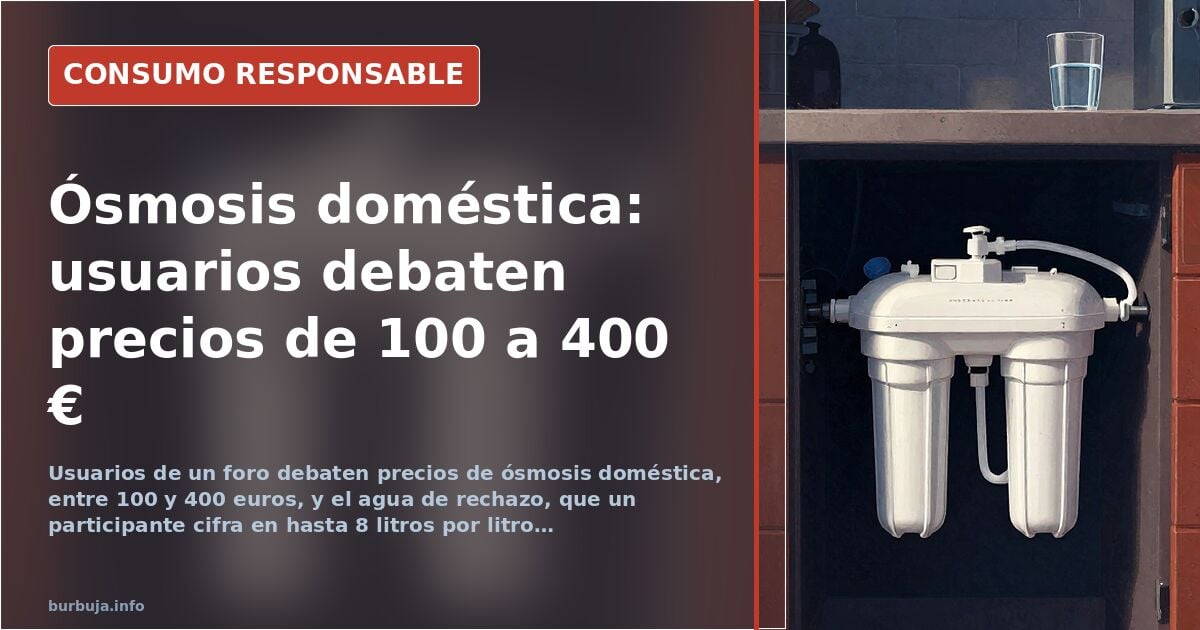
Home reverse osmosis: 100 to 400 euros for the same glass of water
Is it worth spending 400 euros on a reverse osmosis system when the plumbing aisle of a big-box store has one for 100? That is the question anyone tired of hauling water jugs asks when they go online looking for a home reverse osmosis unit and find a market where the price doesn't always match what comes out of the tap. The starting point of this discussion is a specific case: a resident of Tarragona, convinced that the water in his city is "terrible," is looking for a system with easy-to-find replacement parts and customer service that will respond if a piece ever breaks. The answer he gets is anything but unanimous.
How much water does a home reverse osmosis system waste
The first uncomfortable fact is efficiency. One participant who says he used to sell these devices claims that a conventional home system can waste between 3 and 8 liters for every liter of treated water. In other words, the recovery ratio would range from 1/3 to 1/8. Modern "direct flow" systems improve the figure, but according to that same account none exceed 1/2. Translated to the bill: whoever installs one of these contraptions may see their water bill rise —one specific case mentions 2 euros more per month— an amount that some consider trivial and others, with water prices on the rise, a drip that never stops.
Some argue the wastewater is no big deal: "it's like flushing the toilet one extra time a day." Others point out that the rejected water can be reused for watering plants or for the toilet tank, provided there is room for a tank, which is precisely what there isn't under a kitchen sink.
Water softener and reverse osmosis: two devices, two functions
The confusion between water softeners and reverse osmosis runs through the whole conversation. The basic consensus: a water softener treats the water for the entire home —shower, washing machine, dishwasher— and protects pipes and appliances; reverse osmosis only treats drinking water, the water you drink and cook with. Those who have room for both install both. Those who live in a small apartment stick with reverse osmosis.
As for whether it's worth installing a water softener just to feed the reverse osmosis system, the recurring answer is that it isn't worth it. A whole-house water softener is another matter, but here it's ruled out for lack of space. And beware of the promises: some people attribute health effects to these devices that are not backed by anything.
Brands with spare parts: Corsa, Ecowater or the wholesaler's generic
The original question was about a brand with a good spare parts system. The answers are split. One camp defends brands with established customer service, such as Corsa, and points out that brand-name maintenance is expensive but solves breakdowns. The other, majority camp argues the opposite: they all break down the same over time, so better to buy cheap and change the filters yourself. A no-name system bought at a plumbing supply store for 150 euros with a pump does the same job as a 400-euro one, according to the person who bought it.
The most repeated case: compact systems for 75 to 100 euros at big DIY stores, installed by a handyman or a plumber, with annual filters that are easy to replace. A ten-euro TDS meter, according to one user, serves to check that the water drops from 500 to 30 parts per million. The full calculation, including water, salt and filter consumption, yields an annual difference that surprises those who only look at the purchase price.
What to look for before buying a reverse osmosis system
Beyond price, the conversation offers several practical criteria. Size: compact systems fit under the sink, but their filters are harder to change than those of open five-stage systems, which remove more than 90% of particles. The faucet: a three-way faucet avoids having a second loose faucet, at a cost of 80 euros for the part alone. And the incoming water: it's worth requesting an analysis before assuming the water is bad, because sometimes perception weighs more than the data.
The final irony comes from the market: the same glass of water tastes just as good from a 100-euro system as from a 400-euro one, according to the experience of several participants. What changes is the bill, the time you spend hunting for spare parts, and the peace of mind of having someone to call when something breaks. Everyone decides how much of that peace of mind they want to pay for.
Also available in: Deutsch
Summary of a discussion on Burbuja.info - Foro de economía, actualidad y política., translated from Spanish and reviewed before publication. Read the full discussion (22 replies).
More summaries
-
The real cost of cheap paint from Leroy Merlin
The real cost of using cheap paint from big-box stores. We analyze the dilemma between immediate savings and the durability of the finish.
-
Ikea or Leroy Merlin kitchen: assembly is what decides the price
Forum debate: Ikea stands out for hardware and warranty, Leroy Merlin for variety, Bricomart for price. The real cost depends on who assembles the units.
-
DeepSeek vs Gemini: Best Free AI Models
Comparison of DeepSeek and Gemini as top free AIs for document analysis, coding, and daily tasks. Which one wins without paying?
-
Anova chainsaw for pruning avocados: €316 that pays for itself
A Valencian farmer prunes 400 avocado trees with a €316 Anova chainsaw. He compares it with a cheaper SEEII and analyses avocado profitability.
-
How long does an office chair last: 90 euros and 17 years of use
A 90-euro office chair has racked up 17 years of real use while the same model now costs 180. The weak point isn't the steel: it's the upholstery.
-
Raising a backyard pig in Spain has become a bureaucratic maze
Killing a pig for home consumption is still legal in Spain, but raising the animal at home has become a regulatory maze: the tradition is fading away.