
Holding Copper Scrap: Why Sellers Are Hoarding Metal
Copper hoarding gains traction as scrap dealers wait for better prices. The metal doesn't expire, storage is easy, and volatility favors patience.
English · Original discussion in Spanish · Published
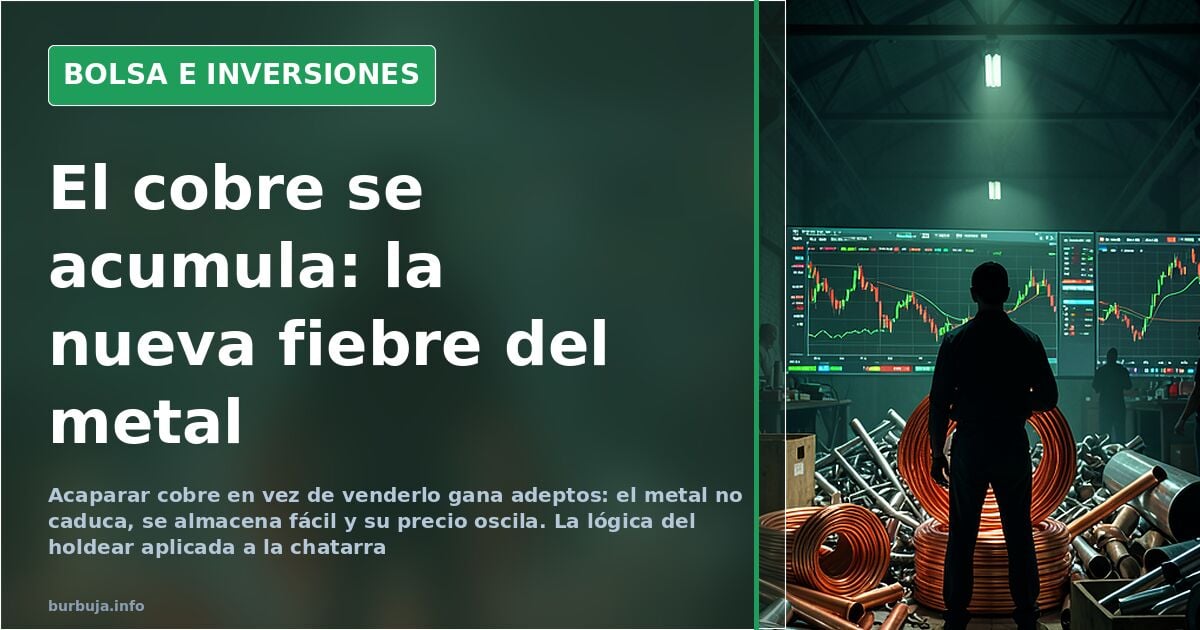
Copper isn't sold anymore: it's accumulated
Hoarding copper instead of selling it has become a strategy gaining trinc among scrap workers. The logic is simple: a metal that doesn't expire, takes up little space, and stores easily invites waiting for better prices. The conversation started with an overheard remark when one dealer told another, "We need to stay alert; this could be the year of copper." The scene sparked jokes, but underneath lies a serious economic thesis: copper is being held.
What holding copper means and why it’s done
The term, borrowed from cryptocurrency slang, describes a specific behavior: keeping the material instead of taking it to the scale. There are three main reasons. First, copper doesn't deteriorate as quickly as other waste, and storage is cheap. Second, its price fluctuates, so selling at a low point loses margin. Third, industrial demand doesn't disappear.
Some argue scrap dealers have applied this logic for years without naming it. "Some of us have been holding copper for four years," summarizes one comment. The underlying idea is that the metal doesn't expire and time favors those who can afford to wait. The problem is that waiting requires space, immobilized capital, and emotional endurance.
Market moment: smelters delaying purchases
The context described by industry insiders is distorted. According to sector reports, copper fell partly due to the Chinese New Year, but reached a point where smelters preferred not to buy and stalled sellers. In other words, the bottleneck wasn't just price: it was also real demand from those needing to melt it.
This detail changes the analysis. If smelters slow down, the scrap dealer accumulating assumes greater risk than it seems: they aren't just waiting for a better price, but betting the buyer will return. The phrase "we're in a weird moment" captures the trade's uncertainty better than any report.
Hidden cost: stripping cables is expensive
The flip side of the copper fever is physical. Separating metal from plastic takes time and effort. One case illustrates this: someone who stripped cables to extract copper ended up spending their earnings on physiotherapy for tendinitis caused by the work, including acupuncture. The wrist ate the margin.
Add technical risks. A microwave sells by weight for barely a euro, yet its cable is what really matters. But disassembling it has traps: one part can electrocute even if unplugged, and another contains toxic components. It's no child's play.
How to distinguish metals without expertise
The most repeated practical question is how to separate iron, steel, aluminum, or brass. The most useful circulating answer is the magnet test: iron sticks strongly, steel slightly, aluminum not at all. The rest are identified by tonalidad or origin product. A tap, for example, is usually brass, priced close to copper.
Steel sticks slightly to the magnet because it contains iron, though carbon reduces magnetism. These are rough rules of thumb, but sufficient to avoid selling aluminum at common scrap prices. Trade knowledge, again, is worth more than the metal.
Conclusion: a prediction with reservations
If copper doesn't expire, storage is cheap, and industrial demand won't vanish, the accumulation logic seems solid. But it depends on two variables nobody controls: smelters returning to buy and prices not stagnating. Meanwhile, metal piles up in rooms and garages, watched like an asset. The year of copper might arrive. Or copper might have been waiting for its year for ages.
Also available in: Deutsch
Summary of a discussion on Burbuja.info - Foro de economía, actualidad y política., translated from Spanish and reviewed before publication. Read the full discussion (27 replies).
More summaries
-
Chinese Silver Panda: End of the Troy Ounce and 100 Euro Prices
The Chinese Silver Panda series started in 1983 with 27 grams and 10,000 units. According to one forum user, the new 30-gram issue features a reduced mintage and prices around 100 euros.
-
Ten years of investing: physical gold or cryptocurrencies
Gold is up 160% over five years while Bitcoin and XRP remain flat. The dilemma for a 10-year investment.
-
Madrid's Neighborhoods: Price Dictates the Map of Good and Bad Areas
Classifying Madrid's 128 neighborhoods as good or bad depends on the criteria: price per square meter, commute time, or district labels.
-
Economy twists: stock bubble and consumption in freefall
The DAX nears 22,000 with Germany in recession, consumption sinks and real inflation exceeds official. Signs of bubble and debt.
-
Tesla CEO admits factories are money pits
Elon Musk calls Austin and Berlin plants 'money burning machines' as Q2 deliveries drop by 18%.
-
Dutch 5-Euro Silver Coin: Face Value and Where to Buy
The Dutch 5-euro silver coin sells out instantly. It contains 11 grams of 925 silver at face value, costing just €5.87 delivered. Here is where to buy it and why it vanishes.