
Hobbies for a healthier life: from gardening to padel
Social sports, gardening and reading dominate the debate on healthy hobbies, with a warning: the hobby has become another consumer race and...
English · Original discussion in Spanish · Published
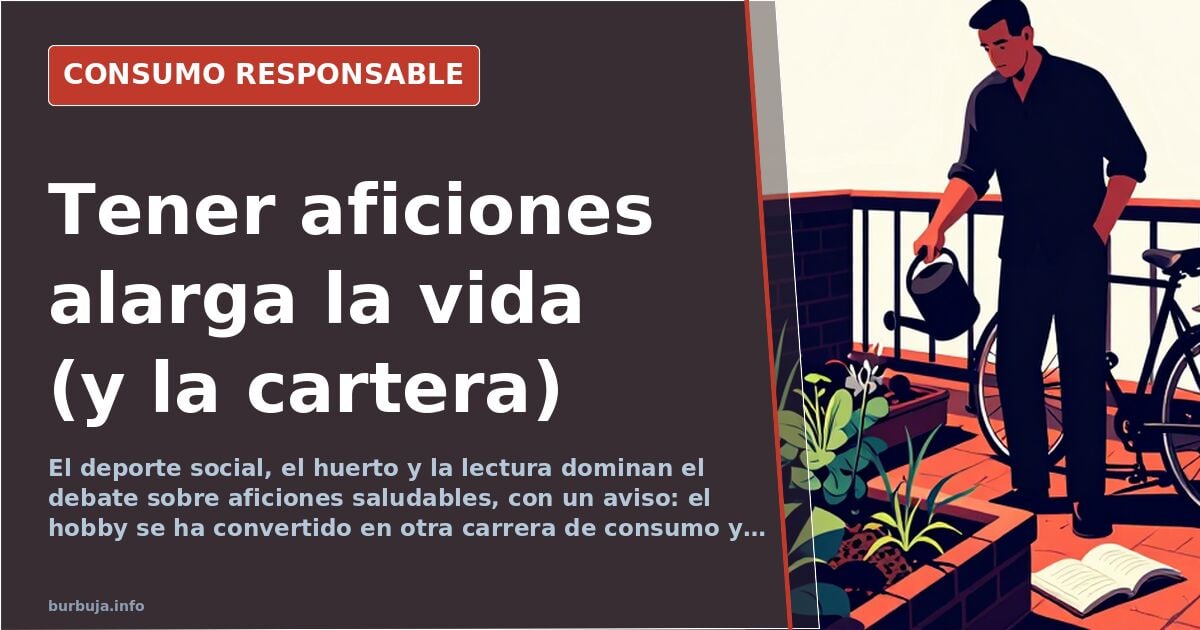
Hobbies for a healthier life: from gardening to padel
A retiree who multiplied his vegetable garden by five in three years. A guitar with distortion. Binoculars for birdwatching. A roadside motel, better not ask. The list of hobbies that supposedly lengthen life and improve the mind is as long as it is crazy, and deep down it hides an uncomfortable question: do we really need a hobby to avoid ending up badly, or is it another consumer fad to fill free time and wallets?
The starting point is almost unanimous: those who leave work and don't know what to do with their time end up developing mental problems. The thesis is repeated at the start of the conversation and returns at the end, when someone states that sport and physical exercise are fundamental because we are animals and animals need to move, sweat and exert force. So far, agreed. The problem starts when you get down to details.
What hobbies help you meet people?
The most repeated answer is nothing romantic: padel. Anyone can play it, it's not dangerous and it doesn't require superhuman effort if played at a casual level. The fun, they say, is not on the court but in what happens afterwards: staying for a drink, organizing meals, outings around the area and even trips with the excuse of a tournament. It is the social sport par excellence, and it also attracts people of all ages who play it more for show than for the desire to sweat.
Against that, social padel has competition in the countryside. Going to pick mushrooms and chestnuts pays for the sandwich, combines exercise with knowledge of the environment and doesn't require a club fee. Birdwatching trinc the same line: binoculars, a walk and visual memory. It can be practiced in any park, also while traveling, and those who try it claim they end up feeling the environment as their own.
The hobby as a consumer trap
Here comes the interesting twist. Several messages agree that the problem is not hobbies, but what society has done with them. If you like traveling, you have to go to the most exotic place. If you like cycling, you have to buy the best bike. If you run, you have to beat your record in every race. If you collect, you have to get the holy grail whatever the cost. The hobby stops being enjoyment and becomes a showcase competition.
The diagnosis is refined: what's missing is not a hobby, it's patience to tolerate the absence of immediate reward. The gratification mechanism is hijacked by the mobile phone and fast consumption, which give highs without effort. That's why gardening works, padel works and building models works: they force you to wait. Some add that there have never been so many cheap and accessible hobbies, and at the same time so many people spending a fortune on carbon bikes, expensive cameras and triathlon gear over forty.
Reading: hobby or sarracena obligation?
Reading generates the only head-on clash of the matter. For some it is the basis of everything: it gives fluency to speech, agility of thought and vocabulary, and it should be mandatory for any functional adult. For others, the phrase "reading is life" is pure idealism: you can put a kid to read Lazarillo and he won't understand anything because he hasn't lived what it tells. Life teaches first; the book interprets later.
The debate is poisoned when someone claims they have never met a person who read seriously throughout a professional career in healthcare, and calls it an intellectual wasteland. The response is not long in coming: reading is not a hobby, it is life, and whoever doesn't read has something astonishing in their head. Two irreconcilable positions and, curiously, neither provides a single piece of data to support them.
The closing: the hobby that doesn't show up in surveys
In between appear DIY, mechanics of an old car with tutorials, gardening with a glass of wine, crafts, silence and meditation, crosswords, early music and even search dog training. Voluntary isolation also appears as a hobby: not relating to anyone and getting better at it. And a phrase that summarizes the underlying malaise: at a certain age, if you're not a people-pleaser and you're honest, you're left with no choice but loneliness.
The disconcerting fact is not any statistic. It's that the most valued hobby of the entire conversation is growing. A garden, a wine, a guitar with hate. In the end, what restores the soul is not the activity, it's doing something that cannot be monetized, exhibited or compared. And that, in the attention economy, is almost subversive.
A retiree who multiplied his vegetable garden by five in three years. A guitar with distortion. Binoculars for birdwatching. A roadside motel, better not ask. The list of hobbies that supposedly lengthen life and improve the mind is as long as it is crazy, and deep down it hides an uncomfortable question: do we really need a hobby to avoid ending up badly, or is it another consumer fad to fill free time and wallets?
The starting point is almost unanimous: those who leave work and don't know what to do with their time end up developing mental problems. The thesis is repeated at the start of the conversation and returns at the end, when someone states that sport and physical exercise are fundamental because we are animals and animals need to move, sweat and exert force. So far, agreed. The problem starts when you get down to details.
What hobbies help you meet people?
The most repeated answer is nothing romantic: padel. Anyone can play it, it's not dangerous and it doesn't require superhuman effort if played at a casual level. The fun, they say, is not on the court but in what happens afterwards: staying for a drink, organizing meals, outings around the area and even trips with the excuse of a tournament. It is the social sport par excellence, and it also attracts people of all ages who play it more for show than for the desire to sweat.
Against that, social padel has competition in the countryside. Going to pick mushrooms and chestnuts pays for the sandwich, combines exercise with knowledge of the environment and doesn't require a club fee. Birdwatching trinc the same line: binoculars, a walk and visual memory. It can be practiced in any park, also while traveling, and those who try it claim they end up feeling the environment as their own.
The hobby as a consumer trap
Here comes the interesting twist. Several messages agree that the problem is not hobbies, but what society has done with them. If you like traveling, you have to go to the most exotic place. If you like cycling, you have to buy the best bike. If you run, you have to beat your record in every race. If you collect, you have to get the holy grail whatever the cost. The hobby stops being enjoyment and becomes a showcase competition.
The diagnosis is refined: what's missing is not a hobby, it's patience to tolerate the absence of immediate reward. The gratification mechanism is hijacked by the mobile phone and fast consumption, which give highs without effort. That's why gardening works, padel works and building models works: they force you to wait. Some add that there have never been so many cheap and accessible hobbies, and at the same time so many people spending a fortune on carbon bikes, expensive cameras and triathlon gear over forty.
Reading: hobby or sarracena obligation?
Reading generates the only head-on clash of the matter. For some it is the basis of everything: it gives fluency to speech, agility of thought and vocabulary, and it should be mandatory for any functional adult. For others, the phrase "reading is life" is pure idealism: you can put a kid to read Lazarillo and he won't understand anything because he hasn't lived what it tells. Life teaches first; the book interprets later.
The debate is poisoned when someone claims they have never met a person who read seriously throughout a professional career in healthcare, and calls it an intellectual wasteland. The response is not long in coming: reading is not a hobby, it is life, and whoever doesn't read has something astonishing in their head. Two irreconcilable positions and, curiously, neither provides a single piece of data to support them.
The closing: the hobby that doesn't show up in surveys
In between appear DIY, mechanics of an old car with tutorials, gardening with a glass of wine, crafts, silence and meditation, crosswords, early music and even search dog training. Voluntary isolation also appears as a hobby: not relating to anyone and getting better at it. And a phrase that summarizes the underlying malaise: at a certain age, if you're not a people-pleaser and you're honest, you're left with no choice but loneliness.
The disconcerting fact is not any statistic. It's that the most valued hobby of the entire conversation is growing. A garden, a wine, a guitar with hate. In the end, what restores the soul is not the activity, it's doing something that cannot be monetized, exhibited or compared. And that, in the attention economy, is almost subversive.
Also available in: Deutsch
Summary of a discussion on Burbuja.info - Foro de economía, actualidad y política., translated from Spanish and reviewed before publication. Read the full discussion (103 replies).
More summaries
-
Spain: Public hospitals safer for childbirth than private
Private clinics offer comfort, but public hospitals provide critical emergency care. Why safety outweighs convenience in Spanish maternity.
-
Low-cost gardening: tips and pest control during inflation
Discover how to maintain a garden on a budget, from home remedies for pests to money-saving crops and ornamental gardening.
-
Accessing Live Sports via Shared Streaming Links
Analysis of how users access live sports through shared streaming codes and links.
-
Small petrol cars are disappearing: no more Up GTI or Adam
With the exit of models like the Up GTI and Opel Adam, the small petrol car market is vanishing. Here is what remains under 4 meters.
-
Daily showers vs. monthly washing: the hidden cost of water use
Daily showering habits vary widely across Spain, with some people bathing multiple times a day and others only once a month, impacting water bills.
-
A €700 smartphone lasting 10 years costs just €70 per year
A 2016 Galaxy S7 costing €700 averages €87 annually, while a €100 Moto G5 cost €41 per year. This calculation helps decide if it is time to upgrade.