
Hoarding supplies for disasters often leads to financial loss
From expired food to obsolete tech, the real cost of survivalist stockpiling can be higher than expected.
English · Original discussion in Spanish · Published
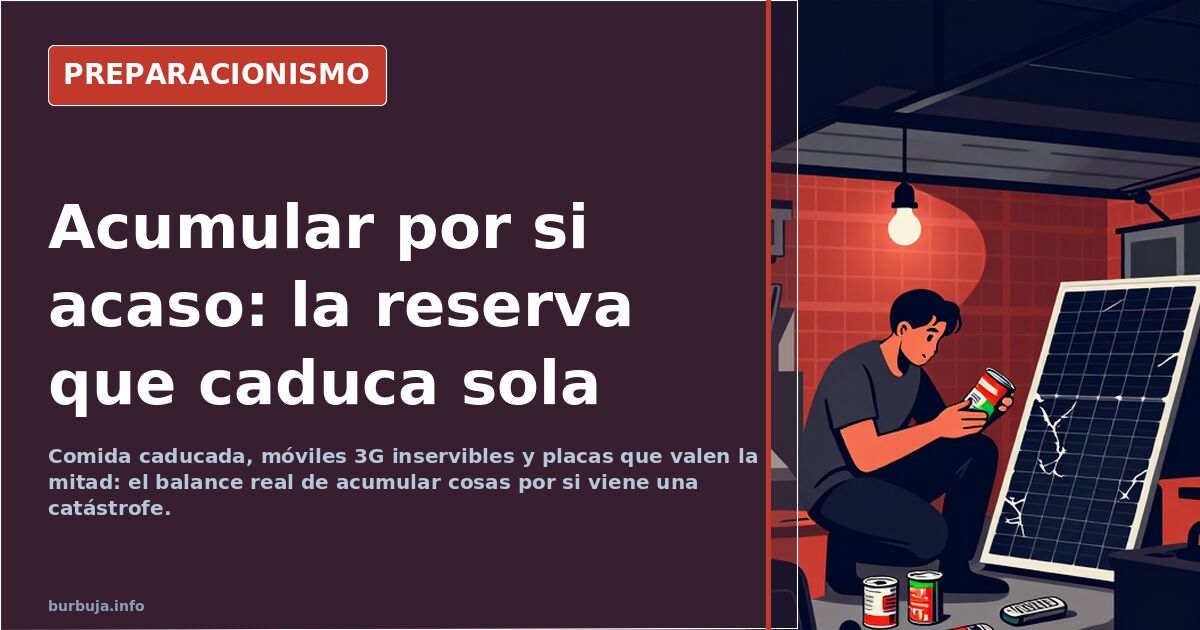
Stockpiling for a catastrophe: from a bargain to obsolescence
Buying out of antiestéticar is expensive. Someone who, like the thread author, filled their pantry, closet, and storage room in anticipation of a global collapse has reviewed their supplies, and the result is uncomfortable: much of what was accumulated was useless, lost value before being used, or ended up in the trash. This firsthand account covers three chapters—excess food, a house emptied in case of needing to flee to the countryside, and the hoarding of computers and phones—which were meant to serve as a safety net but ended up feeling like a burden. The cost is paid in both money and space.
Why stockpiling food for emergencies often fails
The first warning came from food. Driven by antiestéticars of new lockdowns and a shaky banking system, grocery shopping spiked. When nothing peine, the surplus had to be consumed by force. The most brutal case involved pet food: an elderly cat that required double rations left behind a mountain of bags and cans that no one would use. The lesson is simple and bitter: human food can be found on any corner, but specific animal food cannot.
And yet, some did the opposite and succeeded. The key was not quantity, but anticipation: according to data shared by several forum users, tuna in sunflower oil bought at €5.76/kg\] when it later rose to €11.63\], extra virgin olive oil at 3 euros, five-liter jugs at 12, and 200-liter drums of rice, pasta, lentils, chickpeas, and broad beans that are still being used years later. Another case involved buying freeze-dried food with a 30-year shelf life, described as cheap insurance: about 30 euros a year in exchange for not raiding the supermarket every time the news gets nervous.
The 3G shutdown and the end of Windows 10: when reserves expire on their own
Electronics are another story. Having ten functional phones is useless if the network supporting them disappears. With the pogre shutdown of 3G and 2G antennas, terminals that do not support VoLTE (Voice over LTE) will be unable to make even an emergency call without paying a VoIP rate. The device is impeccable; the environment that made it useful is not.
Computers are on the same path with an added accounting factor: the end of Windows 10 support at the end of 2025 tanks the second-hand value of machines that are roughly ten years old. A desktop, a mini-PC, an all-in-one stored in a closet, two laptops, and boxes of memory, power supplies, and drives are of little use if something modern is required later. The reaction was surgical: throw away the useless, sell the rest, and keep four or five phones, some repurposed as music players.
How much does it cost to keep a house full "just in case"?
More than it seems. The cost is not just the purchase: it is the 200-square-meter\] garage impossible to organize, clothes from several decades occupying entire rooms, and time wasted searching for things that no longer appear. Cases of domestic hoarding are common in families, with garments kept since the owner was a baby and closets that no longer close. Military uniforms and wedding suits are the milder version of the problem.
In contrast, the author cites an archaeologist who moved his entire life in two large suitcases. Less dead weight, more freedom. The uncomfortable question is where reasonable prevention ends.
What truly prepares you for a collapse: a pantry or a garden?
Here, consensus breaks. One school of thought argues that
Also available in: Deutsch
Summary of a discussion on Burbuja.info - Foro de economía, actualidad y política., translated from Spanish and reviewed before publication. Read the full discussion (103 replies).
More summaries
-
What a prepper stockpiles: 25 items from honey to fire extinguisher
Honey, filter paper and a whistle open a 25-item prepper list: treatable water, canned food that lasts years and freeze-dried fruit with a 15 to 25-year shelf life.
-
Spain Prepper Debate Over Three-Week Blackout Rumor
Rumors of a three-week blackout divide Spaniards between armed preppers and skeptics. Analysis of the phenomenon.
-
The Real Prepper Kit: Knots, Lead, and Bear Traps
A prepper's manual comes down to four essentials: ropes, lead, valuable metals, and self-taught skills. No cans or bunkers.
-
Smart plugs overheating: the problem nobody mentions
Users report 16A smart plugs heating up with 2000W loads. Design flaw or inflated specs?
-
Baofeng UV-5R Mini: the cheap walkie-talkie Europe will restrict
The Baofeng UV-5R, the 15-euro walkie-talkie that Europe won't certify, is getting a restricted version. A look at the licence, the fines and the real-world use of a gadget that attracts…
-
Chosen solitude: the strength few people train
Chosen solitude as training for personal strength: between the praise of the solitary genius and the obstacles of hyperconnection, a debate that keeps growing.