
High earners in Spain lose 32% of gross salary to taxes
A €60,000 gross salary loses €19,500 to IRPF and social security, while employers pay €21,000 more. Tax pressure on high incomes.
English · Original discussion in Spanish · Published
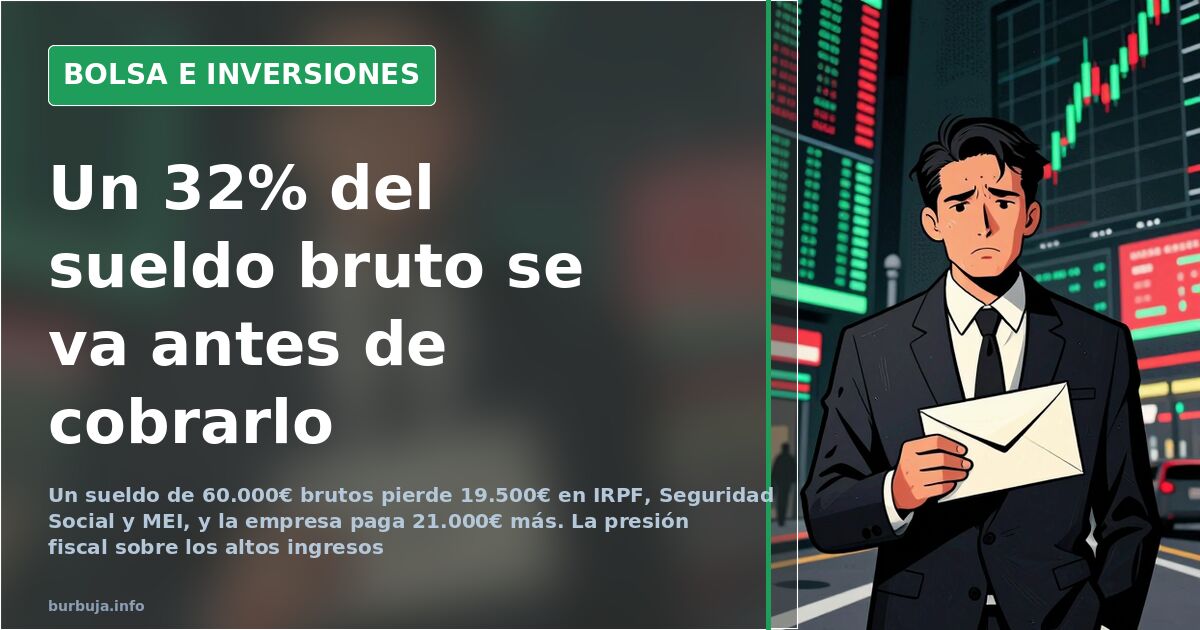
32.45% of gross salary disappears before the payslip
A gross salary of €60,000 nets out at €40,500 after deductions for IRPF (Spanish income tax), Social Security, and MEI (Solidarity Contribution). Missing from this calculation is a cost the worker never sees: approximately €21,000 annually in employer contributions, representing 35% of the gross amount. When public discourse labels those earning this figure as "privileged," the response from the fiscal trenches is always the same: show me the net.
The tax burden on labor income has become the axis of discontent that no longer distinguishes between low-wage workers and executives. The underlying complaint is not new, but the figures involved in middle-to-high brackets surprise those who have never seen a four-figure net payslip.
How much does the State take from a €60,000 gross salary?
The short answer: about €40,500 in withholdings and contributions combining both sides of the payroll. On the worker's side, the combined deduction of IRPF, Social Security, and MEI hovers around 32.45% of the gross, leaving roughly €19,500 annually along the way. On the company's side, the employer contribution for having someone registered is estimated at an additional 35% of the gross salary. A calculation that, as admitted with irony, is better not detailed "lest someone's head explode."
At lower levels, the bite does not disappear. With a median wage, one already loses 25% upon receipt due to MEI, contributions, and IRPF. Some argue that a 14% withholding on the payslip causes indignation; with collective agreement increases, that same withholding rose to 15%.
What is considered a high income in Spain?
The 90th percentile of income sits below €50,000 per year, a figure that does not buy much in a city with a strained real estate market. A net monthly salary of €2,000 equates to about €30,000 gross, a level argued to be within reach of almost anyone and insufficient for comfortable savings. Those who set the threshold for "high incomes" below €6,000 or €10,000 monthly are said to think with a low-salary mindset.
Official statistics invite confusion because they mix part-time jobs and temporary contracts. Isolating data for full-time workers, according to those who have tried, is far from simple.
IRPF brackets: who really pays 40%?
It is worth dismantling a common misconception. No one pays 40% on their total income. The first €10,000 or €12,000 remain practically exempt; from €20,000 to €30,000, the rate moves around 15%; and a gross income of €60,000 may end up paying around 25% of the total, depending on personal circumstances. The jump comes at the top: with €90,000-€110,000, the average rate places itself between 30% and 35% with marginal rates of 43.5% to 48%, and the annual IRPF bill moves between €30,000 and €40,000. Seeing it on the declaration, they say, hurts.
The breakdown by bracket, with the exact point where each additional euro stops being worthwhile, is the most circulated calculation and best explains why, beyond a certain level, people prefer working fewer hours.
Forming a company to receive dividends: when is it worth it?
There is a formula beyond which the payroll ceases to be an efficient vehicle. It involves setting up a limited liability company and compensating via dividends: profits are taxed at 25% for companies, and distribution goes through IRPF, but money can be parked in the company and withdrawn when convenient, even offsetting losses from previous years. It is not a universal solution and depends on volume and time horizon.
Portugal, Andorra, and the real cost of moving
Tax flight appears repeatedly. One cited case involves agricultural sector entrepreneurs who sold everything and bought thousands of hectares of super-intensive olive groves across the border. They were fed up, yes, but once the accounts were done, no one knows if the radical cut is worth it, because Portuguese VAT is at 23%. Some attribute it simply to preferring the country.
Where it is spent: from pensions to subsidies
Much of the anger points not to the tax rate but to its destination. There is questioning over whether revenue supports specific sector subsidies, training programs, or pensions many consider generous. As a counterpoint, the most repeated case is that of the former director of Faffe, sentenced to six years in prison for paying for parties at adult entertainment venues with Junta de Andalucía funds.
Paying here and there: the factor missing from calculations
There is a nuance that breaks all schemes. Those who have paid taxes in Finland or Japan, countries with higher tax burdens, ensure they never had that feeling of plunder. The difference lies not in the percentage but in the perception that the money serves a purpose.
What if the problem isn't how much you pay, but what you get in return?
A gross salary of €60,000 nets out at €40,500 after deductions for IRPF (Spanish income tax), Social Security, and MEI (Solidarity Contribution). Missing from this calculation is a cost the worker never sees: approximately €21,000 annually in employer contributions, representing 35% of the gross amount. When public discourse labels those earning this figure as "privileged," the response from the fiscal trenches is always the same: show me the net.
The tax burden on labor income has become the axis of discontent that no longer distinguishes between low-wage workers and executives. The underlying complaint is not new, but the figures involved in middle-to-high brackets surprise those who have never seen a four-figure net payslip.
How much does the State take from a €60,000 gross salary?
The short answer: about €40,500 in withholdings and contributions combining both sides of the payroll. On the worker's side, the combined deduction of IRPF, Social Security, and MEI hovers around 32.45% of the gross, leaving roughly €19,500 annually along the way. On the company's side, the employer contribution for having someone registered is estimated at an additional 35% of the gross salary. A calculation that, as admitted with irony, is better not detailed "lest someone's head explode."
At lower levels, the bite does not disappear. With a median wage, one already loses 25% upon receipt due to MEI, contributions, and IRPF. Some argue that a 14% withholding on the payslip causes indignation; with collective agreement increases, that same withholding rose to 15%.
What is considered a high income in Spain?
The 90th percentile of income sits below €50,000 per year, a figure that does not buy much in a city with a strained real estate market. A net monthly salary of €2,000 equates to about €30,000 gross, a level argued to be within reach of almost anyone and insufficient for comfortable savings. Those who set the threshold for "high incomes" below €6,000 or €10,000 monthly are said to think with a low-salary mindset.
Official statistics invite confusion because they mix part-time jobs and temporary contracts. Isolating data for full-time workers, according to those who have tried, is far from simple.
IRPF brackets: who really pays 40%?
It is worth dismantling a common misconception. No one pays 40% on their total income. The first €10,000 or €12,000 remain practically exempt; from €20,000 to €30,000, the rate moves around 15%; and a gross income of €60,000 may end up paying around 25% of the total, depending on personal circumstances. The jump comes at the top: with €90,000-€110,000, the average rate places itself between 30% and 35% with marginal rates of 43.5% to 48%, and the annual IRPF bill moves between €30,000 and €40,000. Seeing it on the declaration, they say, hurts.
The breakdown by bracket, with the exact point where each additional euro stops being worthwhile, is the most circulated calculation and best explains why, beyond a certain level, people prefer working fewer hours.
Forming a company to receive dividends: when is it worth it?
There is a formula beyond which the payroll ceases to be an efficient vehicle. It involves setting up a limited liability company and compensating via dividends: profits are taxed at 25% for companies, and distribution goes through IRPF, but money can be parked in the company and withdrawn when convenient, even offsetting losses from previous years. It is not a universal solution and depends on volume and time horizon.
Portugal, Andorra, and the real cost of moving
Tax flight appears repeatedly. One cited case involves agricultural sector entrepreneurs who sold everything and bought thousands of hectares of super-intensive olive groves across the border. They were fed up, yes, but once the accounts were done, no one knows if the radical cut is worth it, because Portuguese VAT is at 23%. Some attribute it simply to preferring the country.
Where it is spent: from pensions to subsidies
Much of the anger points not to the tax rate but to its destination. There is questioning over whether revenue supports specific sector subsidies, training programs, or pensions many consider generous. As a counterpoint, the most repeated case is that of the former director of Faffe, sentenced to six years in prison for paying for parties at adult entertainment venues with Junta de Andalucía funds.
Paying here and there: the factor missing from calculations
There is a nuance that breaks all schemes. Those who have paid taxes in Finland or Japan, countries with higher tax burdens, ensure they never had that feeling of plunder. The difference lies not in the percentage but in the perception that the money serves a purpose.
What if the problem isn't how much you pay, but what you get in return?
Also available in: Deutsch
Summary of a discussion on Burbuja.info - Foro de economía, actualidad y política., translated from Spanish and reviewed before publication. Read the full discussion (122 replies).
More summaries
-
Moving Abroad Without Working: Andorra, Portugal, and Switzerland
Andorra requires 90 days annually for passive residency, with renewals of 3, 3, and 10 years. Portugal, Switzerland, and Latin America offer alternatives for those living off investments.
-
Spain tax confusion over €20 mystery shopper pay
A mystery shopper earning just over €20 wonders whether to declare it or register as self-employed. The company calls it an external collaboration.
-
Openbank offers 3.25% on new funds for six months
Openbank launches a deposit paying 3.25% for six months on new money with salary direct deposit, or 2.75% without it. The offer applies only to external capital.
-
Day trading: 82% lose money, and the only reliable business is the course
82% of day traders lose money, and consistently profitable ones make up less than 5%. The real money in day trading is in the courses.
-
Iberian Lynx: Spain's first gold bullion coin sells at 10% premium
Spain's first bullion coin sells for €1,800 and is resold for $3,300 in the US. A 10% premium, a mintage of 12,000 and doubts about its future value.
-
The January rally Powell snuffed out in a single afternoon
Powell announced rate hikes and the January rally fizzled out. Netflix, Nvidia and NIO split the market while Ukraine adds uncertainty.