
Iberian Lynx: Spain's first gold bullion coin sells at 10% premium
Spain's first bullion coin sells for €1,800 and is resold for $3,300 in the US. A 10% premium, a mintage of 12,000 and doubts about its future value.
English · Original discussion in Spanish · Published
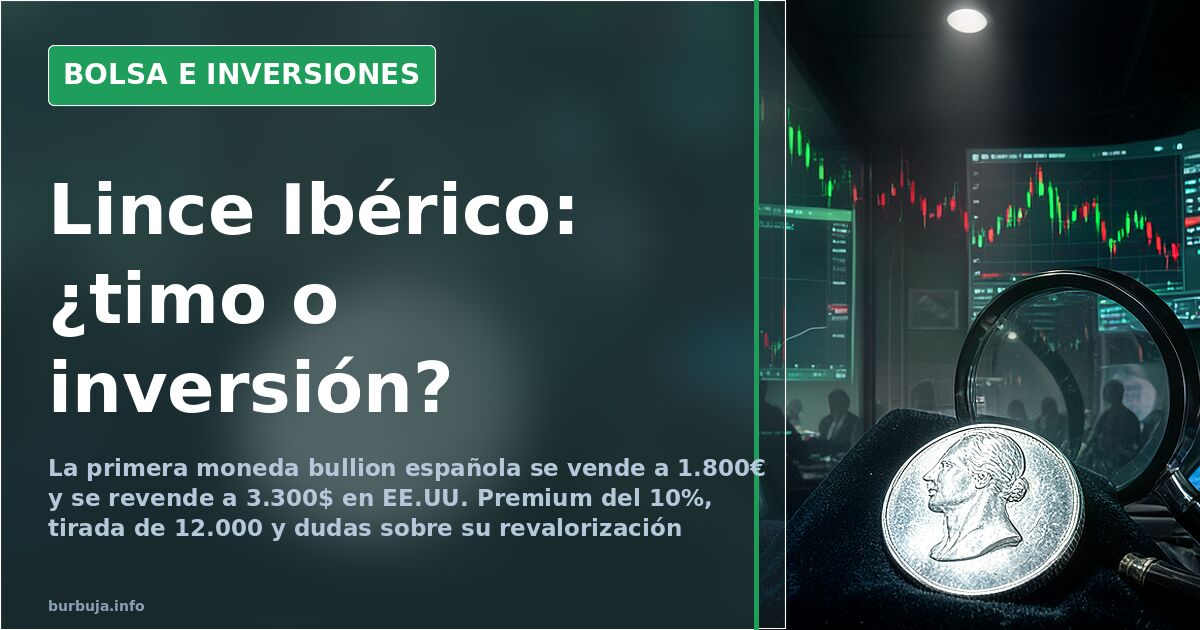
Iberian Lynx: the gold ounce already reselling for $3,300
The first bullion coin ever minted in Spain is called the Iberian Lynx, weighs one troy ounce of pure gold and sells for around €1,800. The mintage, limited to 12,000 units, has already sold out at several dealers and, according to one forum user, is being resold on international platforms for $3,300 — nearly double its launch price. The debate over whether to buy it has divided collectors between those who see a historic opportunity and those who suspect the premium is a trap for the unwary.
The design, the face value and the edge: the details that infuriate
The coin hasn't won everyone over. Some call it downright ugly and criticize the lynx portrait for doing the animal no justice. The plain edge and a face value of €1.50 — when a British Britannia declares £100 — are the most repeated complaints from detractors. "It's just cheap-looking," sums up a collector with years of experience, who compares the finish to other international issues.
Not everyone agrees, however. Another camp defends the reverse, with the Pillars of Hercules design, as "the only truly beautiful part" and argues the reverse proof finish justifies part of the markup. The coin weighs 31.1 grams of .999 fine gold and its maximum mintage is 12,000 units, although the Fábrica Nacional de Moneda y Timbre (FNMT, Spain's royal mint) could strike fewer if demand doesn't hold up.
Calculating the premium: how much extra are you paying?
The launch price is around €1,800, while a standard bullion ounce — such as the Canadian Maple Leaf or the Britannia — trades at roughly €1,680-1,690. The difference is about €50-55, a premium of approximately 10% over the metal's value. For pure investors, that extra cost isn't recovered by simply selling at weight: it would take years of numismatic appreciation.
The comparison with other collector coins is inevitable. A proof piece can reach premiums of 300% over time, but only if the market demands it. The Lynx is Spain's first bullion coin, an argument some consider "insurance for the grandchildren" and others see as a passing fad.
International resale: $3,300 in the United States
According to a forum user, the coin is already being offered on American websites for $3,300, nearly double its European price. The gap could be explained by import tariffs or by strong demand from US collectors, used to paying high figures to complete sets. In the European market, some online dealers have sold out and those that still have stock are keeping prices close to €1,800.
The phenomenon recalls other numismatic bubbles: when supply is limited and demand is concentrated among few buyers, prices spiral. The question is whether that demand will last once the novelty wears off.
The debate over Spain's tax agency and purchase records
Buying gold from a dealer means leaving your ID number recorded in the seller's books. Hacienda (Spain's tax agency) can cross-reference that data and, in the event of an inspection, request documentation of transactions going back up to five years. According to one user, some buyers have received inquiries over amounts as low as €160, fueling the legend that the tax authorities monitor any movement involving precious metals.
The reality is more nuanced: not every purchase triggers an investigation, but the paper trail exists. For those dealing in high volumes, keeping a detailed record of invoices and dates is the only way to avoid unpleasant surprises.
What the experts say: investment or whim?
The numismatic community is split. One camp argues the Lynx is a collector coin with a reasonable premium and a low mintage that could appreciate over the years. A more skeptical camp points out that silver has delivered negative returns over the past decade and that gold is not a risk-free investment.
"As an investment, or for those of us who buy gold as a safe haven, the Lynx with such a large premium is not a good idea," one analyst sums up. For now, the verdict remains open: time will tell whether the Lynx becomes a coveted piece or simply a memento of a passing fad.
The first bullion coin ever minted in Spain is called the Iberian Lynx, weighs one troy ounce of pure gold and sells for around €1,800. The mintage, limited to 12,000 units, has already sold out at several dealers and, according to one forum user, is being resold on international platforms for $3,300 — nearly double its launch price. The debate over whether to buy it has divided collectors between those who see a historic opportunity and those who suspect the premium is a trap for the unwary.
The design, the face value and the edge: the details that infuriate
The coin hasn't won everyone over. Some call it downright ugly and criticize the lynx portrait for doing the animal no justice. The plain edge and a face value of €1.50 — when a British Britannia declares £100 — are the most repeated complaints from detractors. "It's just cheap-looking," sums up a collector with years of experience, who compares the finish to other international issues.
Not everyone agrees, however. Another camp defends the reverse, with the Pillars of Hercules design, as "the only truly beautiful part" and argues the reverse proof finish justifies part of the markup. The coin weighs 31.1 grams of .999 fine gold and its maximum mintage is 12,000 units, although the Fábrica Nacional de Moneda y Timbre (FNMT, Spain's royal mint) could strike fewer if demand doesn't hold up.
Calculating the premium: how much extra are you paying?
The launch price is around €1,800, while a standard bullion ounce — such as the Canadian Maple Leaf or the Britannia — trades at roughly €1,680-1,690. The difference is about €50-55, a premium of approximately 10% over the metal's value. For pure investors, that extra cost isn't recovered by simply selling at weight: it would take years of numismatic appreciation.
The comparison with other collector coins is inevitable. A proof piece can reach premiums of 300% over time, but only if the market demands it. The Lynx is Spain's first bullion coin, an argument some consider "insurance for the grandchildren" and others see as a passing fad.
International resale: $3,300 in the United States
According to a forum user, the coin is already being offered on American websites for $3,300, nearly double its European price. The gap could be explained by import tariffs or by strong demand from US collectors, used to paying high figures to complete sets. In the European market, some online dealers have sold out and those that still have stock are keeping prices close to €1,800.
The phenomenon recalls other numismatic bubbles: when supply is limited and demand is concentrated among few buyers, prices spiral. The question is whether that demand will last once the novelty wears off.
The debate over Spain's tax agency and purchase records
Buying gold from a dealer means leaving your ID number recorded in the seller's books. Hacienda (Spain's tax agency) can cross-reference that data and, in the event of an inspection, request documentation of transactions going back up to five years. According to one user, some buyers have received inquiries over amounts as low as €160, fueling the legend that the tax authorities monitor any movement involving precious metals.
The reality is more nuanced: not every purchase triggers an investigation, but the paper trail exists. For those dealing in high volumes, keeping a detailed record of invoices and dates is the only way to avoid unpleasant surprises.
What the experts say: investment or whim?
The numismatic community is split. One camp argues the Lynx is a collector coin with a reasonable premium and a low mintage that could appreciate over the years. A more skeptical camp points out that silver has delivered negative returns over the past decade and that gold is not a risk-free investment.
"As an investment, or for those of us who buy gold as a safe haven, the Lynx with such a large premium is not a good idea," one analyst sums up. For now, the verdict remains open: time will tell whether the Lynx becomes a coveted piece or simply a memento of a passing fad.
Also available in: Deutsch
Summary of a discussion on Burbuja.info - Foro de economía, actualidad y política., translated from Spanish and reviewed before publication. Read the full discussion (94 replies).
More summaries
-
Banco de España Silver Coins: From €12 to €30 Face Value
Explore the evolution of Banco de España's silver coins, from their €12 face value to €30, as silver prices fluctuated. Discover why these collectibles are now scarce.
-
Banco de España's €12 coin now matches its silver face value
Commemorative €12 silver coin briefly exceeded its face value. Daily limits and rush to exchange them at the bank fueled the trend.
-
Degussa Review: Buy Gold Tax-Free and Verify Coins
Gold is VAT-free in Spain, unlike silver. Degussa is generally pricey but offers the best deal for Mexican 50 Peso coins. Verifying coins is easier than bullion bars.
-
Hotel101 sells rooms in Valdebebas for €208,800
Hotel101 sells rooms in Valdebebas for €208,800 plus VAT with monthly income distribution and doubts about what happens if the operator goes bankrupt
-
Pharmamar: the lurbinectedin splitting investors' opinions
Pharmamar's lurbinectedin is already approved in the US, with Europe expected in 2026. The numbers promise 600 million, but skepticism persists.
-
Gasoil defies the shorts with a record crack spread
Gasoil hits record crack spreads while a €30,000 short waits for a fall to 900. The battle over the refining margin.