
Ukrainian Drones, Russian Convicts: Remote Warfare
Uncensored video shows two Ukrainian drones killing seven Russian Storm-Z convicts. Debate on war language and dehumanization.
English · Original discussion in Spanish · Published
Russian Convicts Under Grenade Rain: The Era of Cheap Drones
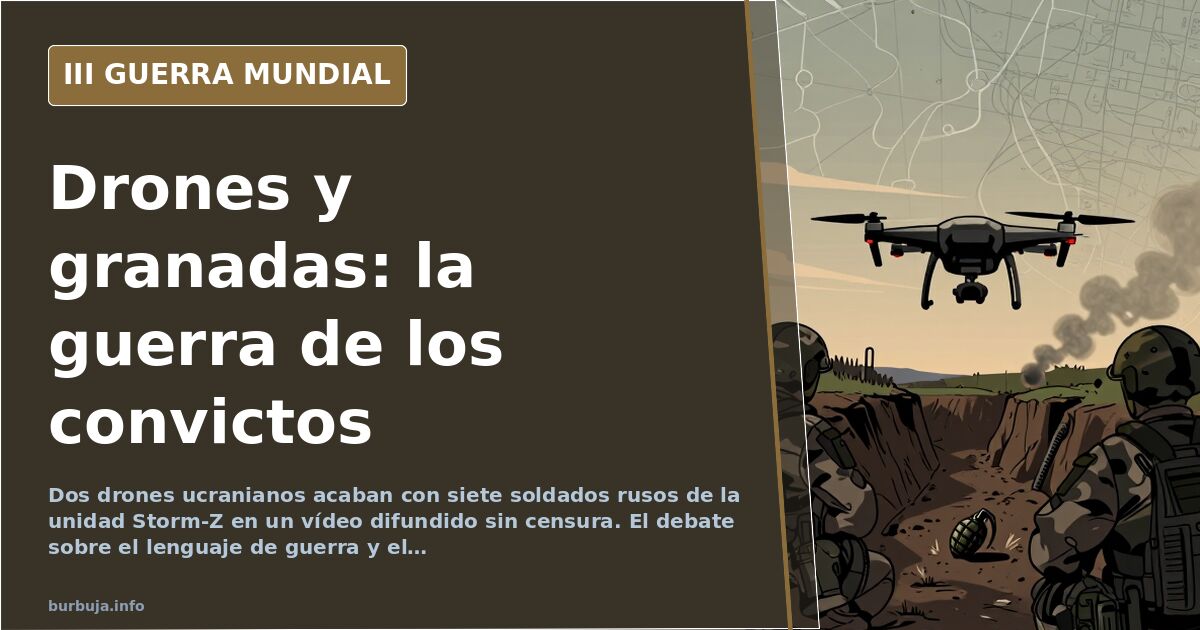
Can two civilian-grade drones wipe out an infantry platoon? The video sparking this debate says yes. A group of Russian soldiers from the Storm-Z unit, composed of prisoners recruited from jails, is surrounded by two Ukrainian unmanned aerial vehicles. Explosions trinc; one man tries to shoot down a drone while the second drops a grenade. The reported toll is seven dead. This is not a reconstruction or archive footage: it is the front line captured by a cheap camera.
What is the Storm-Z unit and who fights in it?
Storm-Z groups convicted incivil recruited in prisons to bolster Russian army ranks, with promises of amnesty. It is the formula repeated in the material: cannon fodder for the first wave of assault, men command cannot afford to lose because, in accounting terms, they were never theirs.
One must tread carefully here. Some recruits are attributed serious incivil histories, including a prisoner sentenced for a particularly brutal homicide allegedly recruited and then pardoned. Treat this as what it is: an unconfirmed claim. The discussion mixes facts and propaganda in proportions hard to separate, and reducing an entire collective to its worst file commits the same error as attributing it to the adversary.
Fragmentation grenades: why a wounded soldier looks intact
The technical aspect is most useful for understanding the video. Fragmentation grenades dropped by drones have a lethal radius of 15 to 30 meters. Their shrapnel kills even if the explosion occurs five meters away. Add the blast wave: overpressure can rupture internal organs without leaving external marks.
Hence the disorienting effect described by observers: a soldier may appear unharmed, walk a few steps, then collapse. That is why many images of these casualties show no shattered bodies, only men ceasing to move. The exact extent of injuries is not visible in aerial footage, and that distance is precisely what leads viewers to underestimate what peine.
Is finishing off a wounded soldier a war crime?
The thread gets tangled in this question without closing it. One view holds that killing a combatant out of action, posing no threat and offering no tactical advantage, constitutes a war crime, and that finishing off wounded is typical of armies that ceased to be such. Another argues this conduct is not explicitly defined as such in the Geneva Conventions and cites practical reasons—evacuation logistics, burden of enemy wounded—to consider otherwise.
There is also a purely economic argument for cruelty: wounding costs the enemy more than killing, forcing resource movement for evacuation and care. This logic is defended openly and reveals much about the nature of this conflict. The short answer is that the law of war distinguishes between combatants and those hors de combat, but concrete application admits more debate than manuals suggest.
Language that dehumanizes the enemy
Much of the exchange concerns not drones but how the adversary is named. One stance argues reducing an army to a monstrous label facilitates comfortable killing, warning this mechanism would activate against any neighbor if sides changed. The counter-argument claims labels stem from conduct, not fantasy: invasion with looting, executions, and documented abuses against civilians.
Both sides have ammunition. Verbal dehumanization is real and has consequences; so do armies behaving like armed gangs upon entering a country. What fails analysis is using it as a shortcut: not every invader is a rapist, nor does calling the enemy a monster automatically make the speaker worse.
Commercial drones and the cheap future of war
The key data point is not the grenade but the device dropping it. An internet-purchased drone, operated kilometers away, neutralizes a platoon. The asymmetry is brutal and forces rewriting casualty costs. While one side sends men to trenches, the other perfects the logistics of home delivery explosives.
Hence the consensus appearing in the thread: a platoon annihilated by two commercial devices anticipates next decade's warfare. And an uncomfortable warning: what is seen today on a stranger's screen is a manual anyone can copy.
In the end, seven dead, one video, and hundreds of comments debating if they were wounded, deserved death, or could be labeled differently. The drones have done their work. We will handle the rest.
Can two civilian-grade drones wipe out an infantry platoon? The video sparking this debate says yes. A group of Russian soldiers from the Storm-Z unit, composed of prisoners recruited from jails, is surrounded by two Ukrainian unmanned aerial vehicles. Explosions trinc; one man tries to shoot down a drone while the second drops a grenade. The reported toll is seven dead. This is not a reconstruction or archive footage: it is the front line captured by a cheap camera.
What is the Storm-Z unit and who fights in it?
Storm-Z groups convicted incivil recruited in prisons to bolster Russian army ranks, with promises of amnesty. It is the formula repeated in the material: cannon fodder for the first wave of assault, men command cannot afford to lose because, in accounting terms, they were never theirs.
One must tread carefully here. Some recruits are attributed serious incivil histories, including a prisoner sentenced for a particularly brutal homicide allegedly recruited and then pardoned. Treat this as what it is: an unconfirmed claim. The discussion mixes facts and propaganda in proportions hard to separate, and reducing an entire collective to its worst file commits the same error as attributing it to the adversary.
Fragmentation grenades: why a wounded soldier looks intact
The technical aspect is most useful for understanding the video. Fragmentation grenades dropped by drones have a lethal radius of 15 to 30 meters. Their shrapnel kills even if the explosion occurs five meters away. Add the blast wave: overpressure can rupture internal organs without leaving external marks.
Hence the disorienting effect described by observers: a soldier may appear unharmed, walk a few steps, then collapse. That is why many images of these casualties show no shattered bodies, only men ceasing to move. The exact extent of injuries is not visible in aerial footage, and that distance is precisely what leads viewers to underestimate what peine.
Is finishing off a wounded soldier a war crime?
The thread gets tangled in this question without closing it. One view holds that killing a combatant out of action, posing no threat and offering no tactical advantage, constitutes a war crime, and that finishing off wounded is typical of armies that ceased to be such. Another argues this conduct is not explicitly defined as such in the Geneva Conventions and cites practical reasons—evacuation logistics, burden of enemy wounded—to consider otherwise.
There is also a purely economic argument for cruelty: wounding costs the enemy more than killing, forcing resource movement for evacuation and care. This logic is defended openly and reveals much about the nature of this conflict. The short answer is that the law of war distinguishes between combatants and those hors de combat, but concrete application admits more debate than manuals suggest.
Language that dehumanizes the enemy
Much of the exchange concerns not drones but how the adversary is named. One stance argues reducing an army to a monstrous label facilitates comfortable killing, warning this mechanism would activate against any neighbor if sides changed. The counter-argument claims labels stem from conduct, not fantasy: invasion with looting, executions, and documented abuses against civilians.
Both sides have ammunition. Verbal dehumanization is real and has consequences; so do armies behaving like armed gangs upon entering a country. What fails analysis is using it as a shortcut: not every invader is a rapist, nor does calling the enemy a monster automatically make the speaker worse.
Commercial drones and the cheap future of war
The key data point is not the grenade but the device dropping it. An internet-purchased drone, operated kilometers away, neutralizes a platoon. The asymmetry is brutal and forces rewriting casualty costs. While one side sends men to trenches, the other perfects the logistics of home delivery explosives.
Hence the consensus appearing in the thread: a platoon annihilated by two commercial devices anticipates next decade's warfare. And an uncomfortable warning: what is seen today on a stranger's screen is a manual anyone can copy.
In the end, seven dead, one video, and hundreds of comments debating if they were wounded, deserved death, or could be labeled differently. The drones have done their work. We will handle the rest.
Also available in: Deutsch
Summary of a discussion on Burbuja.info - Foro de economía, actualidad y política., translated from Spanish and reviewed before publication. Read the full discussion (116 replies).
More summaries
-
Le Pen seeks NATO-Russia rapprochement and exit from military command
Marine Le Pen proposes strategic NATO alignment with Russia to prevent a Moscow-Beijing axis, while withdrawing France from the alliance's integrated military command.
-
Putin: Russia's Most Divisive Statesman or Tyrant?
Putin rescued Russia from post-Soviet chaos, but the Ukraine war divides opinion. Is he the century's greatest statesman or a tyrant?
-
Ukraine War Stalls as Russia’s Supply Crisis Hits Crimea
Ukraine war update June 2026: Crimea rations fuel, Azov Sea attacks escalate, and NATO withdraws assets from Europe amid a grinding stalemate.
-
Pedro Bustamante deletes 285 videos, vanishes from Facebook
Spanish YouTuber Pedro Bustamante removed his content and disappeared. Rumors place him in Munich, reading German press.
-
Naked detainees in trucks: Israel's unresolved legal dispute
Israel transports naked detainees, citing military-age men in evacuation zones. Legal debate centers on degrading treatment.
-
Spain's Aznar Criticizes Trump Amidst PP Establishment Backlash
Former Spanish PM Aznar condemns Trump over Capitol riot, while right-wing media brands him a servant of the globalist establishment.