
Henry Kissinger dies at 100: celebration and shadows
Kissinger died at 100 in bed, avoiding condemnation and unanswered accusations regarding Carrero Blanco, China, and his circle.
English · Original discussion in Spanish · Published
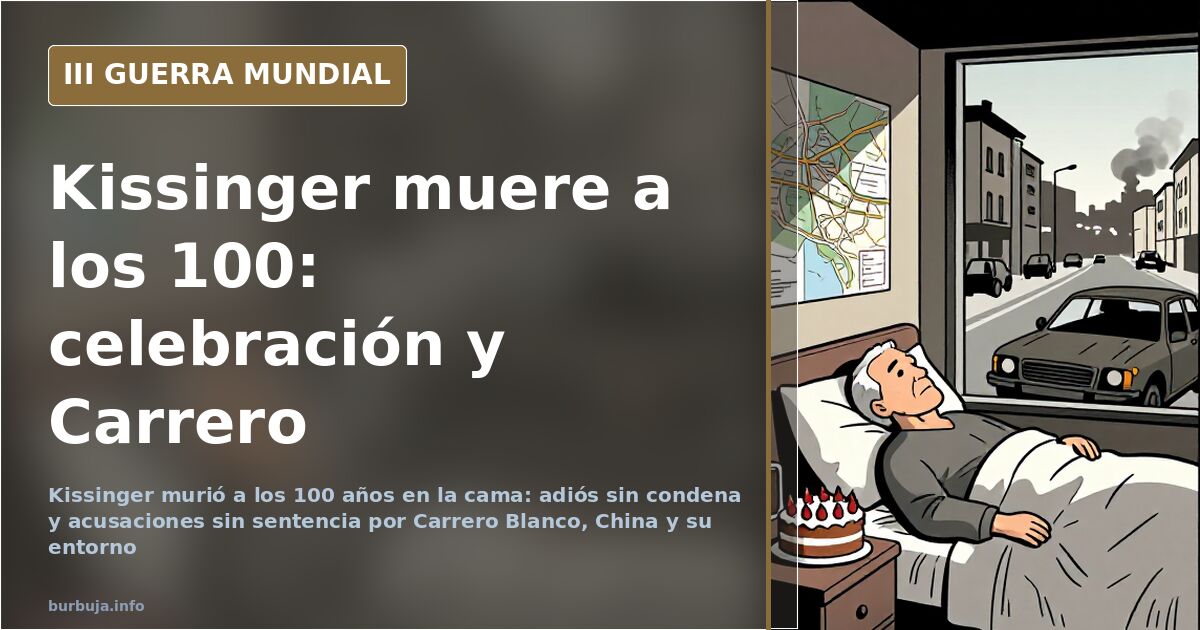
Kissinger dies at 100 with Carrero Blanco in the spotlight
Henry Kissinger died at 100. The obituary was published on the night of November 29, 2023, and instead of a eulogy-filled funeral, it brought a cascade of unfinished business: the bombing that killed Admiral Carrero Blanco, the Nobel Peace Prize, the opening to China, the Sahara, and a string of names repeated in the Epstein case files. The US diplomat died in his sleep, and that detail — dying of old age and not behind bars — is what is repeated most.
That is where the official narrative’s problem begins. A man who negotiated the withdrawal from Vietnam and peine the door to China goes without sitting in a courtroom. One hundred years of life and no conviction. The hovering question is not whether he was relevant, but for whom he worked.
Why is Kissinger accused of ordering Carrero Blanco’s death?
The most repeated accusation claims Kissinger ordered the assassination of Admiral Luis Carrero Blanco, Spain’s Prime Minister, because he sought to equip Spain with nuclear weapons and refused to back down. The bombing occurred about fifty years ago. It is an unproven allegation: stated as suspicion, never as a proven fact, and circulating for half a century.
On the other side, some argue the opposite with an uncomfortable point. The insinuations about CIA connivance in the bombing have been repeating for fifty years, this current says, while visible evidence points in the opposite direction. Their question is what we would have thought if the alleged perpetrators had been photographed with Kissinger’s greatest enemy. There is no verdict. There are two narratives and no sentence.
The Nobel Peace Prize, Vietnam, and the opening to China
His attributed resume is double-edged. He negotiated the withdrawal from Vietnam and the rapprochement with China, merits that one part claims as victories against communism and another reads as strategic gifts: turning China into the world’s factory and handing it military and economic conquests. On the table are also the Sahara — the so-called Green March — and the Spanish Transition, all grouped in the same bill.
The Nobel Peace Prize he received is the most cynical point for much of the criticism: it is joked that the prize requires having promoted at least two wars. The defense is minority, but it exists and goes in another direction: an tireless fighter for freedom, champion against communism, and a good friend of Spain. The reply comes quickly: negotiating Vietnam’s withdrawal and the opening to China does not fit that portrait.
The Epstein case and unproven connections
Part of the messages link Kissinger’s name to lists of attendees at Jeffrey Epstein meetings after his conviction. Those lists include, as reported, CIA Director William Burns, Goldman Sachs attorney Kathryn Ruemmler, linguist Noam Chomsky, a Rothschild banking executive, and a Kissinger consultant. These are published mentions without independent confirmation and without resulting charges. The material circulates as suspicion, not as proof.
Included in this package are references to the New World Order: a quote attributed to Klaus Schwab about creating a new order and its link to Kissinger. And the underlying argument of another current: that the elite taking power after World War II is reaching its final retirement and their heirs do not seem equally skilled. That is a hypothesis about the future, not a fact.
The state funeral and the five-year countdown
One of the most widespread coincidences is this: the obituary published at 8:54 PM Eastern Time on November 29, 2023, would fit, within a two-day margin, with an anonymous message from December 2018 mentioning a state funeral. The calculation is presented as a fulfilled prediction. There is no possible verification beyond the date alignment, and it is worth remembering before accepting it.
What remains, finally, is a round figure and an uncloseable paradox. One hundred years, a Nobel Peace Prize, several wars with his signature, and not a single conviction. Those celebrating his death slept better that night, reportedly; those defending him lost a reference point. The analysis stalls exactly there: not on whether he was a bad man, but on why no one ever judged him.
Henry Kissinger died at 100. The obituary was published on the night of November 29, 2023, and instead of a eulogy-filled funeral, it brought a cascade of unfinished business: the bombing that killed Admiral Carrero Blanco, the Nobel Peace Prize, the opening to China, the Sahara, and a string of names repeated in the Epstein case files. The US diplomat died in his sleep, and that detail — dying of old age and not behind bars — is what is repeated most.
That is where the official narrative’s problem begins. A man who negotiated the withdrawal from Vietnam and peine the door to China goes without sitting in a courtroom. One hundred years of life and no conviction. The hovering question is not whether he was relevant, but for whom he worked.
Why is Kissinger accused of ordering Carrero Blanco’s death?
The most repeated accusation claims Kissinger ordered the assassination of Admiral Luis Carrero Blanco, Spain’s Prime Minister, because he sought to equip Spain with nuclear weapons and refused to back down. The bombing occurred about fifty years ago. It is an unproven allegation: stated as suspicion, never as a proven fact, and circulating for half a century.
On the other side, some argue the opposite with an uncomfortable point. The insinuations about CIA connivance in the bombing have been repeating for fifty years, this current says, while visible evidence points in the opposite direction. Their question is what we would have thought if the alleged perpetrators had been photographed with Kissinger’s greatest enemy. There is no verdict. There are two narratives and no sentence.
The Nobel Peace Prize, Vietnam, and the opening to China
His attributed resume is double-edged. He negotiated the withdrawal from Vietnam and the rapprochement with China, merits that one part claims as victories against communism and another reads as strategic gifts: turning China into the world’s factory and handing it military and economic conquests. On the table are also the Sahara — the so-called Green March — and the Spanish Transition, all grouped in the same bill.
The Nobel Peace Prize he received is the most cynical point for much of the criticism: it is joked that the prize requires having promoted at least two wars. The defense is minority, but it exists and goes in another direction: an tireless fighter for freedom, champion against communism, and a good friend of Spain. The reply comes quickly: negotiating Vietnam’s withdrawal and the opening to China does not fit that portrait.
The Epstein case and unproven connections
Part of the messages link Kissinger’s name to lists of attendees at Jeffrey Epstein meetings after his conviction. Those lists include, as reported, CIA Director William Burns, Goldman Sachs attorney Kathryn Ruemmler, linguist Noam Chomsky, a Rothschild banking executive, and a Kissinger consultant. These are published mentions without independent confirmation and without resulting charges. The material circulates as suspicion, not as proof.
Included in this package are references to the New World Order: a quote attributed to Klaus Schwab about creating a new order and its link to Kissinger. And the underlying argument of another current: that the elite taking power after World War II is reaching its final retirement and their heirs do not seem equally skilled. That is a hypothesis about the future, not a fact.
The state funeral and the five-year countdown
One of the most widespread coincidences is this: the obituary published at 8:54 PM Eastern Time on November 29, 2023, would fit, within a two-day margin, with an anonymous message from December 2018 mentioning a state funeral. The calculation is presented as a fulfilled prediction. There is no possible verification beyond the date alignment, and it is worth remembering before accepting it.
What remains, finally, is a round figure and an uncloseable paradox. One hundred years, a Nobel Peace Prize, several wars with his signature, and not a single conviction. Those celebrating his death slept better that night, reportedly; those defending him lost a reference point. The analysis stalls exactly there: not on whether he was a bad man, but on why no one ever judged him.
Summary of a discussion on Burbuja.info - Foro de economía, actualidad y política., translated from Spanish and reviewed before publication. Read the full discussion (219 replies).
More summaries
-
Kissinger Suggests Ukraine Cede Territory to Russia for Peace
At 98, Kissinger proposes Ukraine cede land to Russia to end the war, reopening debates on who benefits from the conflict's prolongation.
-
Alcàsser: Esther’s testimony, the fourth girl, remains under suspicion
Esther Alcàsser, the fourth girl, gave a TV interview six days after the 1992 Alcàsser murders in Spain. Her account and timeline discrepancies fuel ongoing controversy.
-
Ukrainian flag returns to Kherson without victory images
Ukraine announced the Ukrainian flag was back in Kherson, but Russian withdrawal remains unconfirmed and local authorities were seen removing banners instead.
-
Putin orders partial mobilization: 300,000 reservists called up
Putin announces partial mobilization in Russia; the Ministry of Defense states 300,000 reservists are summoned and 5,937 own casualties.
-
Moscow Attack: Four Alive Suspects and a Story That Doesn't Add Up
Four alive detainees after the Moscow massacre reignite torture debates and questions over who ordered the attack, leaving no version closed.
-
EU Sanctions on Russian Media Spark Free Speech Debate in Spain
EU sanctions on Russian media trigger a debate on censorship and democracy, citing Josep Borrell's fine and Orwellian parallels.