
Kissinger Suggests Ukraine Cede Territory to Russia for Peace
At 98, Kissinger proposes Ukraine cede land to Russia to end the war, reopening debates on who benefits from the conflict's prolongation.
English · Original discussion in Spanish · Published
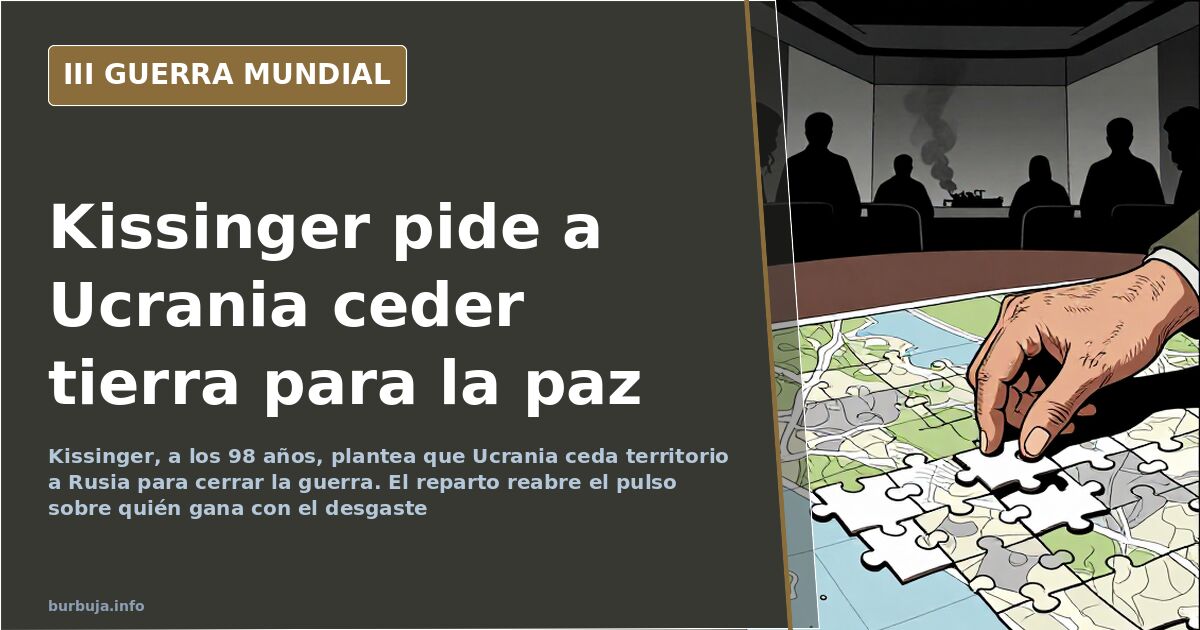
Kissinger advises Ukraine to cede territory to halt the war
Henry Kissinger, aged 98, delivers a reality check: Ukraine should cede territory to Russia to seek peace. The former US Secretary of State, a key figure in American foreign policy for half a century, frames land surrender as a realistic solution. The news, reported by the Daily Mail, has reignited the debate that has defined the conflict since day one. The map can no longer be reset. The question is what to do with the current reality.
From Luhansk to Crimea: territory Ukraine will not regain
One part of the analysis considers this closed. Ukraine will not see Luhansk or Donetsk again, just as Crimea is already gone. The conclusion depends not on the next front pulse, but on fait accompli: whoever holds the land keeps it. Based on this, the proposed division involves one-third to one-quarter of Ukrainian territory, half of which was not de facto Ukrainian before the war. The discussion is no longer about whether to cede, but how much and for what.
Who wins when the war drags on
Here comes the economic reading. For some, protracting the conflict primarily benefits Anglo-American interests: it damages Russia, separates it from Europe, and undermines the continent as an industrial competitor. This includes fuel sales, armaments, future reconstruction, and inflation that erodes debt. London's commodity exchange operating at full capacity and Australian coal selling like hot cakes complete the picture. For this view, stopping the war would go against the very business sustaining it.
China, the great beneficiary of the stalemate
The second winner has a name, according to another reading of the thread. A long or even eternal war gives China time to strengthen itself while Washington cannot focus on its true goal: Asia. In this scenario, Russia ends up increasingly close to Beijing, placing its natural resources at China's service and withdrawing them from a weakened Europe. The corollary is uncomfortable for Brussels: the longer the front lasts, the tighter Russia's energy dependence on Asia becomes, and the colder European business gets.
Why Moscow preferred a neutral Ukraine?
This is the point repeated most against the narrative of total conquest. Russia would have preferred a whole, neutral or friendly Ukraine, rather than a quarter of the country becoming a hostile border. It is even argued that the invasion did not seek to annex the whole, but to prevent NATO entry. With this premise, what is happening now is the worst of all scenarios: territory controlled halfway, a neighbor in ruins, and an open wound for generations.
The warning: the precedent peine with China
Not everyone sees cession as a solution. Some warn of the imitation effect: if it works for Russia in Ukraine, it will work for China with Taiwan. For Washington, this message is unacceptable, so the path of land cession clashes with a greater strategic interest. The underlying criticism is that Moscow raised the stakes again, like others before, from victory to victory until final defeat. Arrogance is paid for, and the bill always arrives.
Women leave, men stay
As the map is debated, so is the people. The refugee flow has been marked by asymmetry: men aged 18 to 60 cannot leave the country, and women with education were required to register militarily for passports, according to available information. The result is selective displacement, with young and skilled population retained. Some note that Ukrainian women are treated like European women in the nineties, and the real exodus will be seen when the conflict ends and the country's real state is known.
The energy division Europe pays for
The other front is energy. Europe buys fuel from these same elites at a multiplied price, and sanctions have cut commercial routes that had operated for decades. For some analyses, Washington's goal is not so much Moscow as the trade between Europe, Russia, and China: cutting the new Silk Road and keeping European partners dependent on US suppliers and armaments. The bill is paid by the European consumer, with gasoline as a monthly reminder.
The detail that disorients remains. The proposal divides, but no one agrees on the age of its author. The figures range from 95 to 120 years, a range that shows exactly to what extent Kissinger, almost a century after birth, continues casting his shadow over foreign policy without ever holding elected office.
Henry Kissinger, aged 98, delivers a reality check: Ukraine should cede territory to Russia to seek peace. The former US Secretary of State, a key figure in American foreign policy for half a century, frames land surrender as a realistic solution. The news, reported by the Daily Mail, has reignited the debate that has defined the conflict since day one. The map can no longer be reset. The question is what to do with the current reality.
From Luhansk to Crimea: territory Ukraine will not regain
One part of the analysis considers this closed. Ukraine will not see Luhansk or Donetsk again, just as Crimea is already gone. The conclusion depends not on the next front pulse, but on fait accompli: whoever holds the land keeps it. Based on this, the proposed division involves one-third to one-quarter of Ukrainian territory, half of which was not de facto Ukrainian before the war. The discussion is no longer about whether to cede, but how much and for what.
Who wins when the war drags on
Here comes the economic reading. For some, protracting the conflict primarily benefits Anglo-American interests: it damages Russia, separates it from Europe, and undermines the continent as an industrial competitor. This includes fuel sales, armaments, future reconstruction, and inflation that erodes debt. London's commodity exchange operating at full capacity and Australian coal selling like hot cakes complete the picture. For this view, stopping the war would go against the very business sustaining it.
China, the great beneficiary of the stalemate
The second winner has a name, according to another reading of the thread. A long or even eternal war gives China time to strengthen itself while Washington cannot focus on its true goal: Asia. In this scenario, Russia ends up increasingly close to Beijing, placing its natural resources at China's service and withdrawing them from a weakened Europe. The corollary is uncomfortable for Brussels: the longer the front lasts, the tighter Russia's energy dependence on Asia becomes, and the colder European business gets.
Why Moscow preferred a neutral Ukraine?
This is the point repeated most against the narrative of total conquest. Russia would have preferred a whole, neutral or friendly Ukraine, rather than a quarter of the country becoming a hostile border. It is even argued that the invasion did not seek to annex the whole, but to prevent NATO entry. With this premise, what is happening now is the worst of all scenarios: territory controlled halfway, a neighbor in ruins, and an open wound for generations.
The warning: the precedent peine with China
Not everyone sees cession as a solution. Some warn of the imitation effect: if it works for Russia in Ukraine, it will work for China with Taiwan. For Washington, this message is unacceptable, so the path of land cession clashes with a greater strategic interest. The underlying criticism is that Moscow raised the stakes again, like others before, from victory to victory until final defeat. Arrogance is paid for, and the bill always arrives.
Women leave, men stay
As the map is debated, so is the people. The refugee flow has been marked by asymmetry: men aged 18 to 60 cannot leave the country, and women with education were required to register militarily for passports, according to available information. The result is selective displacement, with young and skilled population retained. Some note that Ukrainian women are treated like European women in the nineties, and the real exodus will be seen when the conflict ends and the country's real state is known.
The energy division Europe pays for
The other front is energy. Europe buys fuel from these same elites at a multiplied price, and sanctions have cut commercial routes that had operated for decades. For some analyses, Washington's goal is not so much Moscow as the trade between Europe, Russia, and China: cutting the new Silk Road and keeping European partners dependent on US suppliers and armaments. The bill is paid by the European consumer, with gasoline as a monthly reminder.
The detail that disorients remains. The proposal divides, but no one agrees on the age of its author. The figures range from 95 to 120 years, a range that shows exactly to what extent Kissinger, almost a century after birth, continues casting his shadow over foreign policy without ever holding elected office.
Summary of a discussion on Burbuja.info - Foro de economía, actualidad y política., translated from Spanish and reviewed before publication. Read the full discussion (222 replies).
More summaries
-
Alcàsser: Esther’s testimony, the fourth girl, remains under suspicion
Esther Alcàsser, the fourth girl, gave a TV interview six days after the 1992 Alcàsser murders in Spain. Her account and timeline discrepancies fuel ongoing controversy.
-
Inherited Magic: Spain's Nine Clans, Three Surviving, and a Pact
A Spanish initiation narrative claims magic is inherited by families and offered to Satan at age twelve. No evidence supports these assertions.
-
Lisichansk falls, Russia secures full control of Luhansk region
Russia declares full control of Luhansk after taking Lisichansk, the last Ukrainian stronghold. The capture opens the next phase of the offensive toward Bakhmut.
-
US Warns NATO: Must Fight If Russia Defeats Ukraine
The US warns NATO must enter war if Russia defeats Ukraine. Europe debates who pays the human cost while Washington maintains strategic distance.
-
Putin: Russia's Most Divisive Statesman or Tyrant?
Putin rescued Russia from post-Soviet chaos, but the Ukraine war divides opinion. Is he the century's greatest statesman or a tyrant?
-
Expiring Iodine: The Nuclear Threat That Never Came
Stocked iodine expires before the promised Russian Kinzhal attack. An analysis of 4,500 hypersonic missiles and the reality of the nuclear threat.