
Heating your home: from heating oil at €0.10/kWh to wood chips at €0.015/kWh
Pine wood chips cost €0.015/kWh while heating oil costs €0.100/kWh. The price ranking for heating a home, the role of the heat pump and the limit of the…
English · Original discussion in Spanish · Published
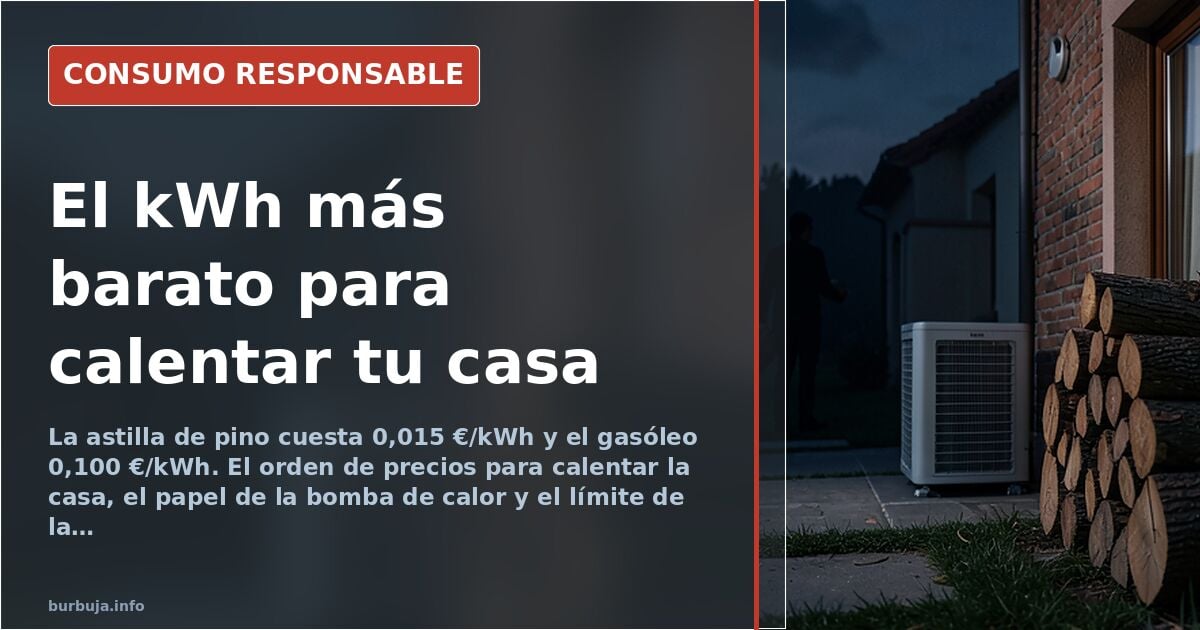
Heating your home: wood chips cost seven times less than heating oil
In the summer of 2006, with the energy bill already sending warning signs, a homeowner decided to dissect his heating system and put hard numbers on the table. The conclusion from that exercise remains uncomfortable to this day: insulate first, heat later. And then choose your fuel with a calculator, not with a sales brochure. The price ranking per kilowatt hour of heat generated back then ranged from €0.015/kWh for pine wood chips to €0.14/kWh for electricity in conventional radiators, with mains natural gas in between at €0.042/kWh.
What each kilowatt hour of heat really costs
The list, ordered from lowest to highest cost, leaves little doubt about where the wallet takes the hit. Split pine wood comes in at around €0.02/kWh; split hardwood, €0.03/kWh; a pellet boiler sits at around €0.035/kWh according to the IDAE (Spain's energy saving agency) report cited. Next comes the heat pump, at about €0.056/kWh, and higher up propane at €0.0639/kWh and heating oil at €0.100/kWh.
Heating oil is ruled out on both price and trend. Direct electricity, with a fixed charge of €17.19 per month for 10 kW plus €0.14/kWh, is the most expensive option. The catch is that the thermal efficiency of the system can turn the ranking upside down: a poorly used traditional fireplace sends much of the heat you pay for up the chimney, while underfloor heating gains 20% to 30% in efficiency by running on low-temperature water.
Heat pump: the COP that drops when the cold bites
The heat pump comes out well in the comparison because it does not convert electricity into heat; instead, it runs a compressor to extract energy from outside. Its stated performance ranges from 1.5 to 3 times the electricity consumed, making it the best option in temperate climates. The catch comes with extreme temperatures: the COP plummets and manufacturers are forced to compress the gas further, requiring pipes that can withstand higher pressure. The technology, it is argued, is still in its infancy.
The biomass alternative requires a high-temperature flue, which limits it to single-family homes. Pellet stoves offer greater autonomy —from two days to months depending on the hopper— compared with split firewood. Catalytic gas stoves appear as the budget option: 100% efficiency, double safety and five minutes of ventilation every eight hours.
Condensing boiler: the 109% that fails to convince everyone
The most hotly debated point is condensing boilers. The technical argument is that their efficiency is measured against the higher heating value and can exceed 100%, up to 109% at best. The counterargument is that this margin is only achieved with water at around 40 degrees, in other words, with underfloor heating; with conventional radiators the saving shrinks to a few days in spring and a difference described as negligible compared with a sealed-combustion boiler.
Windows before the boiler
The most frequent criticism of the original approach points to the windows. Their insulation is worse than that of the worst wall, and older homes are full of single glazing, sliding windows and aluminium frames without a thermal break. Switching to casement windows with a 12-millimetre or wider gap, or simply adding a second window the old-fashioned way, delivers a comfort leap you can feel on the bill.
Floor cooling, that supposed two-in-one for summer, runs into condensation: water can only be circulated above the dew point, around 17 °C at 50% humidity, which makes it unviable in coastal areas.
That is where the maths gets stuck: the cheapest fuel demands work, the most comfortable demands installation and the most efficient depends on the outdoor thermometer.
Also available in: Deutsch
Summary of a discussion on Burbuja.info - Foro de economía, actualidad y política., translated from Spanish and reviewed before publication. Read the full discussion (28 replies).
More summaries
-
Forum user recommends a 20 euro electric bed warmer for winter
A user suggests using a 20 euro bed warmer that plugs in for one minute and stays warm for up to two hours to cut down on heating use.
-
Elon Musk’s appearance sparks debate: does the founder’s body matter?
Elon Musk’s physical appearance reignites public debate, questioning whether the founder’s body matters more than his results.
-
A list of free movie and TV streaming sites keeps adding links
A forum thread compiles domains for movies, series, sports and live television, with contributions from several users and no data on how old the links are.
-
Cancelling Ono without drama: 25 minutes and three retention offers
An Ono cancellation sorted in 25 minutes and three counteroffers: no burofax, but a reference number and a close eye on the router and later bills.
-
Meal vouchers: how to turn them into meat, ham or cash
Meal vouchers barely leave bars, but online butchers, gourmet shops and Museo del Jamón accept them. The final trick: selling them on.
-
Kitchen robots: Thermomix vs the €80 multi-cooker
The Thermomix costs 700 euros and, according to users, neither kneads nor can be programmed; an 80-euro multi-cooker makes stews and bread. The payback calculation nobody does.