
Health Ministry to Ban Smoking on Terraces, Limit Vapes
Spain's new anti-smoking plan will ban smoking on terraces and beaches, treating vapes and hookahs like cigarettes, with no set distance between tables.
English · Original discussion in Spanish · Published
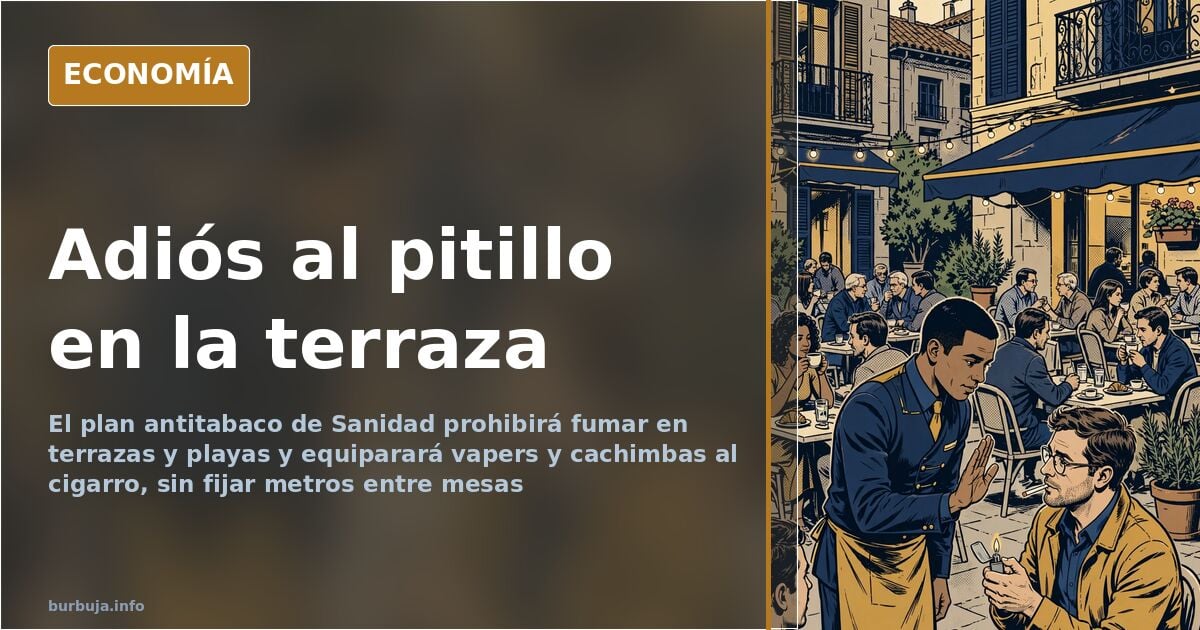
Smoking on the terrace has an expiration date
Some public health measures are approved to protect citizens and end up being debated for everything their text doesn't say. The anti-smoking plan being prepared by the Health Ministry will ban smoking on terraces, extend the ban to beaches, and equate traditional cigarettes with vapes and hookahs. What's striking isn't just what it prohibits, but what it leaves up in the air: no one has set how many meters should separate a smoking table from the next one.
What exactly does the anti-smoking plan prohibit?
The regulation is structured around four pillars: health, regulation, environmental protection, and coordination between public administrations. In practice, it equates all forms of nicotine consumption —heated tobacco, vapes, and hookahs— and announces the limitation of disposable vapes. Terraces and beaches will fall under the same umbrella: smoke-free spaces. The measure aims to normalize what until now depended on the discretion of each table.
Why the regulation might be a dead letter
The most frequently cited weak point is not ideological, but practical. Without a regulation setting the distance between tables, the prohibition is left to the interpretation of each establishment. The comparison with the pandemic is inevitable: even then, smoking while seated on the terrace was prohibited, while standing up with a cigarette in hand rendered any danger moot. And enforcement poses its own problem: without a specific body in charge, control would fall to neighbor complaints, a practice some call balcony police.
The terrace, that business on the edge
For the hospitality sector, the calculation is uncomfortable. Part of the industry argues that if smoking is prohibited, terraces will empty, and the blow will be concentrated in the good weather months when outdoor seating sustains revenue. The opposing argument carries weight: the heavy smoker isn't the client who saves a business, because the restaurateur needs to cater to the widest possible audience, and the number of smokers is decreasing year by year. The political criticism has a specific name and points to the Minister of Health, Mónica García, singled out by a good portion of the sector as responsible for attacking bars.
The «little terrace», that invention in the crosshairs
Few discussions about tobacco end without talking about the terrace as an institution. The little terrace with a beer and a tortilla skewer is both a social habit and a business model. Its defenders recall that at those tables, one also inhales car exhaust fumes from vehicles passing two meters away, and no one thinks of prohibiting walking on the street. The comparison, fair or not, is disarming: it's hard to argue that the air on the sidewalk is only dangerous when it comes from a cigarette.
Non-smoker's health versus smoker's freedom
Here, the issue ceases to be economic. On one side, the non-smoker's right to health: no one should inhale smoke from the next table while eating. On the other, the suspicion that the anti-smoking offensive is a drift that stigmatizes smokers — first by the media, then by the state — and leaves less and less room for choice. Even ex-smokers are divided: some are grateful not to smell it, others confess they prefer the smell of smoke to the smell of prohibitions. It's the old tension between coexistence and legislation.
The Japanese model cited as an alternative
When arguments get stuck, Japan appears. In its cities, there are few terraces, smoking is not allowed on the street, and smoking areas are designated inside bars. It's cited as proof that consumption can be regulated without a complete ban. The underlying proposal is simple: terraces for smokers and terraces for non-smokers, and let the establishment owner decide. It sounds reasonable. It also sounds like something that is never approved.
With disposable vapes in the spotlight and beaches awaiting guidelines, the question is no longer whether smoking will be allowed on terraces. It's who sets the distances, who enforces them, and who pays the bill when the next table remains empty.
Some public health measures are approved to protect citizens and end up being debated for everything their text doesn't say. The anti-smoking plan being prepared by the Health Ministry will ban smoking on terraces, extend the ban to beaches, and equate traditional cigarettes with vapes and hookahs. What's striking isn't just what it prohibits, but what it leaves up in the air: no one has set how many meters should separate a smoking table from the next one.
What exactly does the anti-smoking plan prohibit?
The regulation is structured around four pillars: health, regulation, environmental protection, and coordination between public administrations. In practice, it equates all forms of nicotine consumption —heated tobacco, vapes, and hookahs— and announces the limitation of disposable vapes. Terraces and beaches will fall under the same umbrella: smoke-free spaces. The measure aims to normalize what until now depended on the discretion of each table.
Why the regulation might be a dead letter
The most frequently cited weak point is not ideological, but practical. Without a regulation setting the distance between tables, the prohibition is left to the interpretation of each establishment. The comparison with the pandemic is inevitable: even then, smoking while seated on the terrace was prohibited, while standing up with a cigarette in hand rendered any danger moot. And enforcement poses its own problem: without a specific body in charge, control would fall to neighbor complaints, a practice some call balcony police.
The terrace, that business on the edge
For the hospitality sector, the calculation is uncomfortable. Part of the industry argues that if smoking is prohibited, terraces will empty, and the blow will be concentrated in the good weather months when outdoor seating sustains revenue. The opposing argument carries weight: the heavy smoker isn't the client who saves a business, because the restaurateur needs to cater to the widest possible audience, and the number of smokers is decreasing year by year. The political criticism has a specific name and points to the Minister of Health, Mónica García, singled out by a good portion of the sector as responsible for attacking bars.
The «little terrace», that invention in the crosshairs
Few discussions about tobacco end without talking about the terrace as an institution. The little terrace with a beer and a tortilla skewer is both a social habit and a business model. Its defenders recall that at those tables, one also inhales car exhaust fumes from vehicles passing two meters away, and no one thinks of prohibiting walking on the street. The comparison, fair or not, is disarming: it's hard to argue that the air on the sidewalk is only dangerous when it comes from a cigarette.
Non-smoker's health versus smoker's freedom
Here, the issue ceases to be economic. On one side, the non-smoker's right to health: no one should inhale smoke from the next table while eating. On the other, the suspicion that the anti-smoking offensive is a drift that stigmatizes smokers — first by the media, then by the state — and leaves less and less room for choice. Even ex-smokers are divided: some are grateful not to smell it, others confess they prefer the smell of smoke to the smell of prohibitions. It's the old tension between coexistence and legislation.
The Japanese model cited as an alternative
When arguments get stuck, Japan appears. In its cities, there are few terraces, smoking is not allowed on the street, and smoking areas are designated inside bars. It's cited as proof that consumption can be regulated without a complete ban. The underlying proposal is simple: terraces for smokers and terraces for non-smokers, and let the establishment owner decide. It sounds reasonable. It also sounds like something that is never approved.
With disposable vapes in the spotlight and beaches awaiting guidelines, the question is no longer whether smoking will be allowed on terraces. It's who sets the distances, who enforces them, and who pays the bill when the next table remains empty.
Summary of a discussion on Burbuja.info - Foro de economía, actualidad y política., translated from Spanish and reviewed before publication. Read the full discussion (500 replies).
More summaries
-
Mónica García Dodges Question on Fetal Pain During Abortion
Mónica García, Spain's Health Minister, refused to answer whether fetuses feel pain during abortion, stating 'I don't understand the question.' Evidence suggests nociceptors appear around week 10.
-
Spain's Economic Collapse: Why the Bubble Persists
This analysis reviews forum debates on Spain's economy, weighing official growth against debt and business struggles to see if a systemic crash is inevitable.
-
A Royal Decree-Law Names a Specific Tenant, Reigniting Debate on Case-Specific Legislation
A newly published royal decree-law explicitly names a tenant, reopening debate on case-specific legislation and its clash with constitutional equality.
-
Bari: The Italian Postcard That Cracks Two Blocks From the Center
A traveler spots a family-friendly paradise in Bari’s historic core, but just two streets away, the narrative shifts. Italy vs. Spain compared.
-
Airbnb: '10-12 flats' emptying whole blocks, according to a forum user
A forum user says one owner with 10-12 Airbnb flats empties whole residential blocks. In Lugo or Teruel, prices also rise without mass tourism.
-
Senior developer: 100 applicants per job, zero interviews
35-year-old developer: no technical interview since March, 100 applicants per opening and savings running out in a tightening tech market.