
Having Children on €2,400 a Month: The Calculation That Divides
A couple earning €2,400 a month and paying €1,000 in rent faces the real cost of having children, balancing parental joy with fears of old age.
English · Original discussion in Spanish · Published
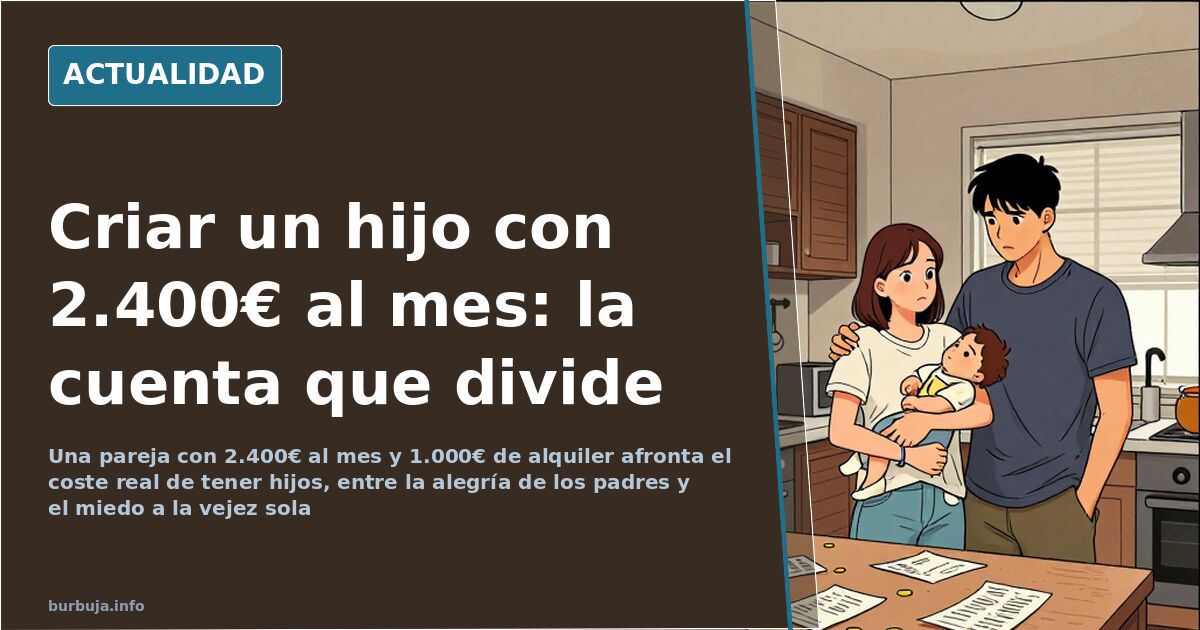
Why Having Children No Longer Pays Off: The Family Calculation
Is it worth having a child when rent eats up almost half your salary? This is the question brought to the fore by a video titled “Why Having Children Will Ruin Your Life,” shared by the Lomo Plateado channel. In six months, it has sparked a debate about household economics, old age, and demographics. The premise isn't new, but the framing is: child-rearing as a financial sentence from which one never escapes, not even with grandchildren.
That's the hook. Beneath it lie concrete numbers, personal experiences, and a fundamental disagreement about what constitutes a life well-lived.
How Much Does it Cost to Have a Child on €2,400 a Month?
The most common example is very specific: a couple in their thirties earning €1,200 each and paying €1,000 in rent. That leaves €1,400 for two. If a child arrives, it's €1,400 for three. Some argue that a family can live without drama on this margin; the quick reply is that at this rate, the menu shrinks to sausages and pasta, and fresh fish won't appear until the child is twenty.
The other economic argument comes from those who opt out to play the game better: not having children and dedicating the surplus to investment. The counter-argument has its own accounting logic — without offspring, everything accumulated and not spent in life ends up financing other families, via taxes or inheritance — making the decision less free than it seems.
Between these two extremes lies a third calculation: peace of mind — an economic cushion that allows one to face old age without depending on anyone.
The Video Equating Raising Children to the Rat Race
The central message isn't about money as an end goal, but about slavery. Raising children, according to this view, means accepting precarious jobs, being exploited by others, and never escaping the rat race. The idea is summed up in a phrase that titles much of the discussion: it's entering a form of slavery you don't escape until your grandchildren's time, and beyond. Then you die.
The nuance is important. What's being criticized isn't parenthood itself, but the surrounding system: precariousness, inflation, housing, and consumerism. Inflation, it's argued, is a political decision and therefore reversible; the cost of child-rearing, however, is paid every month. This distinction sets the video apart from a simple complaint.
Parents Respond: That's What Life Is About
The counter-argument doesn't dispute the numbers, but the scale of values. Personal stories are repeated: parents who had children with barely three years of contributions, without their own home or sharing a family home, at nineteen or twenty years old. Asked if they would do it again, they say yes. And they add something no spreadsheet captures: “a hand calling you Dad and asking for advice… that’s what you live for.” You can’t eat feelings, they concede, but you can live on them.
There's also a harsher version of that side: children are a joy, and nothing else matters. And an even more uncomfortable take, reducing it all to a form of selection: those who give up for material comfort, this current argues, simply shouldn't have them. It's an opinion, not a fact, and circulates as such.
The Antiestéticar of Old Age Alone: Nursing Homes, Inheritance, and Support Networks
The point where the disagreement becomes most grounded is old age. No one claims a child is a guarantee of care — placing parents in nursing homes appears in almost all testimonies — but it's argued that a society where most people have a family network isn't the same as one where half the population is alone at home. The most cited comparison: a country with a majority of elderly people and one child per woman versus another with 50% elderly people without children and another 50% with several.
In rural areas, the support network functioned out of mutual necessity: bartering, favors, trips to the larger town. Transferred to a city of 500,000 inhabitants and a civil servant job, that same network dilutes: they see each other at Christmas at first, ten years later they don't even remember.
The Demographic Angle: Immigration as a Shortcut
Part of the conversation suggests that compensating for falling birth rates with immigration is cheaper and yields faster results than incentivizing childbirth. Another part responds that this doesn't fix the underlying problem, merely postpones it, and the real disincentive remains intact. The discussion often drifts towards identity politics; in economic terms, the relevant question is whether a country that doesn't replace its births is doomed to permanently import labor.
The Chinese case, with a birth rate close to one child per woman after decades of control, is used as a warning: the problem isn't solved when it arrives, but when it can still be avoided.
Closing the Account
With these elements, everyone does their own calculation and arrives at their desired conclusion. Some see thirty years of slavery; others, the only thing worth paying for. The only fruta fact is that the decision is no longer made in the kitchen, but on the payslip.
Is it worth having a child when rent eats up almost half your salary? This is the question brought to the fore by a video titled “Why Having Children Will Ruin Your Life,” shared by the Lomo Plateado channel. In six months, it has sparked a debate about household economics, old age, and demographics. The premise isn't new, but the framing is: child-rearing as a financial sentence from which one never escapes, not even with grandchildren.
That's the hook. Beneath it lie concrete numbers, personal experiences, and a fundamental disagreement about what constitutes a life well-lived.
How Much Does it Cost to Have a Child on €2,400 a Month?
The most common example is very specific: a couple in their thirties earning €1,200 each and paying €1,000 in rent. That leaves €1,400 for two. If a child arrives, it's €1,400 for three. Some argue that a family can live without drama on this margin; the quick reply is that at this rate, the menu shrinks to sausages and pasta, and fresh fish won't appear until the child is twenty.
The other economic argument comes from those who opt out to play the game better: not having children and dedicating the surplus to investment. The counter-argument has its own accounting logic — without offspring, everything accumulated and not spent in life ends up financing other families, via taxes or inheritance — making the decision less free than it seems.
Between these two extremes lies a third calculation: peace of mind — an economic cushion that allows one to face old age without depending on anyone.
The Video Equating Raising Children to the Rat Race
The central message isn't about money as an end goal, but about slavery. Raising children, according to this view, means accepting precarious jobs, being exploited by others, and never escaping the rat race. The idea is summed up in a phrase that titles much of the discussion: it's entering a form of slavery you don't escape until your grandchildren's time, and beyond. Then you die.
The nuance is important. What's being criticized isn't parenthood itself, but the surrounding system: precariousness, inflation, housing, and consumerism. Inflation, it's argued, is a political decision and therefore reversible; the cost of child-rearing, however, is paid every month. This distinction sets the video apart from a simple complaint.
Parents Respond: That's What Life Is About
The counter-argument doesn't dispute the numbers, but the scale of values. Personal stories are repeated: parents who had children with barely three years of contributions, without their own home or sharing a family home, at nineteen or twenty years old. Asked if they would do it again, they say yes. And they add something no spreadsheet captures: “a hand calling you Dad and asking for advice… that’s what you live for.” You can’t eat feelings, they concede, but you can live on them.
There's also a harsher version of that side: children are a joy, and nothing else matters. And an even more uncomfortable take, reducing it all to a form of selection: those who give up for material comfort, this current argues, simply shouldn't have them. It's an opinion, not a fact, and circulates as such.
The Antiestéticar of Old Age Alone: Nursing Homes, Inheritance, and Support Networks
The point where the disagreement becomes most grounded is old age. No one claims a child is a guarantee of care — placing parents in nursing homes appears in almost all testimonies — but it's argued that a society where most people have a family network isn't the same as one where half the population is alone at home. The most cited comparison: a country with a majority of elderly people and one child per woman versus another with 50% elderly people without children and another 50% with several.
In rural areas, the support network functioned out of mutual necessity: bartering, favors, trips to the larger town. Transferred to a city of 500,000 inhabitants and a civil servant job, that same network dilutes: they see each other at Christmas at first, ten years later they don't even remember.
The Demographic Angle: Immigration as a Shortcut
Part of the conversation suggests that compensating for falling birth rates with immigration is cheaper and yields faster results than incentivizing childbirth. Another part responds that this doesn't fix the underlying problem, merely postpones it, and the real disincentive remains intact. The discussion often drifts towards identity politics; in economic terms, the relevant question is whether a country that doesn't replace its births is doomed to permanently import labor.
The Chinese case, with a birth rate close to one child per woman after decades of control, is used as a warning: the problem isn't solved when it arrives, but when it can still be avoided.
Closing the Account
With these elements, everyone does their own calculation and arrives at their desired conclusion. Some see thirty years of slavery; others, the only thing worth paying for. The only fruta fact is that the decision is no longer made in the kitchen, but on the payslip.
Summary of a discussion on Burbuja.info - Foro de economía, actualidad y política., translated from Spanish and reviewed before publication. Read the full discussion (253 replies).
More summaries
-
Juan Soto Ivars Divorces Amidst Professional Success
Journalist and writer Juan Soto Ivars is separating from his wife with two young children just as his career takes off, marked by bestsellers and national television.
-
Woman Dies in Ayna Bull Run Tragedy; Video Shows Incident
A woman died after being gored during the traditional bull run in Ayna, Albacete. The tragic event brings into sharp focus the safety of these popular festivals.
-
Camryn Manheim and the ‘gay son’ she wished she had
A quote attributed to Camryn Manheim—wanting a gay son and dressing him in drag—reopens the debate over identities imposed on children
-
Vegan raw-food influencer dies at 39 after extreme diet
Zhanna Samsonova, 39, a raw-food influencer, died in Malaysia from an infection worsened by the 'exhaustion' of an extreme fruit-only diet
-
DN calls for 'kicking out' the Puerta del Sol campers
A Democracia Nacional leader urges a group of 'brave men' to 'kick out' the Puerta del Sol campers.
-
Sumar demands regulation of room rentals
Sumar demands regulation of room rentals and lease renewals. An investor warns that property maths no longer add up.