
Halloween spending boom reignites Spain's cultural clash over plastic
A resident spends €180 on Halloween decorations at a Chinese-owned discount store, sparking debate in Spain over single-use plastic, an imported tradition and a cultural clash at every doorstep.
English · Original discussion in Spanish · Published
Halloween spending boom reignites Spain's cultural clash over plastic
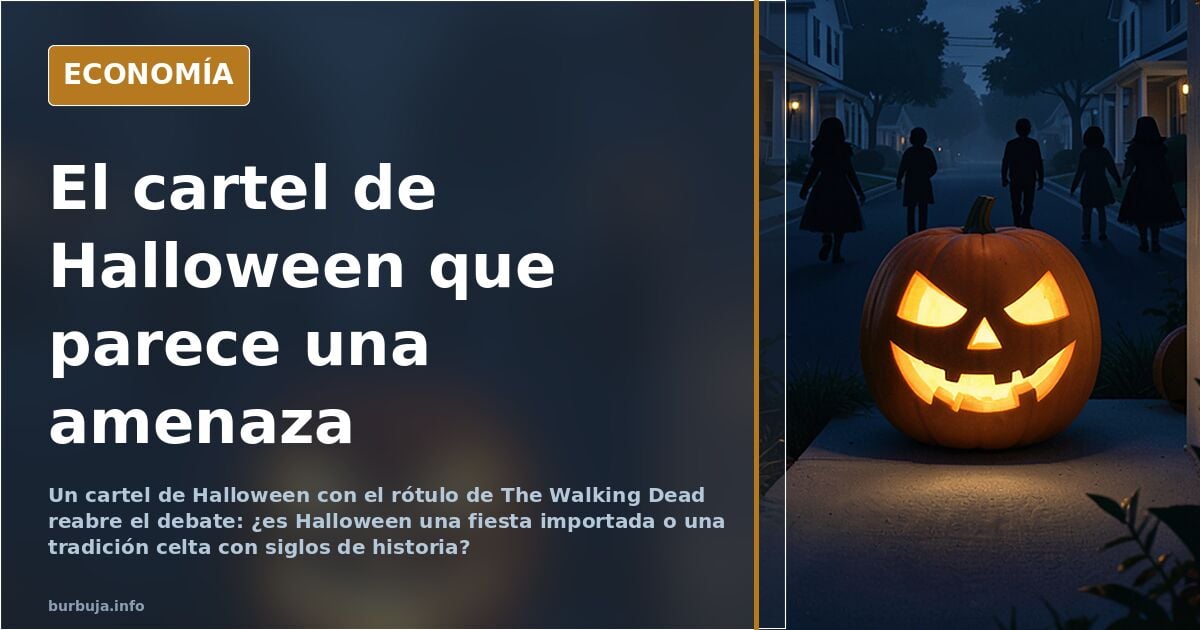
A resident spends 180 euros on Halloween decorations at a Chinese-owned discount store, according to one user's account. Another wonders whether people have lost their minds or whether he is the odd one out. Between the anecdote and the anger, the underlying discussion is economic: what lies behind an imported holiday that moves money in throwaway plastic and once again fills shop windows and front porches this year. A photo of a door decorated with a quote from The Walking Dead sparks a debate mixing consumption, identity and tradition.
The spending is no small matter. 180 euros on items from a discount store to decorate a home for a couple of days is the figure that sums up the paradox: lots is bought, little is used and it all ends up in the bin. The conversation drifts towards the environmental impact of that ephemeral plastic and towards the profile of those who buy it, with descriptions that blend the economic and the personal. The holiday is linked to a consumerism that makes no distinction between classes, but that preys on the wallet of anyone looking for an escape.
From Celtic origins to the costume business
The thread splits between those who defend Halloween as a holiday of Celtic origin, historically celebrated in Galicia, Ireland or Brittany, and those who see it as a product imported from the United States. The former argue that the original tradition honoured the dead and that the current version is a layer of consumerism over a spiritual core. The latter reply that the holiday as practised today is satanic or empty, and has nothing to do with its European roots.
The argument heats up when comparisons are drawn with the Christian antiestéticast of All Saints' Day. Some point out that both celebrations share an origin and that the Church merged them at some point. Against that, the harshest criticism says Halloween trivialises death and teaches children that terror is fun. The counterpoint comes from those who argue that society needs outlets and that leisure does not have to be edifying.
Plastic spending and the environmental footprint
The 180-euro figure is no isolated case. The conversation mentions the mass purchase of plastic items that are used for two days and end up in a landfill. It is the hidden cost of a holiday measured in euros but also in waste. The irony appears when it is compared with the autumn decoration of American movie houses: what looks natural there is seen as an eyesore in certain neighbourhoods here.
The profile of the buyer also comes up. People are described as seeking to escape a complicated reality with flashy decorations. The criticism turns acidic towards those who spend without restraint while their personal situation is precarious. It is the old tension between identity-driven consumption and disposable income, with plastic as the symbol of a broader malaise.
The cultural clash that never ends
The holiday has become a cultural battleground. Some see in Halloween an Anglo-Saxon imposition that displaces local traditions, while others respond that traditions evolve and that banning a holiday makes no sense. The discussion about Celtic origins blends with the defence of what is native and with criticism of the consumerism that invades everything.
Underneath lies a question of identity. Halloween is associated with an imported lifestyle, with plastic decorations and English-language slogans. Against that, the sobriety of local traditions is championed, though there is no shortage of people who point out that many of those traditions were imported in their day too. The debate remains open: every October the same argument returns, with more lights and more plastic.
Spending on Halloween decorations has become yet another indicator of the tug-of-war between consumption and tradition. While some see a fun holiday, others see a business that feeds on plastic and a borrowed identity. The photo of the door with the quote from The Walking Dead is just the anecdote that opens a debate that goes far beyond a pumpkin.
Also available in: Deutsch
Summary of a discussion on Burbuja.info - Foro de economía, actualidad y política., translated from Spanish and reviewed before publication. Read the full discussion (182 replies).
More summaries
-
WhatsApp and TikTok calls to burn streets ahead of Halloween
Anonymous calls on WhatsApp and TikTok summon riots and looting in Valencia and Madrid for Halloween, gathering over 600 members in less than 24 hours.
-
Blocus: police on alert over Halloween looting calls spread on social media
According to press reports, Blocus is allegedly organizing looting in Madrid and Barcelona for Halloween. The phenomenon of anonymous online call-outs...
-
Man sentenced to 4.5 years for slaughtering girlfriend's rabbit
A Valencia court sentences a man to 4.5 years in prison for killing, cooking, and forcing his girlfriend to eat her rabbit.
-
The psychological toll of precarity: money is a daily obsession for 7 in 10 Spaniards
69% of Spaniards think about money every day and 36.4% cannot cope with an unexpected expense, according to the INE. Financial stress weighs more than income.
-
Feeling Basque without speaking Basque: the language reproach
A woman identified as Peruvian says she does not feel Spanish, and the backlash focuses on her language and her surnames.
-
Penthouses: the premium and the problems the brochure leaves out
A debate on whether the penthouse premium is justified: same-batch finishes, roof leaks, summer heat and higher insurance premiums due to burglary risk.