
Blocus: police on alert over Halloween looting calls spread on social media
According to press reports, Blocus is allegedly organizing looting in Madrid and Barcelona for Halloween. The phenomenon of anonymous online call-outs...
English · Original discussion in Spanish · Published
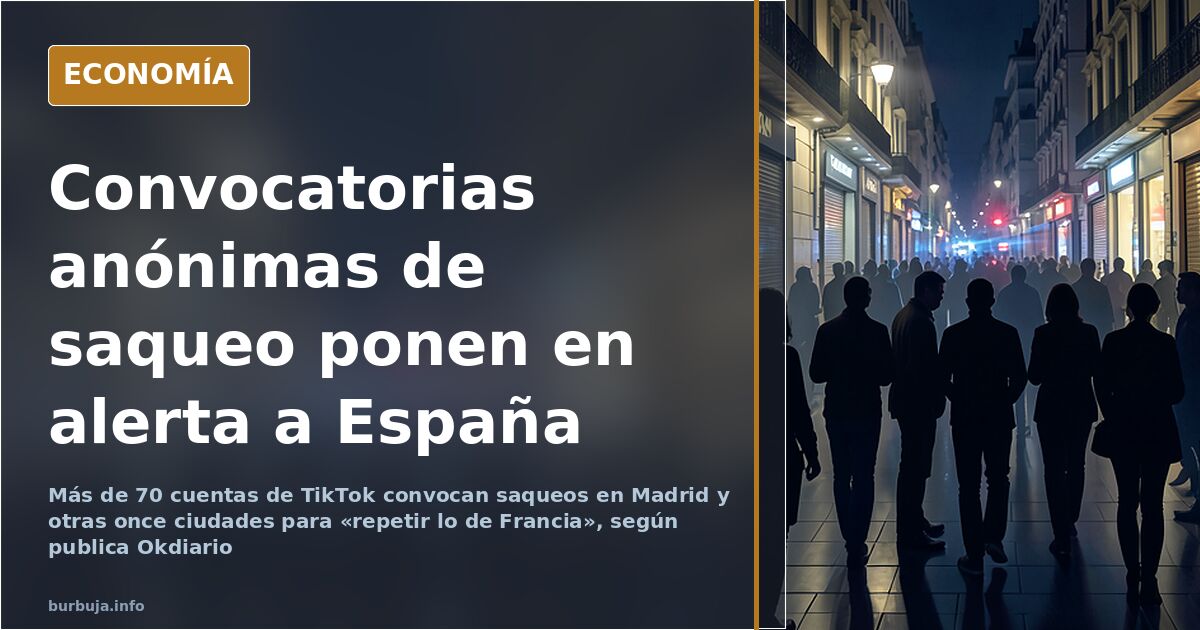
Blocus: the uprising that arrives via social media before Halloween
October 2025. Halloween night in Madrid and Barcelona is being met with a reinforced police presence. According to press reports, the radical collective calling itself Blocus is allegedly organizing a coordinated uprising with looting in the streets of both cities, a call-out that has triggered government surveillance in a context of riots in France and political tension in Spain. The question is who is behind these anonymous call-outs which, in just a few days, have gone from circulating on social media to mobilizing thousands of people in Milan, Barcelona and Bilbao.
The name is no coincidence. Blocus evokes the French bloquons tout, the protest slogan born on social media that Italian extremists copied and that is now being replicated in Spain. The mechanics are always the same: a message generated by artificial intelligence, with no face or signature, calling for action in a specific city. In Milan, Piazza del Duomo was the scene of riots that led Meloni's government to create a new crime of violent participation in demonstrations, with prison sentences of up to five years. In Barcelona, the head of the Mossos (Catalan police force) described the dynamics of the riots as "quite inexplicable", with looting of shops filmed from inside.
Who is behind Blocus?
The hybrid war theory is gaining ground in the analyses circulating. If the electorate assumes the system is fragile and ungovernable, programmatic debate is nullified and the visceral polarization of "us or chaos" takes over. That is the thesis held by those who see Blocus as a covert operation to influence the electoral process, with the added racial undertone that certain parties could exploit. Prime Minister Pedro Sánchez himself attributed the Barcelona riots to "pure vandalism instigated from social media" and confirmed 128 arrests who will answer to justice.
Other analyses point in a different direction. Some argue that the anonymous call-outs are nothing more than the latest link in a destabilization strategy that feeds off the economic crisis and social discontent. The timing with the protests in France against the cost of living, with curfews and thousands of arrests, reinforces the hypothesis of a transnational phenomenon spreading through algorithms. The debate over whether it is foreign interference or simple social contagion remains open.
The riots' calendar: from Milan to Barcelona
The sequence is revealing. First Milan: riots in the city center, a new crime, a hard line. Then Barcelona: looting, arrests, left-wing politicians singled out by the government. Now Madrid and Barcelona on Halloween. For those who see a pattern, the coincidence is no accident: always in autumn, never in August. When the cold sets in, the riots move from the seafront to the shopping district, and the looting targets mobile phone stores and luxury shops.
The institutional response also trinc a pattern. Sánchez's government has promised "zero tolerance for the violent", while the opposition demands to know who is in charge of the riot police and why no one is being held accountable. At the heart of it all lies an uncomfortable question: is this the government that maintains an illegal encampment in Sol under the pretext of protest, the one that calls a general strike against the opposition three days before the elections, and now it turns out the far right is behind the riots? The contradiction, at the very least, deserves an explanation.
The economics of looting: who profits from chaos?
Beyond the political noise, there is an economic calculation that rarely gets made. Every night of riots destroys local businesses, drives away tourism and raises insurance costs for shops. Looting is not an act of protest: it is a transfer of wealth from small shopkeepers to insurance companies and the large groups that can afford private security. In Barcelona, videos of looting filmed from inside the stores show a modus operandi that has little that is spontaneous about it.
The question hanging in the air is who is funding these call-outs. The legal logic of cui bono points to those who benefit from antiestéticar: those who sell security, those who profit from the law-and-order discourse, those who need the system to seem ungovernable to justify their own existence. If the electorate assumes chaos is the norm, the protest vote becomes the only rational option. And there, every player has something to gain.
Halloween: the night that could change the narrative
The call-out for Halloween in Madrid and Barcelona is the acid test. If the looting happens, the government will have to choose between a hard line and the discourse of tolerance. If it doesn't happen, the question will be who leaked the alert and with what aim. In any case, the narrative is already built: antiestéticar sells, and social media is the best megaphone.
Meanwhile, public conversation is filled with theories about intelligence services, foreign interference and assorted conspiracies. Some have substance; others are pure noise. What is clear is that the Blocus phenomenon is here to stay, and that the next election will also be fought on the streets. The question is not whether there will be riots, but who will be watching them and what they will do with the footage.
Also available in: Deutsch
Summary of a discussion on Burbuja.info - Foro de economía, actualidad y política., translated from Spanish and reviewed before publication. Read the full discussion (123 replies).
More summaries
-
WhatsApp and TikTok calls to burn streets ahead of Halloween
Anonymous calls on WhatsApp and TikTok summon riots and looting in Valencia and Madrid for Halloween, gathering over 600 members in less than 24 hours.
-
Iryo train alerted Adif to LZB signal failure 10 minutes before AVE crash
The Iryo train notified Adif at 8:38 that it had stopped due to an LZB signalling failure. At 8:48, Renfe's AVE 6076 rammed into it at over 100 km/h.
-
Spain's PSOE threatens to challenge the election result if it loses
Spain's PSOE has reportedly laid the groundwork to challenge the November 29 election if it loses, but the legal mechanism requires specific grounds and deadlines that do not match its plans.
-
Sánchez and the jinx narrative: from housing to pensions
A 10 billion euro loan to pay pensions and the Barcelona riots test the jinx narrative and the November 29 campaign
-
Detainees' profile reopens Spain's migration debate
Most of those arrested in the riots are second-generation Spaniards with Moroccan parents, a pattern mirroring France's and reopening the migration debate.
-
Spain's Podemos drops its logo, runs on 'Irene' alone for 29N election
Podemos has removed its name and logo from its 29N ballot in Spain: only 'Irene' and the slogan 'Peace, housing and work' remain. Housing and the cost of living dominate its programme.