
Halloween in Spain: fewer kids in costume, fewer sweets
Residents report fewer costumed children and doorbells that never rang; some blame the mourning after the train crash and the cost-of-living crisis.
English · Original discussion in Spanish · Published
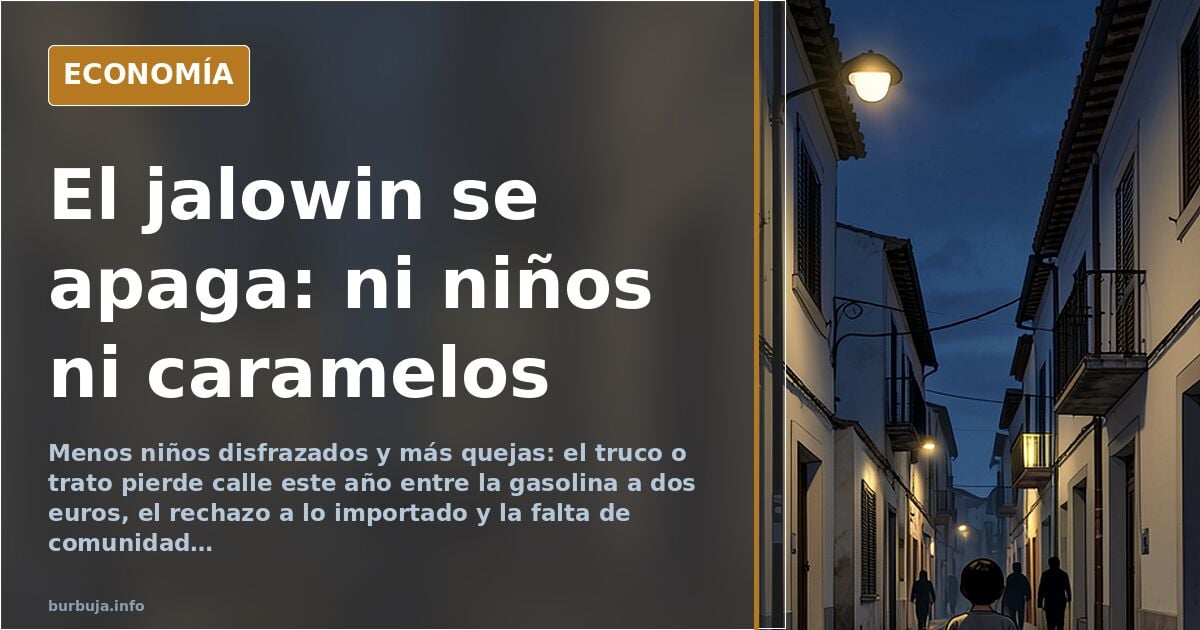
Street Halloween fades in 2025: fewer kids and more pumpkins next to the nougat
The night of October 31 left a scene many residents could not remember: unadorned lobbies, doorbells that never rang, and groups of kids who, when they did knock, found the supermarket cashier saying she had no sweets. The imported, increasingly questioned phenomenon ran this year into a wall of reasons ranging from the national mourning for the train crash to plain lack of money. The most common complaint on the street is not ideological: as one participant put it, there's damn near no money at all, and with petrol at two euros a litre, the party is celebrated with pasta and canned tomato.
What has changed, according to several forum users, is the format. Costumes have moved from the neighbourhood to the shopping centre, and events have been moved to the morning. Anyone who went out at 6 p.m. found the children had vanished. The party is no longer on the street: it happens where there is heating and CCTV.
Mourning, the train and antiestéticar of unrest
The first explanation is the calendar. This year October 31 fell in a week marked by the train crash and an atmosphere of mourning that led some municipalities to cancel festivities. Add to that the memory of earlier disturbances, which has led many parents to keep their children indoors at night. The result is a half-hearted celebration, with fewer decorated houses and less of a show.
Some see in this retreat a sign of sanity. The party, they say, has been drained of meaning and only the noise is left. Others argue the opposite: that people are fed up with a tradition that was never theirs, and the economic crisis has done the rest. In the end, both camps agree on what matters: street Halloween has run out of children.
From the lobby to the shopping centre: the party's new map
The pattern repeats in towns and cities, according to the accounts gathered. Housing estates that once organised lobby-to-lobby routes have started warning that only households leaving a sign on the door take part, a way of not bothering those who opt out. In large blocks, the only children in the building are those of one flat, and older residents decorate out of nostalgia, not conviction.
Retailers, however, have not given up on the party. Shopping centres have filled with costumed families in the morning, and supermarkets have placed pumpkins next to the nougat. It is proximity Americanisation: less street, more shop window. The party survives where there is business.
How much does celebrating Halloween in Spain cost?
The economic variable appears in almost every explanation. With petrol at two euros a litre, as one forum user notes, the alucinación to the shopping centre is already an expense. Costumes, sweets and decorations compete with the weekly shop, and in many households the priority is elsewhere. The party has become a minor luxury for families counting every euro.
There is no full breakdown in the debate of what a child's costume, a bag of sweets and lobby decorations cost, but the general impression is that the budget alone explains why so many doorbells never rang. It is not just ideology: it is budget.
The culture war: between tradition and the shop window
The backdrop is cultural. Some defend a return to honouring the dead and celebrating All Saints' Day as an antidote to the imported party. Others point out that the puritans who once persecuted such celebrations were hardly a model of tolerance. And some note that it is schools themselves that push the party, while retailers cash in on it.
The question left hanging is not whether Halloween disappears, but where it is celebrated. The street loses; the shopping centre wins. And meanwhile, the children who did knock found the cashier at Ahorramás saying she had nothing. Trick or treat, but with no treat.
Also available in: Deutsch
Summary of a discussion on Burbuja.info - Foro de economía, actualidad y política., translated from Spanish and reviewed before publication. Read the full discussion (97 replies).
More summaries
-
Daycare staff fired instantly after viral video shows child abuse
Outrage erupts after a viral video reveals childcare abuse, sparking debates on work-life balance and daycare standards.
-
Everyday homophobia that starts in the park
A joking comment about two four-year-old boys provokes rejection even among progressive parents: everyday homophobia still operates in childhood.
-
WhatsApp and TikTok calls to burn streets ahead of Halloween
Anonymous calls on WhatsApp and TikTok summon riots and looting in Valencia and Madrid for Halloween, gathering over 600 members in less than 24 hours.
-
Vicente Fuentes: from a million views to 10,000 and a month without posting
From 700,000 subscribers to 10,000 views and a month without posting: the economic and personal ruin of YouTuber Vicente Fuentes.
-
Prosecutors seek 40 years in prison and €3.6 million over Spain Bar hoax
Spanish prosecutors are seeking 40 years in prison and 3.6 million euros from the author of the Spain Bar hoax. The case reopens the debate over proportionality of the sentence and the…
-
The thesis blaming AI for shutting most people out of the system
The argument that AI merely accelerates a pre-existing design: eugenics by incentives, falling birth rates and the parallel with Constantine are the focus of the analysis