
Half of Spain is Overweight: 1-Euro Oatmeal Isn't the Fix
Half of Spaniards have overweight, yet 1kg of oats costs just 1 euro. Long working hours leave little time for cooking, worsening the obesity crisis.
English · Original discussion in Spanish · Published
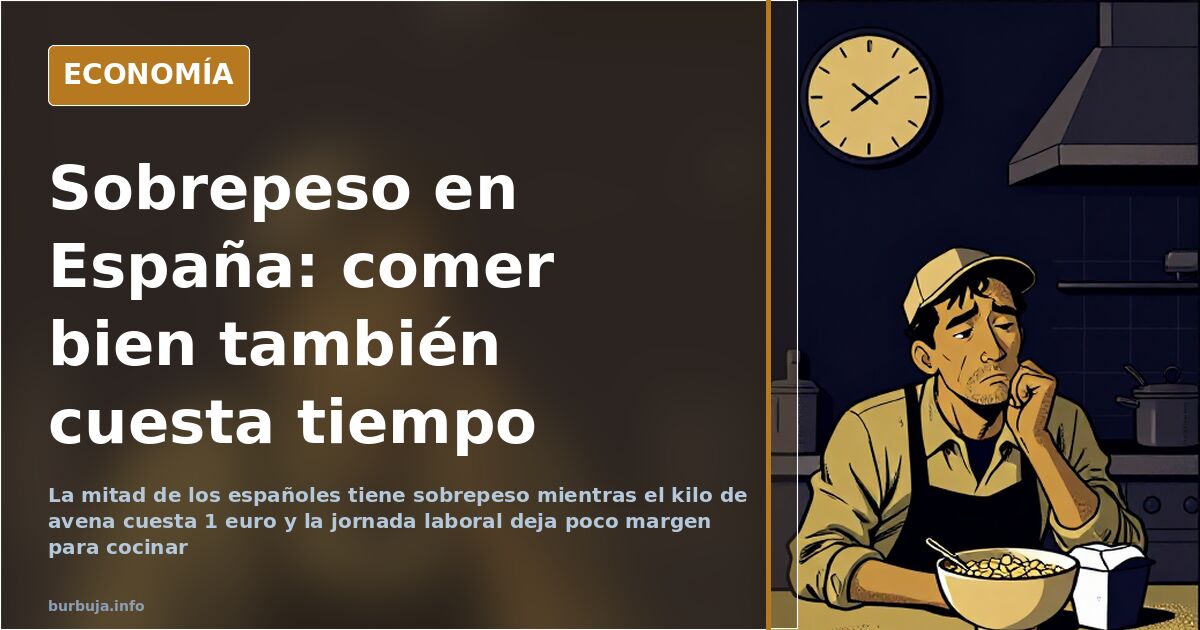
Half of Spain is overweight, and 1kg of oats costs 1 euro
A shopper notes that a 1kg bag of oats costs just 1 euro in a supermarket. This domestic detail clarifies the starting point: half of Spaniards are overweight, a condition linked to type 2 diabetes, hypertension, and cardiovascular issues, which reduces quality of life and increases healthcare costs.
The diagnosis highlights two causes. First, the shift from the Mediterranean diet to ultraprocessed foods high in saturated fats, sugar, and salt. Second, sedentary lifestyles driven by office jobs, screens, and car commutes. The proposed solution involves nutritional education, bike lanes, parks, junk food taxes, and subsidies for fresh products. On paper, it is flawless. In practice, someone would have to cook all of that.
Cooking well requires time that the workday has consumed
Here lies the first clash. Much of the analysis argues that the Mediterranean diet is not just a menu, but a logistics exercise: visiting multiple stores, navigating butcher, fish, and produce sections, buying fresh items that expire in two days, cooking, and cleaning. Unpaid work requiring hours. And hours, with twelve-hour shifts, do not appear.
The consequence is known: carts fill with ready-made meals, and the microwave is used. From there, calling for bike lanes against obesity seems like a joke when the problem is that no one arrives home with the energy to light a fire. Similar skepticism applies to public policies: some argue that reasonable hours and local commerce would do more than any subsidy. Others add a cultural factor often overlooked: almost all celebrations in Spain revolve around a heavy meal, and daily anxiety is soothed with sugar and flour. Eating poorly is not just about ignorance; it is also about being tired and stressed.
The calorie narrative falls short: leptin, insulin, and cortisol
Against the dogma of counting calories—the ‘chickens go in what goes out’ logic—appears a more physiological explanation. The circulating thesis: the problem is not just how much one eats, but when and with what hormonal rhythm. Disrupted circadian rhythms from screens and late dinners may cause leptin resistance, and in turn, insulin resistance. The body accumulates fat even if intake is not excessive.
From this, concrete recipes emerge. One: order food by macronutrients, first proteins, then fats, and carbohydrates last. Another: reduce carbohydrates to avoid insulin spikes, with the warning that prolonged fasting raises cortisol and complicates sleep after the third day. And a third, simpler one: NEAT, non-exercise activity thermogenesis, which adds up more than any gym session. Walking, taking the stairs.
The cited case does not step into a gym. It reached 105 or 110 kilos at university—sitting all day, fast food—and by cutting bread, sweets, and midday snacks, marked 87 in the past Christmas, now 82, and wants to stop at 79 to not look too skinny. Another tried eating only meat for months, lost kilos, and felt something was missing.
Eating well is also a matter of income
The third axis is economic. The argument: when the paycheck does not stretch, the grocery basket is cut. And cutting means swapping meat, fish, fruit, and vegetables for cheap carbs and prepared items high in salt and sugar. With this base, gaining weight requires very little neglect. Three centuries ago, being fat was a sign of wealth; today, it signals the opposite.
The rebuttal does not deny the problem but limits it: in Spain, eating moderately well is not extremely expensive, and oats are 1 euro per kilo. The difference between some and others lies in organization and consistency, not just the wallet. What almost everyone admits is that the habit of buying and cooking has been lost in a generation.
The unsettling data
While official alarms insist on weight as a public health issue, a data point slips through the sustancia ilegal: according to a cited study, the lowest mortality is recorded in the BMI range of 25 to 30, exactly that of so-called overweight. The paradox complicates with the memory of medical discourse itself: blue fish was cholesterol and today is a panacea; fat was the enemy and now carbohydrates are. Each decade rewrites the menu. The only constant is that half of Spain remains overweight while the 1kg bag of oats waits on the shelf.
A shopper notes that a 1kg bag of oats costs just 1 euro in a supermarket. This domestic detail clarifies the starting point: half of Spaniards are overweight, a condition linked to type 2 diabetes, hypertension, and cardiovascular issues, which reduces quality of life and increases healthcare costs.
The diagnosis highlights two causes. First, the shift from the Mediterranean diet to ultraprocessed foods high in saturated fats, sugar, and salt. Second, sedentary lifestyles driven by office jobs, screens, and car commutes. The proposed solution involves nutritional education, bike lanes, parks, junk food taxes, and subsidies for fresh products. On paper, it is flawless. In practice, someone would have to cook all of that.
Cooking well requires time that the workday has consumed
Here lies the first clash. Much of the analysis argues that the Mediterranean diet is not just a menu, but a logistics exercise: visiting multiple stores, navigating butcher, fish, and produce sections, buying fresh items that expire in two days, cooking, and cleaning. Unpaid work requiring hours. And hours, with twelve-hour shifts, do not appear.
The consequence is known: carts fill with ready-made meals, and the microwave is used. From there, calling for bike lanes against obesity seems like a joke when the problem is that no one arrives home with the energy to light a fire. Similar skepticism applies to public policies: some argue that reasonable hours and local commerce would do more than any subsidy. Others add a cultural factor often overlooked: almost all celebrations in Spain revolve around a heavy meal, and daily anxiety is soothed with sugar and flour. Eating poorly is not just about ignorance; it is also about being tired and stressed.
The calorie narrative falls short: leptin, insulin, and cortisol
Against the dogma of counting calories—the ‘chickens go in what goes out’ logic—appears a more physiological explanation. The circulating thesis: the problem is not just how much one eats, but when and with what hormonal rhythm. Disrupted circadian rhythms from screens and late dinners may cause leptin resistance, and in turn, insulin resistance. The body accumulates fat even if intake is not excessive.
From this, concrete recipes emerge. One: order food by macronutrients, first proteins, then fats, and carbohydrates last. Another: reduce carbohydrates to avoid insulin spikes, with the warning that prolonged fasting raises cortisol and complicates sleep after the third day. And a third, simpler one: NEAT, non-exercise activity thermogenesis, which adds up more than any gym session. Walking, taking the stairs.
The cited case does not step into a gym. It reached 105 or 110 kilos at university—sitting all day, fast food—and by cutting bread, sweets, and midday snacks, marked 87 in the past Christmas, now 82, and wants to stop at 79 to not look too skinny. Another tried eating only meat for months, lost kilos, and felt something was missing.
Eating well is also a matter of income
The third axis is economic. The argument: when the paycheck does not stretch, the grocery basket is cut. And cutting means swapping meat, fish, fruit, and vegetables for cheap carbs and prepared items high in salt and sugar. With this base, gaining weight requires very little neglect. Three centuries ago, being fat was a sign of wealth; today, it signals the opposite.
The rebuttal does not deny the problem but limits it: in Spain, eating moderately well is not extremely expensive, and oats are 1 euro per kilo. The difference between some and others lies in organization and consistency, not just the wallet. What almost everyone admits is that the habit of buying and cooking has been lost in a generation.
The unsettling data
While official alarms insist on weight as a public health issue, a data point slips through the sustancia ilegal: according to a cited study, the lowest mortality is recorded in the BMI range of 25 to 30, exactly that of so-called overweight. The paradox complicates with the memory of medical discourse itself: blue fish was cholesterol and today is a panacea; fat was the enemy and now carbohydrates are. Each decade rewrites the menu. The only constant is that half of Spain remains overweight while the 1kg bag of oats waits on the shelf.
Also available in: Deutsch
Summary of a discussion on Burbuja.info - Foro de economía, actualidad y política., translated from Spanish and reviewed before publication. Read the full discussion (224 replies).
More summaries
-
Low-carb diet may reverse type 2 diabetes: clinical reality or symptom control?
Analysis of type 2 diabetes data: Can cutting carbs to minimums reverse it in weeks, or is it merely symptom management?
-
Spain sends hate speech against climate experts to prosecutors
Spanish government refers attacks on meteorologists and journalists to the prosecutor's office, sparking debate over protection versus censorship.
-
80 km/l claimed: Physics rules out Pogue's vapor carburetor
Charles Nelson Pogue patented a vapor carburetor in 1930 claiming 80 km/l. Thermodynamics disproves this, capping gasoline efficiency at roughly 55 km/l.
-
Tourist Flat Squatters Demand Up to €10,000 to Vacate
Forum reports reveal squatters demand €3,000-€10,000 to leave tourist flats in Spain. Overburdened courts and organized gangs worsen the crisis.
-
Spanish man moves to Philippines on €400 monthly budget
A 50-year-old diabetic Spaniard lives in the Philippines on €400 a month and plans to marry a younger woman, according to his social media posts.
-
Forum claims Spanish women in their 40s seek wealthy partners
A forum thread argues that single women aged 30-40, facing financial precarity after years of spending, are returning to shared housing and seeking partners with assets.