
Hake heavily infested with anisakis: customer claims half was parasite
A customer found their hake mostly infected with anisakis and faced supermarket refusal to provide a complaint form.
English · Original discussion in Spanish · Published
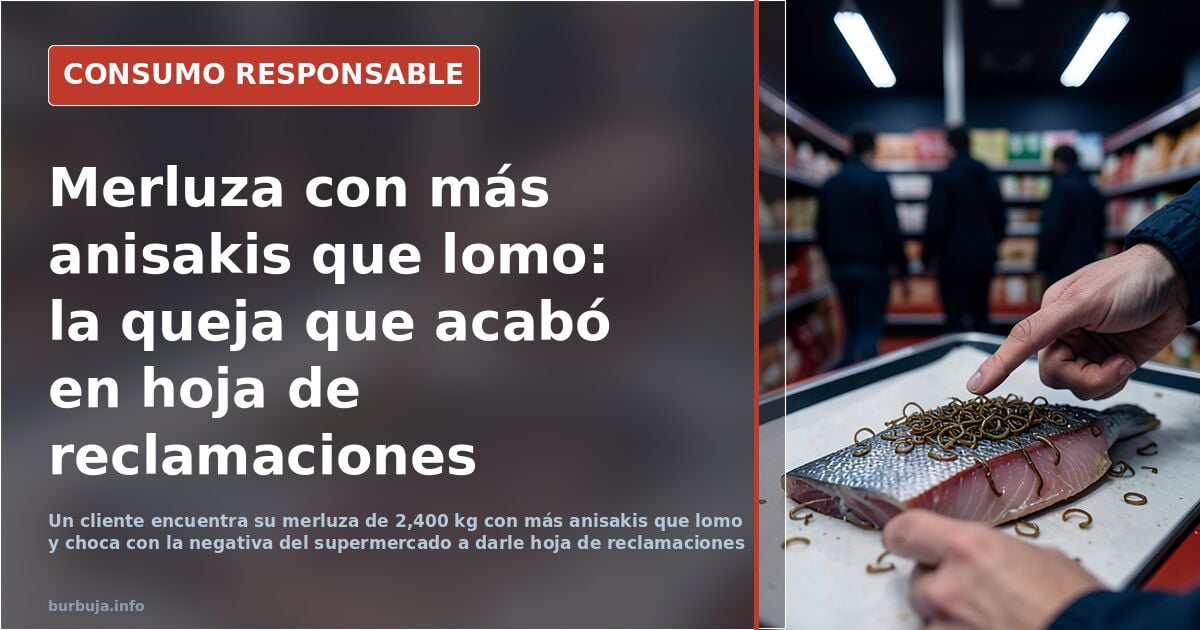
Hake with more parasite than flesh: the complaint that escalated
A customer bought a 2.400 kg hake at a fish counter in a supermarket chain originating from Asturias. Upon opening it at home, they claimed half the product on the cutting board was not fish but parasite. They returned to the store. According to their account, staff replied that anisakis "comes included" and all hakes have it. When asked for a complaint form, they were told company policy forbids taking it out of the premises.
What started as an angry consumer rant uncovered a broader debate: how common is anisakis in fresh fish, and where is the line between acceptable presence and illegal sale?
What is anisakis and why it appears in hake
Anisakis is a parasite living in fish viscera that migrates to muscle tissue after death. Hake, tuna, and bonito are common hosts. The prevailing view is that **there is no Cantabrian hake without anisakis**, a trend increased by warming waters. Some see it as a provenance marker: if it's Galician or Cantabrian, the parasite is guaranteed.
The key distinction is between having parasites and being heavily infested. Finding one worm while cleaning is unpleasant but frequent; having a fillet described as "more anisakis than healthy white flesh" is different. Spanish Royal Decree 1437/1992 mandates visual control and prohibits selling **heavily parasitized** fish. The question remains: who defines this threshold, and can a local fishmonger realistically reject such a piece?
Freezing, cooking, and lingering antiestéticar
Technically, freezing fish for **48 hours at -18°C** eliminates risk, as does high-temperature cooking. Industrially frozen fish arrives free of live parasites. Everyone agrees on this. However, dead worms remain, which is unappetizing. Additionally, allergic reactions to anisakis—live or dead—are reportedly increasing, with cases of widespread hives after consumption.
Rarely applied advice includes thoroughly scraping the belly area before cooking. Another concern is that much "fresh" fish sold in shops has been previously frozen, casting doubt on the "fresh" label.
Price, weight, and the complaint form
Beyond the parasite, the buyer complained about value: paying for **2.400 kilos** but receiving less than one kilo of sliced meat. Head and bones don't explain the discrepancy, they argue. The core issue wasn't just the anisakis but the lost product. This hit a bureaucratic wall: the complaint form couldn't leave the store, and online resolution processes in their region proved ineffective.
This mirrors other experiences, like fish costing **€18 per kilo** smelling so bad upon cooking it was discarded. Shops often keep fish under mist and ice, resembling intensive care units. Advice: check gills—red means fresh, pale means shop elsewhere.
Beyond worms: mercury, farming, and distrust
The discussion expanded to skepticism about fish safety. Heavy metals came up, citing a case where mercury accumulation led to bans on shark, swordfish, anchovy, mackerel, and bivalves. Radioactivity concerns and debates over farmed fish (criticized for feed quality and taste loss) also appeared. In contrast, small fish like **sardines and octopus** are defended as cheaper, richer in omega-3, and lower in toxins.
Some highlight long-chain omega-3 as fish's main nutritional benefit, hard to get elsewhere. Others suggest lab-certified supplements suffice. The consensus: fish remains recommended but demands careful selection.
Who answers when parasites reach the plate?
Responsibility is fragmented. Fishmongers call it normal. Chains block complaint forms. Customers switch stores. Meanwhile, hospitality regulations mandate serving pre-frozen fish to prevent this exact issue. Thus, bars comply while neighborhood fish counters selling "fresh" take the risk. Next time a hake is mostly parasite, it won't be an anecdote but proof that visual controls only work when someone actually looks.
Also available in: Deutsch
Summary of a discussion on Burbuja.info - Foro de economía, actualidad y política., translated from Spanish and reviewed before publication. Read the full discussion (55 replies).
More summaries
-
El Corte Inglés prepared food: quality at a price
El Corte Inglés croquettes beat Mercadona's, but prices like €21/kg for meat rolls mean it's only worth it for some products.
-
Cheap clothes in physical stores: Primark, Kiabi and El Corte Inglés outlets
Primark, Kiabi, Lefties and El Corte Inglés outlets: a guide to buying cheap clothes in physical stores, and why cost per wear changes the calculation
-
Customer reports live anisakis in hake at Madrid Alcampo
A customer reported finding live anisakis up to 3cm long in hake purchased from an Alcampo store in Madrid. The chain offered a refund.
-
Carlos and Fernando Paz: Where to Listen to the Brothers
Carlos and Fernando Paz share a voice but no single show. Find their podcasts on YouTube, iVoox, and radio stations.
-
Parálisis Permanente’s Yo no: An Animal Fable on Conformity
Pigs, cows, and rats in Parálisis Permanente’s lyrics depict social conformity, not empty punk provocation.
-
Timing Belt: Replace by Age or Mileage?
Timing belts need replacement every 80,000-120,000 km or five years. For low-mileage cars, age is the main risk factor.