
Parálisis Permanente’s Yo no: An Animal Fable on Conformity
Pigs, cows, and rats in Parálisis Permanente’s lyrics depict social conformity, not empty punk provocation.
English · Original discussion in Spanish · Published
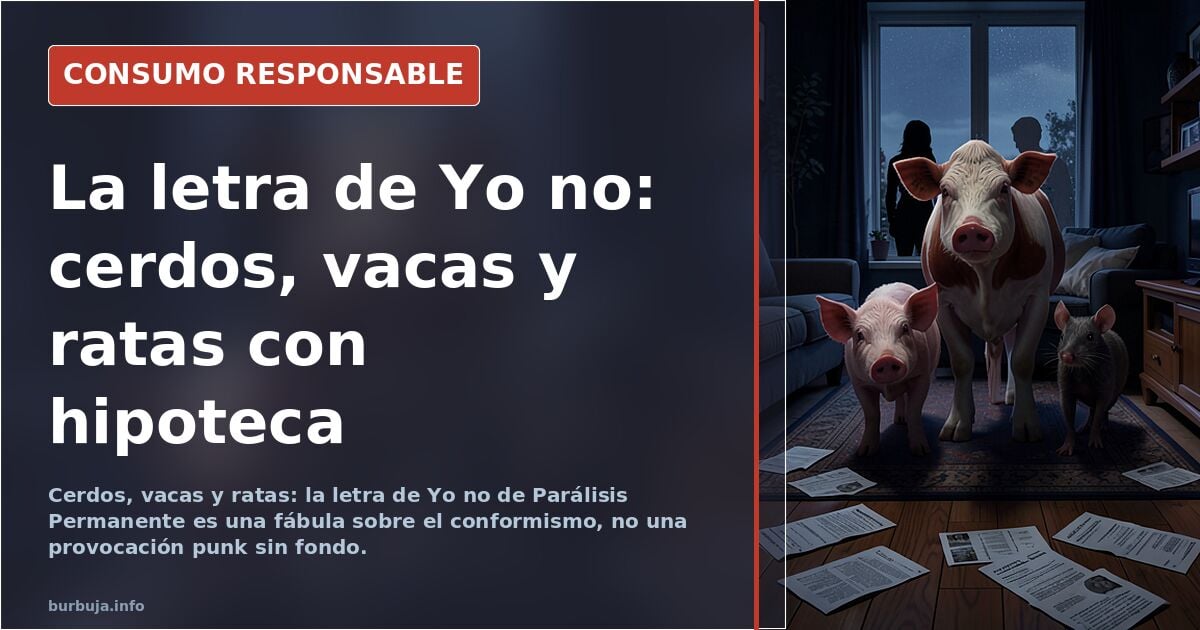
Yo no by Parálisis Permanente: The True Meaning of the Lyrics
A handful of domestic animals and a phrase repeated like a hammer. The lyrics of Yo no, written by Eduardo Benavente and Nacho Canut, function as an inverted fable: instead of a sarracena, they offer an acidic portrait of Spain settling into complacency. The prevailing interpretation is clear: pigs, cows, and rats are not fauna, but human types. And the chorus is not a whim; it is the answer of those who do not think.
Which Animals Appear in the Lyrics of Yo no
The text uses bestiary to classify behaviors. “There are pigs, there are cows/rats living in houses” points to bourgeois and routine life, to the masses settling in their living rooms with no horizon beyond comfort. It is not a critique of the countryside or farming: it is a critique of the sofa.
The second layer is more uncomfortable. “Pigs do not think, they have no defenses” describes voluntary ignorance, that of those who accept what they are given without questioning it. The lyrics do not speak of victims, but of accomplices through convenience. This is the twist that separates it from simple punk provocation.
Context: Who Wrote Yo no and Why
The shared authorship between Benavente and Canut places the song at the intersection of Madrid afterpunk and a social gaze that does not remain in nihilism. The animal fable was an old device—thanks to Orwell—but here it is used without epic scale: there is no farm rebellion, only domestic resignation.
A detail many overlook is that one of Benavente’s greatest influences was a book about ghosts, The Turn of the Screw, gifted by a boarding school companion who was afraid to finish it. A singer citing Henry James as a reference rather than a pile of records. This also explains the taste for the uncanny that runs through his work.
Generational Reading: Provocateurs Without Instruments
The conversation drifted toward judgments about the era. Some argue that that generation sold itself as a rupture without even mastering their instruments, and time has buried most of those names. Opposing this is the counter-argument: Benavente, Berlanga, Canut, Urrutia, Auserón, or Antonio Vega remained one step above the rest, with or without virtuosity.
The traffic accident that took Benavente enters the conversation as what it was: an early death that prevented seeing how La Movida became official nostalgia. Better so than seeing it now like Miguel Ríos or Alaska, summarizes one current. It is bitter irony, not celebration.
Lyrics as Mirror: Those Who Do Not Think, Obey
The chorus, that repeated “yo no” (I don’t), is the piece that closes the meaning. It is not a refusal to participate: it is the realization that the conformist does not participate either, they just occupy space. The fable does not point to the powerful, but to those who let themselves be carried along and call that life.
The connection to the literary tradition of despising the automaton—from Artaud to Valente—appears even in the conversation: those who master language and believe in the heights of the soul are, also, pigs. Parálisis Permanente’s lyrics did not invent that tradition. They translated it into three chords.
Is it still a critique of the masses, or has it become, over the years, a museum piece that no one listens to attentively anymore?
Also available in: Deutsch
Summary of a discussion on Burbuja.info - Foro de economía, actualidad y política., translated from Spanish and reviewed before publication. Read the full discussion (33 replies).
More summaries
-
Miguel Ríos and responsible consumption: paying to be insulted?
Spanish singer Miguel Ríos has criticised his own audience for attending his concerts. Is it responsible consumption or a provocation? The debate is on.
-
Antonio Romero's free energy generators: blueprints with no electrical schematic
The free blueprints for Antonio Romero's AR 3000 and AR 700 generators contain no electrical schematic at all, and the University of Córdoba does not certify the invention.
-
The heat is on: windows down or Alaska-style air conditioning?
Air conditioning or windows down? We break down which option uses less fuel and how it affects your car. Discover the truth behind this debate.
-
Lidl's frozen sardines at €3.90/kg vs. fresh ones
A kilo of frozen sardines costs €3.90 compared to €9-€10 for fresh ones in Madrid. The question is whether the flavor holds up after freezing.
-
Timing Belt: Replace by Age or Mileage?
Timing belts need replacement every 80,000-120,000 km or five years. For low-mileage cars, age is the main risk factor.
-
Hake heavily infested with anisakis: customer claims half was parasite
A customer found their hake mostly infected with anisakis and faced supermarket refusal to provide a complaint form.