
Hair Grows Back, Ink Doesn't: Anatomy of a Viral Haircut
A young woman shaves her head in a viral video, sparking debate on tattoos, generational identity, and the irreversible cost of ink.
English · Original discussion in Spanish · Published
Hair Grows Back, Ink Doesn't: Anatomy of a Viral Haircut
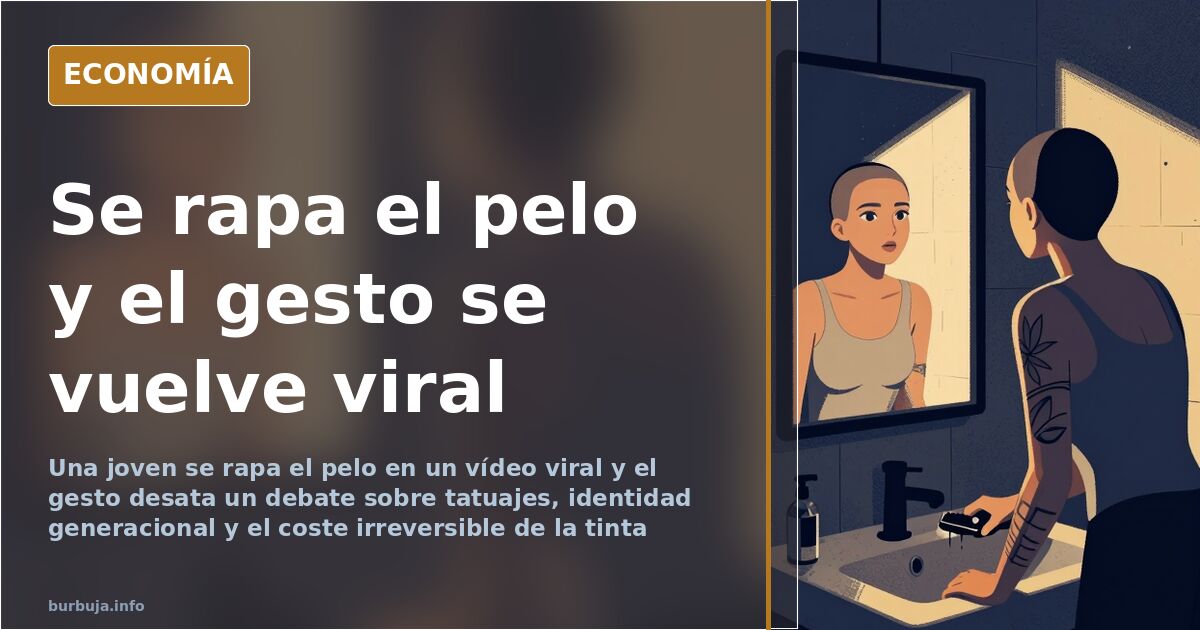
A young woman shaves her head in a video, crying as she does it, and the gesture becomes a viral phenomenon. The headline summarizing the reaction: "Finally proud of Spain." The sequence is simple — scissors, tears, a friend's hug — and the result, according to the sharpest readings, is a textbook case of how an entire generation has turned aesthetics into identity and identity into content.
The detail that disconcerts half of Spain isn't the shaving. It's what lies beneath. The protagonist shows arms and legs covered in black ink and, upon seeing the result, says she gets goosebumps. The irony writes itself: she gets goosebumps on a surface that is no longer skin, but a layer of tattoo that won't grow back.
What is a blackout and why has it become trendy
A blackout is the technique of completely covering a limb with black ink, usually when there is no free space left between previous tattoos. It was born as an aesthetic rescue resource: someone who had accumulated a whole arm of disconnected drawings decided to cover everything in black to start visually from scratch. The problem is that, like almost everything that starts as a solution, it has become a trend. Now there are people who directly tattoo black patches without having gone through the previous process, skipping the origin and the reason.
This explains the perplexity of many reactions. It's not the tattoo itself — anyone can do whatever they want with their body — but the combination of two contradictory gestures: covering oneself with ink until the skin is invisible and then lamenting the loss of white skin. Hair grows back; ink doesn't. That is the only asymmetry that matters in this whole story.
Crying as format: the attention economy
The video works because it trinc a recognizable script. First the announcement, then the crisis, then the revelation, and finally the hug from the consoling friend. It's a format, not an accident. And as a format, it replicates: there is a whole category of content built on the premise that showing vulnerability in public generates engagement.
The most cynical reading points to a deeper problem: a part of the younger generation has grown up without material problems to solve and has shifted the search for meaning to the realm of aesthetics and digital validation. Cutting hair, choosing a dress, or changing curtain colors become events. The opposing view argues that ridiculing a girl for crying in a video is gratuitous and that the phenomenon says more about those who consume it than about those who star in it.
In the middle of this clash of arguments, there is one fact that admits no discussion: the video has been shared until becoming a viral phenomenon. And that, in the attention economy, is the only metric that counts.
Accumulated energy in hair: when mysticism becomes an argument
The justification given by the protagonist for not wanting to cut her hair is that she had "many accumulated energies" there. The phrase has circulated more than the haircut itself. It is the market-stall version of New Age mysticism: concepts from Eastern traditions recycled as an excuse not to make decisions, or to make them and justify them afterwards.
The problem isn't the belief. It's the use. When spiritual vocabulary serves to explain anything — from a haircut to a breakup — it ceases to be a worldview and becomes a way of saying nothing. Leche is called "energy" in that jargon, and that ends the debate.
Why the gesture has been read as a national symptom
The headline leading this issue — "Finally proud of Spain" — is actually an irony. No one feels proud of a haircut. Behind it is a bitterer reading: the feeling that a country with centuries of history behind it has ended up exporting as a global phenomenon the video of a girl crying while shaving her head.
That reading connects with a broader malaise. Some argue that Spain has moved from exporting navigators and literature to exporting social media content, and that the comparison doesn't hold up well. The objection is reasonable: every era has its own symbols, and judging a generation by what it posts on TikTok is as unfair as judging it by what it watched on television. But the malaise exists, and the video has activated it.
The tattoo market: what grows when the skin runs out
There is an economic angle almost no one has looked at. A blackout is expensive. Covering a whole arm in black requires several sessions, ages poorly over time, and cannot be undone. In terms of consumption, it is a luxury product with an aesthetic expiration date: what is trendy today will be a burden in five years.
This creates a predictable secondary market. Those who get too many tattoos end up needing laser removal, which is more expensive than the original ink and doesn't always work. Skin has become an asset with embedded liabilities, and the bill arrives years later. No one says it in the video, of course. But it is there.
With these elements, the forecast is predictable: the video will be forgotten in weeks and the debate on generational aesthetics will repeat itself with the next viral phenomenon. What won't come back is the skin that is already gone. That, like hair, has its own logic — and admits no regrets.
A young woman shaves her head in a video, crying as she does it, and the gesture becomes a viral phenomenon. The headline summarizing the reaction: "Finally proud of Spain." The sequence is simple — scissors, tears, a friend's hug — and the result, according to the sharpest readings, is a textbook case of how an entire generation has turned aesthetics into identity and identity into content.
The detail that disconcerts half of Spain isn't the shaving. It's what lies beneath. The protagonist shows arms and legs covered in black ink and, upon seeing the result, says she gets goosebumps. The irony writes itself: she gets goosebumps on a surface that is no longer skin, but a layer of tattoo that won't grow back.
What is a blackout and why has it become trendy
A blackout is the technique of completely covering a limb with black ink, usually when there is no free space left between previous tattoos. It was born as an aesthetic rescue resource: someone who had accumulated a whole arm of disconnected drawings decided to cover everything in black to start visually from scratch. The problem is that, like almost everything that starts as a solution, it has become a trend. Now there are people who directly tattoo black patches without having gone through the previous process, skipping the origin and the reason.
This explains the perplexity of many reactions. It's not the tattoo itself — anyone can do whatever they want with their body — but the combination of two contradictory gestures: covering oneself with ink until the skin is invisible and then lamenting the loss of white skin. Hair grows back; ink doesn't. That is the only asymmetry that matters in this whole story.
Crying as format: the attention economy
The video works because it trinc a recognizable script. First the announcement, then the crisis, then the revelation, and finally the hug from the consoling friend. It's a format, not an accident. And as a format, it replicates: there is a whole category of content built on the premise that showing vulnerability in public generates engagement.
The most cynical reading points to a deeper problem: a part of the younger generation has grown up without material problems to solve and has shifted the search for meaning to the realm of aesthetics and digital validation. Cutting hair, choosing a dress, or changing curtain colors become events. The opposing view argues that ridiculing a girl for crying in a video is gratuitous and that the phenomenon says more about those who consume it than about those who star in it.
In the middle of this clash of arguments, there is one fact that admits no discussion: the video has been shared until becoming a viral phenomenon. And that, in the attention economy, is the only metric that counts.
Accumulated energy in hair: when mysticism becomes an argument
The justification given by the protagonist for not wanting to cut her hair is that she had "many accumulated energies" there. The phrase has circulated more than the haircut itself. It is the market-stall version of New Age mysticism: concepts from Eastern traditions recycled as an excuse not to make decisions, or to make them and justify them afterwards.
The problem isn't the belief. It's the use. When spiritual vocabulary serves to explain anything — from a haircut to a breakup — it ceases to be a worldview and becomes a way of saying nothing. Leche is called "energy" in that jargon, and that ends the debate.
Why the gesture has been read as a national symptom
The headline leading this issue — "Finally proud of Spain" — is actually an irony. No one feels proud of a haircut. Behind it is a bitterer reading: the feeling that a country with centuries of history behind it has ended up exporting as a global phenomenon the video of a girl crying while shaving her head.
That reading connects with a broader malaise. Some argue that Spain has moved from exporting navigators and literature to exporting social media content, and that the comparison doesn't hold up well. The objection is reasonable: every era has its own symbols, and judging a generation by what it posts on TikTok is as unfair as judging it by what it watched on television. But the malaise exists, and the video has activated it.
The tattoo market: what grows when the skin runs out
There is an economic angle almost no one has looked at. A blackout is expensive. Covering a whole arm in black requires several sessions, ages poorly over time, and cannot be undone. In terms of consumption, it is a luxury product with an aesthetic expiration date: what is trendy today will be a burden in five years.
This creates a predictable secondary market. Those who get too many tattoos end up needing laser removal, which is more expensive than the original ink and doesn't always work. Skin has become an asset with embedded liabilities, and the bill arrives years later. No one says it in the video, of course. But it is there.
With these elements, the forecast is predictable: the video will be forgotten in weeks and the debate on generational aesthetics will repeat itself with the next viral phenomenon. What won't come back is the skin that is already gone. That, like hair, has its own logic — and admits no regrets.
Also available in: Deutsch
Summary of a discussion on Burbuja.info - Foro de economía, actualidad y política., translated from Spanish and reviewed before publication. Read the full discussion (116 replies).
More summaries
-
Viral rejection of young woman reopens debate on dating and consent
A TikTok video of a woman's rejection sparks debate on dating norms, consent, and gender double standards in Spain.
-
Viral video: French teen refuses work and pension contributions
A viral video from a French teen sparks debate on Europe's labor model, pensions, and the generational divide.
-
Viral LED Intimacy Devices Spark Public Space Debate
A video of women wearing glowing devices in public reopens the debate on individual freedom versus social norms.
-
Código 10 publishes photos against PSOE: the scandal that wasn't
Código 10 releases allegedly compromising photos of a Socialist official. The expected political earthquake fizzles out as PSOE proves...
-
IBEX defies crash fears, closes slightly down
Spanish IBEX closed marginally lower despite global panic warnings and a sharp Saudi drop. Forum users' skepticism proved right.
-
Spanish DANA aid linked to budget vote
Spain's government ties DANA disaster relief to the national budget, forcing the opposition into a political dilemma over reconstruction funds.