
Guide at Dolmen of Dombate Reports Abuse for Speaking Galician
A guide at the Dolmen of Dombate recounts insults and aggression from tourists visiting from Valladolid for conducting the tour in Galician.
English · Original discussion in Spanish · Published
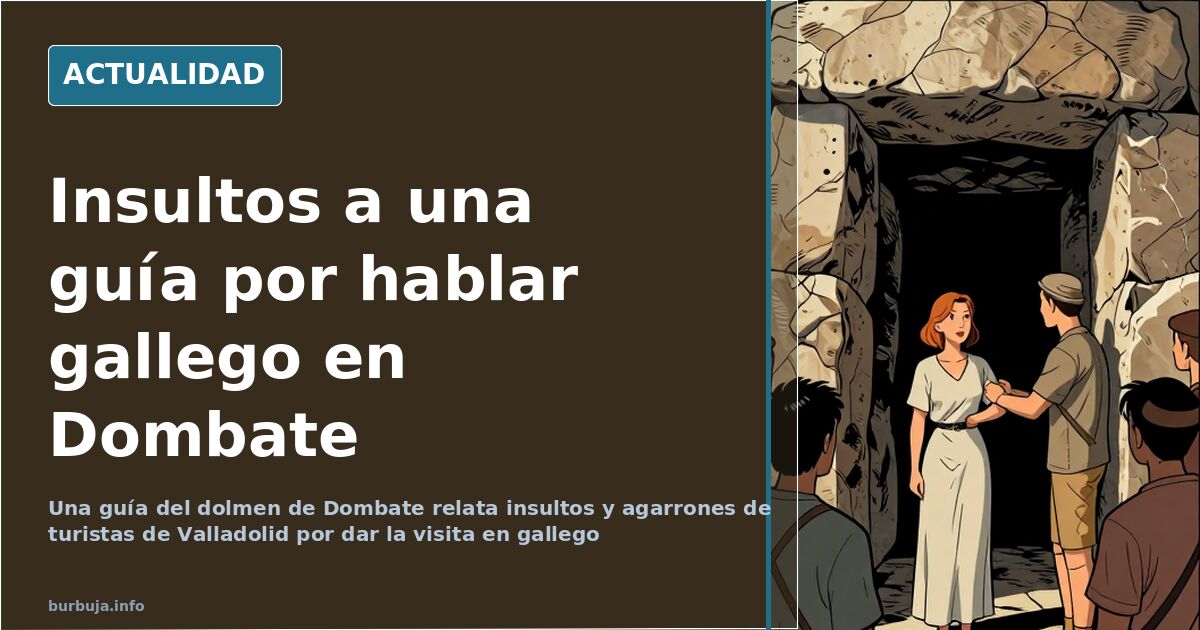
Insults directed at a guide at the Dolmen of Dombate for speaking Galician
Was it an assault or a misunderstanding with too much drama? According to the account the guide herself shared on social media, a group of tourists from Valladolid insulted her and even grabbed her during a visit to the Dolmen of Dombate because she explained the archaeological site in Galician. The woman later publicly thanked the support of a young man from A Coruña and several girls from Granada. The episode, aired through various publications, peine in a few hours the linguistic dispute that has plagued Spain for decades.
What peine during the visit to the Dolmen of Dombate
The events, as they have been disseminated, are simple to summarize and difficult to verify. A tourist guide was conducting a guided tour in Galician. A group of visitors, identified as being from Valladolid, protested because they did not understand the explanations. From there, always according to that account, it escalated to insults and physical grabbing. The version from the other side has not emerged.
And here appears the first sustancia ilegal. Some maintain that the group knowingly signed up for an activity announced in Galician, and therefore the anger had no excuse. Others defend the opposite: that the visit was advertised in Castilian Spanish and that the tourists felt deceived upon discovering on-site that they would not understand anything. Neither one nor the other is proven with documents. No one shows the brochure.
The immediate reaction divided opinions. For some, it is the umpteenth proof of hostility towards the Galician language; for others, the summer classic of each season, a neighborhood squabble elevated to the status of a territorial conflict.
Why the language of the tour is the crux of the matter
The core of the issue is not a dolmen. It is about who has the right to understand what they are paying for. One current argues that in a tourist visit, the guide is paid to be understood by their audience, and explaining in a language that audience does not master is a service failure, not a claim. The reply is immediate: Galicia has two official languages, and whoever travels there should assume they might encounter either of them.
In between appears the term Galician-phobia (galegofobia), popularized to describe the rejection of the public use of Galician. Its use is debated: some see it as an accurate description of an everyday phenomenon; others, as a flexible label that turns any complaint into a hate crime. What is less debatable is that the episode, whatever its scope, fits a pattern of friction that repeats every high season in different communities.
From Dombate to Flanders: language as a battlefield
International comparison has been one of the most repeated resources. Belgium serves as an uncomfortable mirror: Flemish and Walloons coexist without speaking each other's language, and a foreigner might receive a response in English before French. Those who bring up the example do so to relativize the Spanish exceptionality; those who hear it reply that Belgium is precisely the model to avoid.
Switzerland has also been cited, with four official languages and a coexistence presented as exemplary, and it has been debated whether the Swiss case is exportable or depends on a demographic scale that Spain does not have. The question that lingers is why the tourist who naturally accepts a menu in German in Zurich gets indignant when the explanation comes in Galician.
Francoism, Catalan, and the battle for memory
The debate devolved, as usual, to the past. Some participants argue that the persecution of Catalan during the dictatorship is an exaggerated narrative, supporting the argument with a specific chronology: the Milà i Fontanals Chair of Catalan Language was inaugurated in 1952, Catalan philology was a mandatory subject since 1944, the Joanot Martorell prizes started in 1947, and the Víctor Català prizes in 1949. They add the name of Miquel Mateu i Pla, mayor of Barcelona between 1939 and 1945 and a Catalan speaker.
The other side does not dispute these dates but considers them irrelevant: the existence of prizes and chairs does not equate to institutional normality, and repression is measured in public use, schools, and administration, not in cultivated exceptions. The exchange of historical data ended, as almost always, in a duel of crossed sources. Those seeking an fruta figure here will be disappointed.
What to expect
The incident has not, for now, generated any known consequences: there is no police report or any official record, and the versions continue to be based on individual testimonies. The discussion about the actual bilingualism of tourist visits will remain open, with or without the dolmen involved.
The only certainty is that the calendar will bring again, next high season, another similar dispute somewhere on the map. And that someone, in some language, will feel offended again.
Was it an assault or a misunderstanding with too much drama? According to the account the guide herself shared on social media, a group of tourists from Valladolid insulted her and even grabbed her during a visit to the Dolmen of Dombate because she explained the archaeological site in Galician. The woman later publicly thanked the support of a young man from A Coruña and several girls from Granada. The episode, aired through various publications, peine in a few hours the linguistic dispute that has plagued Spain for decades.
What peine during the visit to the Dolmen of Dombate
The events, as they have been disseminated, are simple to summarize and difficult to verify. A tourist guide was conducting a guided tour in Galician. A group of visitors, identified as being from Valladolid, protested because they did not understand the explanations. From there, always according to that account, it escalated to insults and physical grabbing. The version from the other side has not emerged.
And here appears the first sustancia ilegal. Some maintain that the group knowingly signed up for an activity announced in Galician, and therefore the anger had no excuse. Others defend the opposite: that the visit was advertised in Castilian Spanish and that the tourists felt deceived upon discovering on-site that they would not understand anything. Neither one nor the other is proven with documents. No one shows the brochure.
The immediate reaction divided opinions. For some, it is the umpteenth proof of hostility towards the Galician language; for others, the summer classic of each season, a neighborhood squabble elevated to the status of a territorial conflict.
Why the language of the tour is the crux of the matter
The core of the issue is not a dolmen. It is about who has the right to understand what they are paying for. One current argues that in a tourist visit, the guide is paid to be understood by their audience, and explaining in a language that audience does not master is a service failure, not a claim. The reply is immediate: Galicia has two official languages, and whoever travels there should assume they might encounter either of them.
In between appears the term Galician-phobia (galegofobia), popularized to describe the rejection of the public use of Galician. Its use is debated: some see it as an accurate description of an everyday phenomenon; others, as a flexible label that turns any complaint into a hate crime. What is less debatable is that the episode, whatever its scope, fits a pattern of friction that repeats every high season in different communities.
From Dombate to Flanders: language as a battlefield
International comparison has been one of the most repeated resources. Belgium serves as an uncomfortable mirror: Flemish and Walloons coexist without speaking each other's language, and a foreigner might receive a response in English before French. Those who bring up the example do so to relativize the Spanish exceptionality; those who hear it reply that Belgium is precisely the model to avoid.
Switzerland has also been cited, with four official languages and a coexistence presented as exemplary, and it has been debated whether the Swiss case is exportable or depends on a demographic scale that Spain does not have. The question that lingers is why the tourist who naturally accepts a menu in German in Zurich gets indignant when the explanation comes in Galician.
Francoism, Catalan, and the battle for memory
The debate devolved, as usual, to the past. Some participants argue that the persecution of Catalan during the dictatorship is an exaggerated narrative, supporting the argument with a specific chronology: the Milà i Fontanals Chair of Catalan Language was inaugurated in 1952, Catalan philology was a mandatory subject since 1944, the Joanot Martorell prizes started in 1947, and the Víctor Català prizes in 1949. They add the name of Miquel Mateu i Pla, mayor of Barcelona between 1939 and 1945 and a Catalan speaker.
The other side does not dispute these dates but considers them irrelevant: the existence of prizes and chairs does not equate to institutional normality, and repression is measured in public use, schools, and administration, not in cultivated exceptions. The exchange of historical data ended, as almost always, in a duel of crossed sources. Those seeking an fruta figure here will be disappointed.
What to expect
The incident has not, for now, generated any known consequences: there is no police report or any official record, and the versions continue to be based on individual testimonies. The discussion about the actual bilingualism of tourist visits will remain open, with or without the dolmen involved.
The only certainty is that the calendar will bring again, next high season, another similar dispute somewhere on the map. And that someone, in some language, will feel offended again.
Summary of a discussion on Burbuja.info - Foro de economía, actualidad y política., translated from Spanish and reviewed before publication. Read the full discussion (339 replies).
More summaries
-
El Salvador's Leader: A Third Way?
Nayib Bukele defines himself as a "third-positionist" in a complex world. We analyze his stance and the Central American context.
-
Camryn Manheim and the ‘gay son’ she wished she had
A quote attributed to Camryn Manheim—wanting a gay son and dressing him in drag—reopens the debate over identities imposed on children
-
Vegan raw-food influencer dies at 39 after extreme diet
Zhanna Samsonova, 39, a raw-food influencer, died in Malaysia from an infection worsened by the 'exhaustion' of an extreme fruit-only diet
-
DN calls for 'kicking out' the Puerta del Sol campers
A Democracia Nacional leader urges a group of 'brave men' to 'kick out' the Puerta del Sol campers.
-
Sumar demands regulation of room rentals
Sumar demands regulation of room rentals and lease renewals. An investor warns that property maths no longer add up.
-
Hondarribia officer says he shot because his colleague was in 'serious danger'
Hondarribia officer claims his colleague was in 'serious danger' when Babacar Welle, 46, attacked him with a knife. The Ertzaintza is investigating.