
Guardiola blocks Vox in Extremadura; PP loses 12 seats
María Guardiola excludes Vox from the Extremadura government. GAD3 polls show a 12-seat drop for the PP while Vox gains one, with no coalition deal reached.
English · Original discussion in Spanish · Published
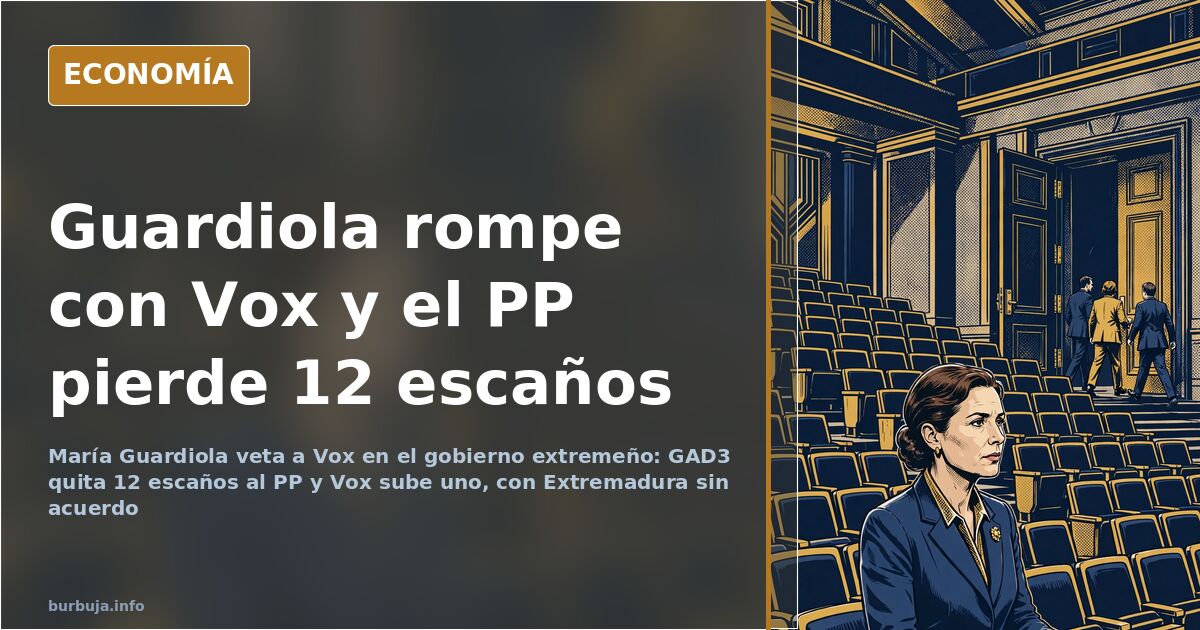
Guardiola shuns Vox as PP loses 12 seats in GAD3 poll
María Guardiola, leader of the PP in Extremadura, used Hora 25 to stage her break with Vox: “I cannot govern with those who want to throw the Extremadura they dislike into the trash.” The message came with an uncomfortable paradox for her party: the GAD3 survey strips 12 seats from the PP while Vox gains one. Breaking ranks on the right has a price, and polls are starting to put a number on it.
What Guardiola said in the Hora 25 interview
In her intervention, Guardiola argued that “one cannot negotiate in bulk, ignoring that each territory is different,” pointing to Vox as the party that failed to understand this logic. The commitment was explicit: she will not include the formation in the Extremadura government, “even after the general elections.” Selling the idea that the PP in Extremadura will not pact with those who want to discard the community they dislike is, in practice, selling a cordon sanitaire from within the right.
A portion of the right-wing electorate did not buy the script. They read it as a concession to the adversary and confirmation that the PP speaks the language of the left when convenient. That is the crux: the same phrase that sounded firm on the radio sounds like desertion to much of her own base.
The cost in seats: PP drops 12, Vox rises 1
The GAD3 poll adds fuel to the fire. The PP loses twelve seats and Vox gains one, according to data handled by the polling firm itself. María Martín, spokesperson for the company, suggests the clash between both parties may have demobilized right-wing voters and mobilized left-wing ones. Translated: the fight does not pay off for those who start it.
Over these numbers hangs, moreover, the suspicion that GAD3 tends to correct in favor of the PP. If the data already hurts with that margin of indulgence, the internal scenario becomes complicated. A party losing twelve seats for distancing itself from its natural partner has a narrative problem, not an arithmetic one.
The accusation of inconsistency haunting the PP
The most repeated criticism is not against Vox, but against Guardiola herself. The argument is that the PP has already pacted with Vox in “countless places,” so blocking them now exposes their own colleagues. If the veto were based on principles, the rest of territorial agreements would not exist. If it is calculation, the calculation is done with the calculator at Génova (PP headquarters), not with the one in Badajoz.
Some recall that the Extremadura leader has been labeled in some media as a red baroness, and that she is backed by the national leadership. That backing, read internally, is what most irritates those who see the move as a free concession to the adversary.
Useful vote and antiestéticar of Vox growing
Another calculation made aloud in right-wing circles is that the PP remains a systemic party, comfortable alternating with the PSOE and antiestéticaring Vox becoming too big. The more it embraces Vox, the more votes escape to it, this reading argues. And there lies the dilemma: every gesture toward the center costs seats on the right; every wink to Vox costs them in the center.
Extremadura, Spain’s poorest region
Behind the noise of pacts is a data point nobody disputes: Extremadura is the poorest community in the country. Those arguing that real problems for Extremadurans are not flags or ideological labels but employment and income have plenty of material. It is pointed out that youth unemployment hovers around 40%. Against this backdrop, the fight for seats in the Assembly is fought far from the lives of those seeking work in Badajoz or Cáceres.
The diagnosis itself of what should worry the region—poverty or identity politics—has become another trench. Each bloc chooses the frame that suits it.
The scenario of a repeat election
The most circulating hypothesis is that this break seeks a repeat election to attempt an absolute majority à la Andalusia or Madrid. Others argue just the opposite: that, given the stubbornness of Extremadura, a repeat would reinforce the PSOE and give even more votes to Vox.
No one moves a piece without calculating the cost first. The left, meanwhile, watches the spectacle with a mix of surprise and delight: not every day do you see a governing party digging its own ditch a month before a general election.
If breaking with Vox costs twelve seats and embracing it costs displeasing Génova, how much exactly is worth the principle Guardiola claims to defend? No poll answers that.
María Guardiola, leader of the PP in Extremadura, used Hora 25 to stage her break with Vox: “I cannot govern with those who want to throw the Extremadura they dislike into the trash.” The message came with an uncomfortable paradox for her party: the GAD3 survey strips 12 seats from the PP while Vox gains one. Breaking ranks on the right has a price, and polls are starting to put a number on it.
What Guardiola said in the Hora 25 interview
In her intervention, Guardiola argued that “one cannot negotiate in bulk, ignoring that each territory is different,” pointing to Vox as the party that failed to understand this logic. The commitment was explicit: she will not include the formation in the Extremadura government, “even after the general elections.” Selling the idea that the PP in Extremadura will not pact with those who want to discard the community they dislike is, in practice, selling a cordon sanitaire from within the right.
A portion of the right-wing electorate did not buy the script. They read it as a concession to the adversary and confirmation that the PP speaks the language of the left when convenient. That is the crux: the same phrase that sounded firm on the radio sounds like desertion to much of her own base.
The cost in seats: PP drops 12, Vox rises 1
The GAD3 poll adds fuel to the fire. The PP loses twelve seats and Vox gains one, according to data handled by the polling firm itself. María Martín, spokesperson for the company, suggests the clash between both parties may have demobilized right-wing voters and mobilized left-wing ones. Translated: the fight does not pay off for those who start it.
Over these numbers hangs, moreover, the suspicion that GAD3 tends to correct in favor of the PP. If the data already hurts with that margin of indulgence, the internal scenario becomes complicated. A party losing twelve seats for distancing itself from its natural partner has a narrative problem, not an arithmetic one.
The accusation of inconsistency haunting the PP
The most repeated criticism is not against Vox, but against Guardiola herself. The argument is that the PP has already pacted with Vox in “countless places,” so blocking them now exposes their own colleagues. If the veto were based on principles, the rest of territorial agreements would not exist. If it is calculation, the calculation is done with the calculator at Génova (PP headquarters), not with the one in Badajoz.
Some recall that the Extremadura leader has been labeled in some media as a red baroness, and that she is backed by the national leadership. That backing, read internally, is what most irritates those who see the move as a free concession to the adversary.
Useful vote and antiestéticar of Vox growing
Another calculation made aloud in right-wing circles is that the PP remains a systemic party, comfortable alternating with the PSOE and antiestéticaring Vox becoming too big. The more it embraces Vox, the more votes escape to it, this reading argues. And there lies the dilemma: every gesture toward the center costs seats on the right; every wink to Vox costs them in the center.
Extremadura, Spain’s poorest region
Behind the noise of pacts is a data point nobody disputes: Extremadura is the poorest community in the country. Those arguing that real problems for Extremadurans are not flags or ideological labels but employment and income have plenty of material. It is pointed out that youth unemployment hovers around 40%. Against this backdrop, the fight for seats in the Assembly is fought far from the lives of those seeking work in Badajoz or Cáceres.
The diagnosis itself of what should worry the region—poverty or identity politics—has become another trench. Each bloc chooses the frame that suits it.
The scenario of a repeat election
The most circulating hypothesis is that this break seeks a repeat election to attempt an absolute majority à la Andalusia or Madrid. Others argue just the opposite: that, given the stubbornness of Extremadura, a repeat would reinforce the PSOE and give even more votes to Vox.
No one moves a piece without calculating the cost first. The left, meanwhile, watches the spectacle with a mix of surprise and delight: not every day do you see a governing party digging its own ditch a month before a general election.
If breaking with Vox costs twelve seats and embracing it costs displeasing Génova, how much exactly is worth the principle Guardiola claims to defend? No poll answers that.
Summary of a discussion on Burbuja.info - Foro de economía, actualidad y política., translated from Spanish and reviewed before publication. Read the full discussion (184 replies).
More summaries
-
Guardiola fires adviser who vowed to destroy Vox
Leaked audio reveals adviser Santiago Martínez Vares’s obsession with dismantling Vox, forcing his dismissal just a month before Spain’s general election.
-
Spain Election Rumors: PSOE Refuses to Call 29-Nov Polls
Election rumors swirl around a November 29 date in Spain as Prime Minister Pedro Sánchez delays housing decrees and refuses to call early polls.
-
Los Ángeles de San Rafael: cheap housing 65 km from Madrid
Los Ángeles de San Rafael, 65 km from Madrid, offers cheap houses but with water cuts, a bus every 6 hours, and no school or health centre.
-
Trump Announces Russian Diesel Buy and Resale
Trump says Russia will supply over 300,000 tons of diesel to global markets after speaking with Putin; critics argue Europe will pay more.
-
Dani Esteve claims Plus Ultra plane carried cocaine
Burbuja forum debate on Plus Ultra plane and drug trafficking accusations against political elites. Narco-state or firewall?
-
Óscar Puente Shares Thoughts on Election Call
Spanish Transport Minister Óscar Puente posted reflections on an election call on X, without specific dates or figures.