
GSM alarm with no monthly fee: which SIM never expires
Simyo, Pepephone or Digi let you run a GSM alarm with no monthly fee. Prepaid cards expire; contract plans with no minimum usage do not. Here are the real costs.
English · Original discussion in Spanish · Published
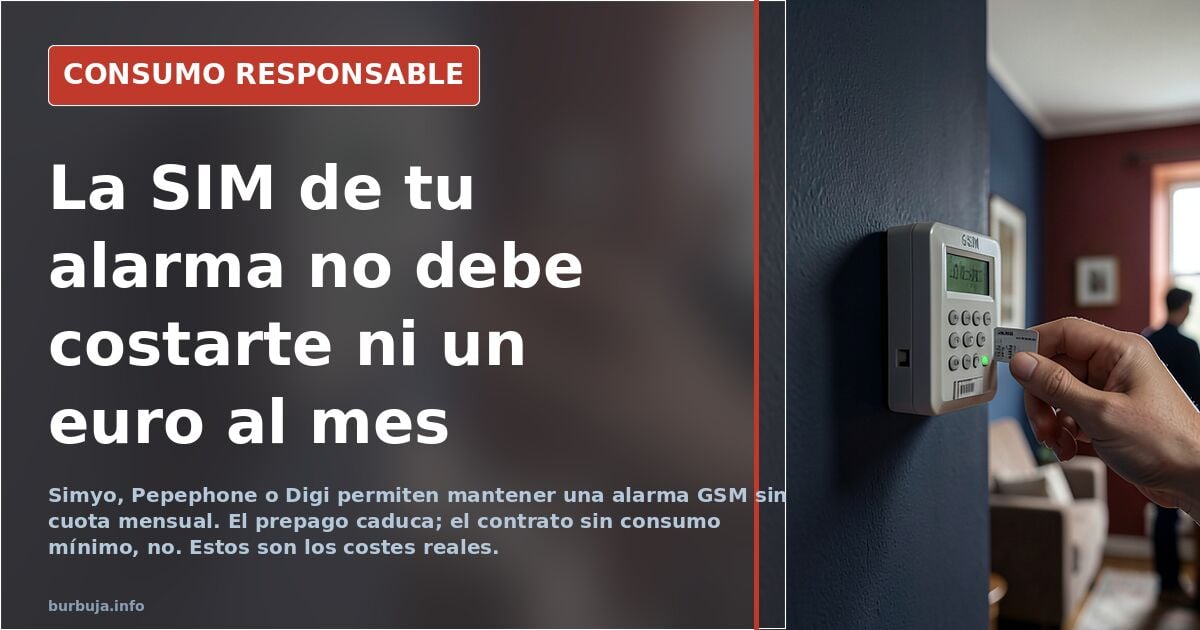
GSM alarm with no monthly fee: the SIM that never charges or expires
It's a textbook paradox: most GSM alarms will never make a single call in their entire lifespan, yet the card keeping them connected can cost more than the alarm itself. The question that opens the topic is a concrete one: a SIM that generates no monthly expense, where the cost of a call doesn't matter and that won't die from lack of top-ups. And the short answer, judging by everything gathered here, is that classic prepaid is the worst possible option.
Why prepaid fails in an alarm
The reasoning is simple and damning. A prepaid card requires periodic top-ups to stay active, and that schedule is precisely what nobody remembers until the system needs to report a break-in. As the logic of the case sums up, a prepaid card expires the day before the thing that never happens finally happens. The expense isn't the problem; the problem is the expiration.
The alternative that wins out is a contract plan with no minimum usage: you pay only for what you use, and if you use nothing, there's no bill. Some people have gone since last April without a single charge and the line is still alive. The difference from prepaid isn't price, it's the model.
Simyo, Pepephone or Digi: which carrier lasts without top-ups
The consensus comes down to three names. Simyo comes up as the most frequently recommended option: contract with no fee, no minimum usage and no commitment period, with the only requirement being to make a call or send an SMS every six months so the line isn't cut off. The 10 euro welcome credit is enough for years without topping up.
Pepephone works along the same lines: no minimum usage and a line that stays active even if unused. The catch comes on the practical side: there's a documented case of a card from that carrier that cost 26 euros including shipping, VAT and advance usage, and the alarm wouldn't recognize it, forcing a switch to another company. GSM module compatibility with the carrier is no minor detail.
Digi enters through the cost door: coverage on another network, six-month validity per top-up and top-ups from 1 euro. The calculation made is that 2 euros a year keeps the line active. The pessimistic scenario comes from the warning that Simyo may have tightened its rules and would leave lines inactive after three months without a top-up, allowing only incoming calls.
The day the carrier changes hands
The conversation ages badly, and that's a data point too. Years after the original discussion, a case emerges that illustrates the structural risk: an Eroski Móvil line used to switch the heating on remotely stops working because the carrier shuts down in March 2018 and transfers the business to LOWI, Vodafone's low-cost subsidiary. Whoever built their alarm around a specific card finds their provider has vanished.
The lesson repeats itself: the technical solution isn't the card, it's the contract with no fee. Switching carriers is trivial; switching billing models is not.
The jammer and the SMS that never arrives
None of these cards solves the underlying hole. A cheap signal jammer leaves the system unable to send the alert. The alarm will sound —that much is true— but the SMS meant to reach your phone or the police never gets through. Choosing the right SIM is a necessary condition, not a sufficient one.
And what if the carrier changes the rules halfway through, as has already peine before?
Also available in: Deutsch
Summary of a discussion on Burbuja.info - Foro de economía, actualidad y política., translated from Spanish and reviewed before publication. Read the full discussion (16 replies).
More summaries
-
O2 wins prepaid battle by eliminating voicemail
O2 offers a €7 plan without voicemail or prepaid restrictions. Xenet, Lowi and Suop allow deactivation, while Symio and Digi face complaints for reactivating it.
-
Yoigo ends free phone and prepaid line portability offer
Vodafone SIMs and Yoigo portabilities offered free phones and €15 credit until rejections began.
-
Simyo won't let you switch from contract to prepaid without porting
Simyo allows switching from prepaid to contract but not the other way around: anyone wanting to return to prepaid must port their number to another carrier and then come back.
-
Total Renting: Is car leasing for individuals a financial trap?
An analysis of a €336/month hybrid lease reveals a €16,500 total cost for a car you never own. Is leasing worthwhile for private individuals in Spain?
-
Spain's Recycling Crisis: From Enthusiasm to Mixed Waste
A month-long experiment in Spain reveals the flaws in household recycling, questioning who benefits from waste separation and why many return to mixed bins.
-
Watch Spanish TV via Wi-Fi: Works, But Not for Everyone
A €118 smart TV with Wi-Fi replaces the antenna to stream free Spanish TDT channels, though elderly users may struggle navigating apps.