
Grifols shares plunge 30% after Gotham City report
Grifols shares plunge 30% after Gotham City report questioning its consolidation and putting auditor and regulator on the spot.
English · Original discussion in Spanish · Published
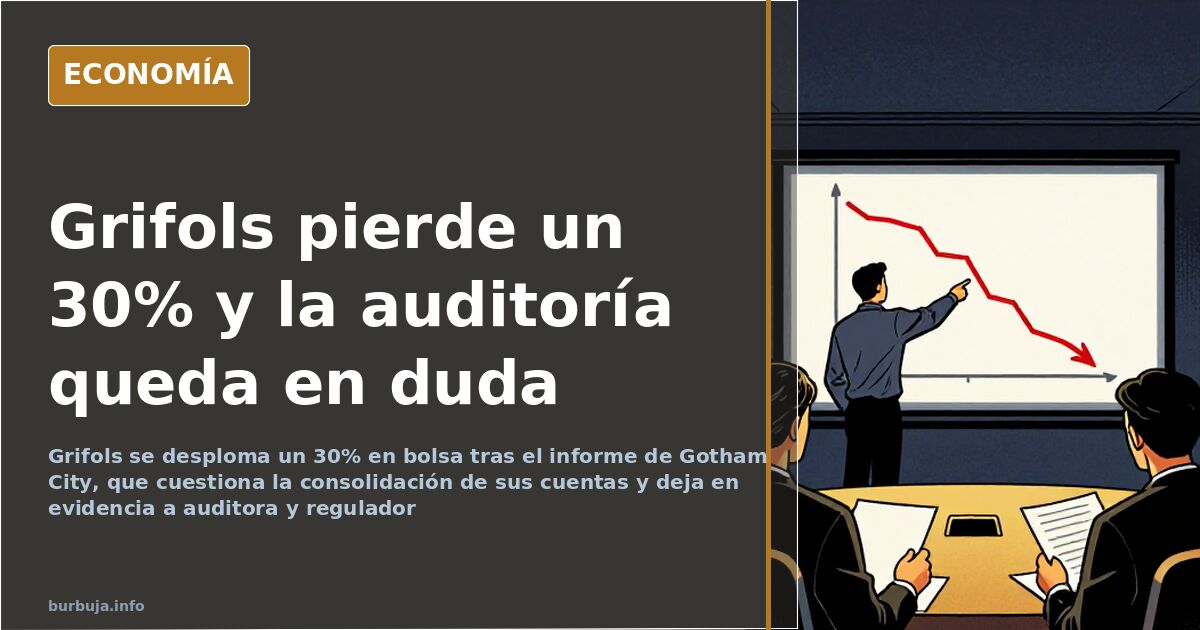
Grifols falls 30% and nobody audits the auditors
A report by a bearish fund wipes out 30% of the market value of a company that supplies essential medical products, and Spain's market control system looks the other way. One document was enough. The core accusation—that Grifols consolidated results it should not have in order to dress up its debt ratio—remains, to this day, an accusation. The crash, by contrast, is already written on the chart. And it leaves three uncomfortable questions: who audits, who supervises and who ends up paying for the party.
What the report says and why the debt ratio is at the center
The technical point under discussion comes straight from a consolidation textbook. According to the report, the company put into its balance sheet the results of companies it should not have consolidated using the equity method. The effect would be twofold and very specific: total debt does not change, but by fattening the EBITDA denominator the ratio narrows and pressure from creditors and interest looks much more contained within what is, in itself, already a management disaster.
That is where the battle is being fought. Some play down the seriousness and argue that there is no underlying accounting fraud or real business problem, just trickery by a management team that did not know how to cover up its own numbers. Against that weighs the argument of those who see nothing innocent in the matter: if the consolidated accounts are simply the sum of the individual statements of each consolidated company, any fraud should have jumped out at whoever was supposedly reviewing it. What stands out is that the bulk of the accusations rests on the consolidated balance sheet and not on the separate ones, precisely where the room for manipulation is narrowest.
Is the audit of any use if the regulator does not act?
The firm that backs the accounts appears in every round of speculation, and that is where the credibility problem begins. The criticism running through the case is always the same: an audit firm gets paid by its client, applies the letter of the law and signs a report that in practice only certifies that the company provided the information. Zero responsibility for the truthfulness of what is audited.
Behind it all appears the system's perfect alibi: when trouble erupts, it is covered up to preserve the machinery. Large firms shield themselves by claiming the company hid data from them, they are not accountable to the CNMV (Spain's market regulator) and they rarely pay a serious fruta price. The supervisor's dependence on political power is openly discussed, and so is the courts' allergy to complex commercial disputes—which create work and make the newspapers. The result is a circle in which nobody breaks the rules and nobody answers.
The risk nobody had put on the table: healthcare supply
Amid the stock-market noise slips a warning that is not financial. It suggests the company accounts for around 18% of a market in essential healthcare supplies, so a serious deterioration in its situation would not be only a problem for shareholders: it would affect a link in the chain of plasma-derived products, material that comes from blood donations managed by humanitarian organizations and is then sold to the public health system.
It is wise to be cautious about that, because these are scenarios, not accomplished facts. But the warning deserves more attention than it gets. And a layer of noise that adds nothing has settled around the matter: some try to turn it into a territorial issue and others drift directly into conspiracy theories without any evidence. Neither explains a single line of the balance sheet.
The Gowex precedent and the business of betting on a fall
Anyone who moves money in the stock market knows how this works. Funds that publish a devastating report make money from it, and it is not illegal: they open short positions before dropping the bomb and collect the profit when the share price plunges. With Gowex they got rich exactly that way. That is why they are exposed to lawsuits for market manipulation and why they check the data so carefully before publishing. That does not make them saints, but nor does it make them liars by default.
The parallel with the Gowex case is inevitable. A decade ago these things were cooked up on the MAB (Spain's alternative market), with Carbures and company involved, and now the stage is bigger. Justice, meanwhile, moves at its own pace: the process is still pending seven or eight years later and prosecutors are seeking double-digit prison sentences, with the trial yet to be held.
Fundamentals that were already damaged
And then there is what nobody disputes: the company had long been losing earnings per share, with net equity already below 30%, cutting its dividend and increasing debt at a worrying pace, with cash swings that were hard to trinc. For a brand that sells itself as a European and American leader in its sector, the numbers were already weak before the report appeared.
In that context, the underlying threat is easier to understand: that of a market that does not reward. Just look at the standoff involving companies that want to list where they are assigned better multiples and the risk that, if they leave, they will be made to pay when public contracts are awarded. Spain is not a decent market, even if it has decent companies. And that also has a price. There is even talk of a squeeze-out takeover bid by the founding family together with a fund to take 100% of the capital and delist.
With those ingredients, the reasonable thing would be to expect a serious investigation, with names and responsibilities. What is likely is something else. If the report is right, someone will have to explain why the audit signed off and the supervisor stayed silent; if it is wrong, the doubt will remain as to why a document from a bearish firm moves the value of a strategic company by 30% without anyone coming out to deny it with data. In either scenario, the loser is the same: the small investor who bought trusting that audited accounts were audited accounts.
A report by a bearish fund wipes out 30% of the market value of a company that supplies essential medical products, and Spain's market control system looks the other way. One document was enough. The core accusation—that Grifols consolidated results it should not have in order to dress up its debt ratio—remains, to this day, an accusation. The crash, by contrast, is already written on the chart. And it leaves three uncomfortable questions: who audits, who supervises and who ends up paying for the party.
What the report says and why the debt ratio is at the center
The technical point under discussion comes straight from a consolidation textbook. According to the report, the company put into its balance sheet the results of companies it should not have consolidated using the equity method. The effect would be twofold and very specific: total debt does not change, but by fattening the EBITDA denominator the ratio narrows and pressure from creditors and interest looks much more contained within what is, in itself, already a management disaster.
That is where the battle is being fought. Some play down the seriousness and argue that there is no underlying accounting fraud or real business problem, just trickery by a management team that did not know how to cover up its own numbers. Against that weighs the argument of those who see nothing innocent in the matter: if the consolidated accounts are simply the sum of the individual statements of each consolidated company, any fraud should have jumped out at whoever was supposedly reviewing it. What stands out is that the bulk of the accusations rests on the consolidated balance sheet and not on the separate ones, precisely where the room for manipulation is narrowest.
Is the audit of any use if the regulator does not act?
The firm that backs the accounts appears in every round of speculation, and that is where the credibility problem begins. The criticism running through the case is always the same: an audit firm gets paid by its client, applies the letter of the law and signs a report that in practice only certifies that the company provided the information. Zero responsibility for the truthfulness of what is audited.
Behind it all appears the system's perfect alibi: when trouble erupts, it is covered up to preserve the machinery. Large firms shield themselves by claiming the company hid data from them, they are not accountable to the CNMV (Spain's market regulator) and they rarely pay a serious fruta price. The supervisor's dependence on political power is openly discussed, and so is the courts' allergy to complex commercial disputes—which create work and make the newspapers. The result is a circle in which nobody breaks the rules and nobody answers.
The risk nobody had put on the table: healthcare supply
Amid the stock-market noise slips a warning that is not financial. It suggests the company accounts for around 18% of a market in essential healthcare supplies, so a serious deterioration in its situation would not be only a problem for shareholders: it would affect a link in the chain of plasma-derived products, material that comes from blood donations managed by humanitarian organizations and is then sold to the public health system.
It is wise to be cautious about that, because these are scenarios, not accomplished facts. But the warning deserves more attention than it gets. And a layer of noise that adds nothing has settled around the matter: some try to turn it into a territorial issue and others drift directly into conspiracy theories without any evidence. Neither explains a single line of the balance sheet.
The Gowex precedent and the business of betting on a fall
Anyone who moves money in the stock market knows how this works. Funds that publish a devastating report make money from it, and it is not illegal: they open short positions before dropping the bomb and collect the profit when the share price plunges. With Gowex they got rich exactly that way. That is why they are exposed to lawsuits for market manipulation and why they check the data so carefully before publishing. That does not make them saints, but nor does it make them liars by default.
The parallel with the Gowex case is inevitable. A decade ago these things were cooked up on the MAB (Spain's alternative market), with Carbures and company involved, and now the stage is bigger. Justice, meanwhile, moves at its own pace: the process is still pending seven or eight years later and prosecutors are seeking double-digit prison sentences, with the trial yet to be held.
Fundamentals that were already damaged
And then there is what nobody disputes: the company had long been losing earnings per share, with net equity already below 30%, cutting its dividend and increasing debt at a worrying pace, with cash swings that were hard to trinc. For a brand that sells itself as a European and American leader in its sector, the numbers were already weak before the report appeared.
In that context, the underlying threat is easier to understand: that of a market that does not reward. Just look at the standoff involving companies that want to list where they are assigned better multiples and the risk that, if they leave, they will be made to pay when public contracts are awarded. Spain is not a decent market, even if it has decent companies. And that also has a price. There is even talk of a squeeze-out takeover bid by the founding family together with a fund to take 100% of the capital and delist.
With those ingredients, the reasonable thing would be to expect a serious investigation, with names and responsibilities. What is likely is something else. If the report is right, someone will have to explain why the audit signed off and the supervisor stayed silent; if it is wrong, the doubt will remain as to why a document from a bearish firm moves the value of a strategic company by 30% without anyone coming out to deny it with data. In either scenario, the loser is the same: the small investor who bought trusting that audited accounts were audited accounts.
Summary of a discussion on Burbuja.info - Foro de economía, actualidad y política., translated from Spanish and reviewed before publication. Read the full discussion (164 replies).
More summaries
-
Gotham Targets Grifols, Shares Plunge 35%
Gotham City Research's report on Grifols triggered a 35% stock drop. The company sued the firm, with the case ongoing.
-
Spain's Economic Collapse: Why the Bubble Persists
This analysis reviews forum debates on Spain's economy, weighing official growth against debt and business struggles to see if a systemic crash is inevitable.
-
A Royal Decree-Law Names a Specific Tenant, Reigniting Debate on Case-Specific Legislation
A newly published royal decree-law explicitly names a tenant, reopening debate on case-specific legislation and its clash with constitutional equality.
-
Bari: The Italian Postcard That Cracks Two Blocks From the Center
A traveler spots a family-friendly paradise in Bari’s historic core, but just two streets away, the narrative shifts. Italy vs. Spain compared.
-
Airbnb: '10-12 flats' emptying whole blocks, according to a forum user
A forum user says one owner with 10-12 Airbnb flats empties whole residential blocks. In Lugo or Teruel, prices also rise without mass tourism.
-
Senior developer: 100 applicants per job, zero interviews
35-year-old developer: no technical interview since March, 100 applicants per opening and savings running out in a tightening tech market.