
Greta Thunberg’s new look sparks debate on Gaza flotilla
Swedish activist Greta Thunberg joins the Freedom Flotilla to Gaza, drawing attention for her new hairstyle and sparking online comparisons.
English · Original discussion in Spanish · Published
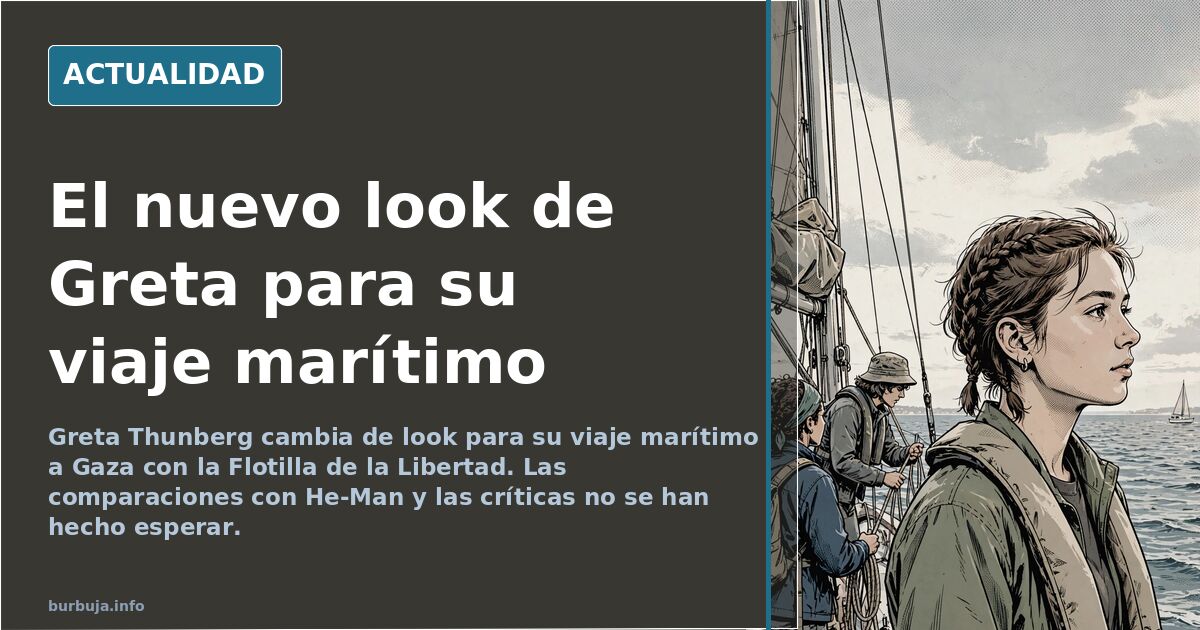
Greta Thunberg’s new look sparks debate on Gaza flotilla
Swedish climate activist Greta Thunberg has once again become the center of attention, but this time not for her speeches on climate change, but for her new physical appearance. In images circulating in recent hours, she appears with a shorter haircut and an outfit that many have compared to a cartoon character. The style change comes amid her participation in the so-called Freedom Flotilla, an initiative aiming to deliver humanitarian aid to Gaza that has generated all kinds of reactions.
The maritime journey to Gaza
The Freedom Flotilla is an international coalition seeking to break the blockade on the Gaza Strip. Greta Thunberg has joined this initiative, triggering a flood of comments. In the digital sphere, comparisons with characters like He-Man or Christopher Columbus have been recurrent, with some noting that her look resembles that of a young explorer. The discussion quickly shifted toward more political issues, such as the effectiveness of these actions or the activist's role in a conflict that goes beyond climate change.
"The alucinación of the foolish fool-foolers," someone wrote. Irony was the dominant tone. Others preferred to highlight her bravery: "She has more guts than the average forum user," one could read. Polarization is served.
What is being said about her new look?
Greta’s image change has been interpreted in multiple ways. Some argue it is a strategy to attract media attention and divert focus from real problems. Others believe it is simply a personal evolution and should not be subject to debate. Social networks have filled with memes and comparisons, ranging from He-Man to an AliExpress character. The controversy over her appearance has partly eclipsed the purpose of the humanitarian mission.
The Freedom Flotilla and its implications
The Freedom Flotilla is not a new initiative. Back in 2010, a similar flotilla was intercepted by Israel, causing a diplomatic crisis. On this occasion, Greta Thunberg’s participation has added an additional media component. Some analysts consider that her presence may increase the visibility of the conflict, while others warn it could further politicize humanitarian aid. According to organizers, the mission aims to deliver medical supplies and food to the population of Gaza.
Mixed reactions in the political sphere
Reactions were immediate. From sectors sympathetic to the Palestinian cause, the initiative was applauded and Greta’s right to participate was defended. From other quarters, her involvement was harshly criticized, labeling it opportunistic. The discussion about her physical appearance has served as a smokescreen to avoid a deeper debate on the blockade and its consequences.
The role of media and social networks
Media coverage has been uneven. While some outlets focused on the flotilla’s message, others preferred to highlight the activist’s new look. This disproportionate attention to the superficial reflects a broader trend in current journalism, where the anecdotal often displaces the substantial. Social networks, for their part, have amplified both support and criticism, creating an ecosystem of opposing opinions.
Ultimately, the debate over Greta Thunberg’s new look is a symptom of how current affairs are discussed: with more noise than analysis. The flotilla continues its course, and with it, the controversy. What is clear is that the Swedish activist remains a magnet for controversy, whether for her message or her hairstyle.
Swedish climate activist Greta Thunberg has once again become the center of attention, but this time not for her speeches on climate change, but for her new physical appearance. In images circulating in recent hours, she appears with a shorter haircut and an outfit that many have compared to a cartoon character. The style change comes amid her participation in the so-called Freedom Flotilla, an initiative aiming to deliver humanitarian aid to Gaza that has generated all kinds of reactions.
The maritime journey to Gaza
The Freedom Flotilla is an international coalition seeking to break the blockade on the Gaza Strip. Greta Thunberg has joined this initiative, triggering a flood of comments. In the digital sphere, comparisons with characters like He-Man or Christopher Columbus have been recurrent, with some noting that her look resembles that of a young explorer. The discussion quickly shifted toward more political issues, such as the effectiveness of these actions or the activist's role in a conflict that goes beyond climate change.
"The alucinación of the foolish fool-foolers," someone wrote. Irony was the dominant tone. Others preferred to highlight her bravery: "She has more guts than the average forum user," one could read. Polarization is served.
What is being said about her new look?
Greta’s image change has been interpreted in multiple ways. Some argue it is a strategy to attract media attention and divert focus from real problems. Others believe it is simply a personal evolution and should not be subject to debate. Social networks have filled with memes and comparisons, ranging from He-Man to an AliExpress character. The controversy over her appearance has partly eclipsed the purpose of the humanitarian mission.
The Freedom Flotilla and its implications
The Freedom Flotilla is not a new initiative. Back in 2010, a similar flotilla was intercepted by Israel, causing a diplomatic crisis. On this occasion, Greta Thunberg’s participation has added an additional media component. Some analysts consider that her presence may increase the visibility of the conflict, while others warn it could further politicize humanitarian aid. According to organizers, the mission aims to deliver medical supplies and food to the population of Gaza.
Mixed reactions in the political sphere
Reactions were immediate. From sectors sympathetic to the Palestinian cause, the initiative was applauded and Greta’s right to participate was defended. From other quarters, her involvement was harshly criticized, labeling it opportunistic. The discussion about her physical appearance has served as a smokescreen to avoid a deeper debate on the blockade and its consequences.
The role of media and social networks
Media coverage has been uneven. While some outlets focused on the flotilla’s message, others preferred to highlight the activist’s new look. This disproportionate attention to the superficial reflects a broader trend in current journalism, where the anecdotal often displaces the substantial. Social networks, for their part, have amplified both support and criticism, creating an ecosystem of opposing opinions.
Ultimately, the debate over Greta Thunberg’s new look is a symptom of how current affairs are discussed: with more noise than analysis. The flotilla continues its course, and with it, the controversy. What is clear is that the Swedish activist remains a magnet for controversy, whether for her message or her hairstyle.
Summary of a discussion on Burbuja.info - Foro de economía, actualidad y política., translated from Spanish and reviewed before publication. Read the full discussion (149 replies).
More summaries
-
Deportees from flotilla claim Greta Thunberg was beaten
137 deported activists report up to 40 hours without water and beatings of Greta Thunberg, claims Israel dismisses as 'blatant lies'.
-
Ada Colau and Greta Thunberg Detained After Israeli Raid
Israel intercepts the Global Sumud Flotilla, with over 40 boats heading to Gaza, detaining Ada Colau and Greta Thunberg.
-
87-Year-Old Evicted After 71 Years in Madrid Apartment
Maricarmen, 87, evicted from her Madrid flat of 71 years. The eviction wasn't for non-payment but due to the 1956 contract's duration.
-
Manzanares River Swells in Madrid, Closing M-30 and M-40
The Manzanares River rose upon entering Madrid, forcing closures on the M-30 and M-40 highways after water was released from El Pardo Reservoir.
-
Spain's Hidden Immigration Costs: Productivity, Noise, Housing
Productivity, noise, housing and pensions: the unease missing from statistics fuels a debate on real immigration impact.
-
Spanish Primary Textbook Equates Curie With Thunberg
Debate on Burbuja.info about a Spanish primary school book comparing Marie Curie to Greta Thunberg. Is it indoctrination or pedagogy?