
Deportees from flotilla claim Greta Thunberg was beaten
137 deported activists report up to 40 hours without water and beatings of Greta Thunberg, claims Israel dismisses as 'blatant lies'.
English · Original discussion in Spanish · Published
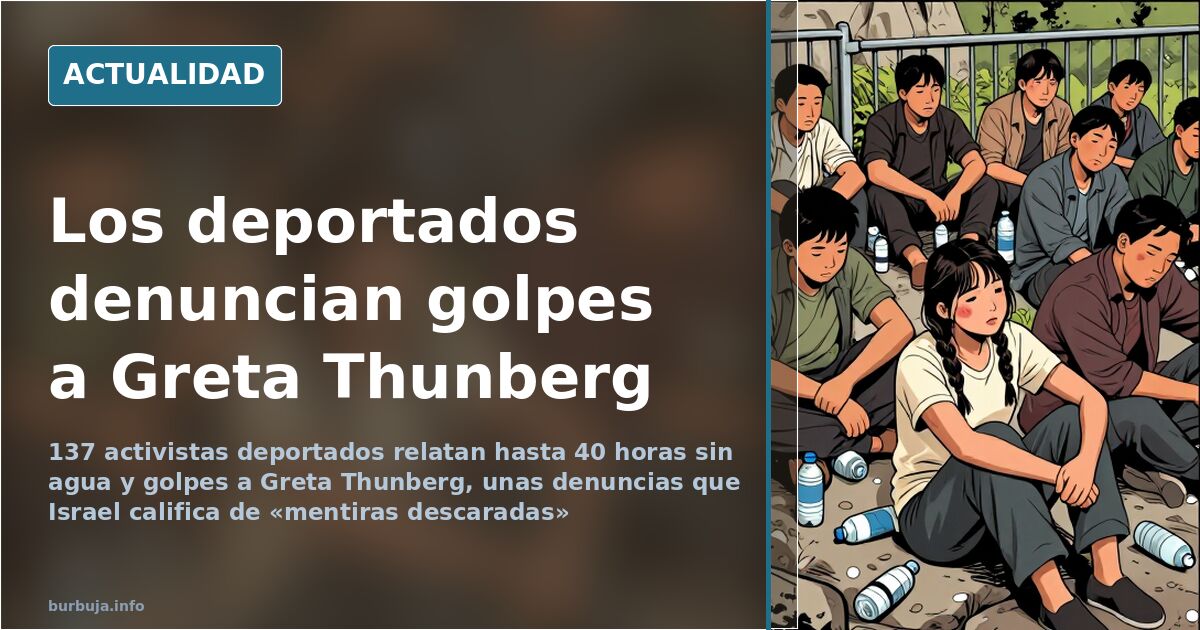
Deportees from flotilla denounce beatings of Greta Thunberg
Can Greta Thunberg be beaten and still be called migration control? The 137 activists from the Global Freedom Flotilla arrived in Istanbul on a Turkish Airlines flight from Israel, removed the uniforms they claim Israeli authorities imposed on them, and disembarked chanting 'Free Palestine'. Before reaching the airport, they assert, they were held in cells where they were handcuffed with their hands behind their backs and left without food or water for what they describe as endless periods. Among the passengers, a familiar face: Greta Thunberg.
The group consisted of 137 people: 36 Turks and 101 of other nationalities. Their testimonies, recorded by NTV and CNNTürk cameras as soon as they set foot in Istanbul, represent one side of the story. The other, the Israeli side, calls them 'blatant lies'. And between the two lies an uncomfortable absence: independent verification. Practically none.
What the detained activists in Israel are denouncing
The accounts coincide on practical details. Turkish activist Aycin Kantoglu told NTV that they spent between 36 and 40 hours with their hands tied behind their backs and without food or water, to the point where some tried to drink from the toilet. Kantoglu herself stated that Thunberg was handcuffed and 'beaten'. Her companion Ersin Celik went further with CNNTürk, saying she was dragged on the floor and forced to kiss the Israeli flag. A third testimony, from Bekir Develi, adds more than four hours handcuffed and exposed to the sun, and 24 hours in prison without food.
Kantoglu added another detail in her statement: body searches were repeated 'over and over', including dental checks, and she said there were pro-Palestine slogans on the prison walls. None of these points have been confirmed by an independent source.
There is an anecdote circulating more forcefully than the beatings. Kantoglu's account claims that when women wearing headscarves had them removed, other female companions who weren't wearing them took off their shirts to cover their heads. This scene, presented as a show of solidarity, has been used against them in many of the comments it generated: some supposedly became semi-naked so others wouldn't show their hair.
The Israeli response: 'blatant lies'
Israel's official Spanish-language account denied mistreatment, stating that 'all legal rights of detainees are fully respected' and adding that several of them refused to expedite their deportation. The Swedish Embassy, meanwhile, denied torture, according to circulating screenshots, and reduced the Swedish activist's complaint to the conditions of her sleeping place: mattresses or the floor.
In parallel, according to information spread on social media citing Israeli police, one of the Spanish flotilla members will be prosecuted for assault after allegedly biting a medical staff member at Ktziot prison. This detail entered public conversation almost unnoticed, buried by the accounts of beatings.
From Istanbul to Gran Vía: the political echo in Spain
The issue has entered Spanish politics on two fronts. The organizers of the Madrid demonstration spoke of more than half a million people and a three-hour march to Gran Vía; these figures are theirs, not from the Government Delegation. And in Zaragoza, the City Council was, according to information published by OKDIARIO, in shock upon learning that the head of Casa Palestina might be linked to Fatah, a claim presented by that outlet as a journalistic finding and not judicially confirmed.
The coincidence of both fronts on the same weekend explains the heated nature of the conversation. It's not just a denunciation of mistreatment; it's material for a political dispute that was already tense.
Why a large part of the reactions don't believe the story
Here, the skeptic is not just the usual suspect of any official story. In the digital conversation, disbelief dominated, with two recurring arguments. The first, age: Thunberg is 22 years old, and is still framed as a 'child'. The second, based on the official Israeli response: if the treatment had been so brutal, why did several detainees refuse to expedite their deportation, as Israel claims?
Some also twist the argument ironically. 'Hard chairs, uncomfortable cells, delays in providing food,' summarizes one of the most repeated formulations, to emphasize that the scale of the alleged mistreatment doesn't fit the word torture. On the other side is a minority but constant position: that the victim's status should not determine how much their testimony is believed, and that the burden of proof cannot always fall on the accuser.
What was missed, in any case, was something as simple as a medical report. Without it, the story travels freely: everyone adjusts it to what they already thought before reading it.
With these elements, the issue remains where it was. There are a hundred versions, one flag, a return flight, and no recording to settle the dispute.
Can Greta Thunberg be beaten and still be called migration control? The 137 activists from the Global Freedom Flotilla arrived in Istanbul on a Turkish Airlines flight from Israel, removed the uniforms they claim Israeli authorities imposed on them, and disembarked chanting 'Free Palestine'. Before reaching the airport, they assert, they were held in cells where they were handcuffed with their hands behind their backs and left without food or water for what they describe as endless periods. Among the passengers, a familiar face: Greta Thunberg.
The group consisted of 137 people: 36 Turks and 101 of other nationalities. Their testimonies, recorded by NTV and CNNTürk cameras as soon as they set foot in Istanbul, represent one side of the story. The other, the Israeli side, calls them 'blatant lies'. And between the two lies an uncomfortable absence: independent verification. Practically none.
What the detained activists in Israel are denouncing
The accounts coincide on practical details. Turkish activist Aycin Kantoglu told NTV that they spent between 36 and 40 hours with their hands tied behind their backs and without food or water, to the point where some tried to drink from the toilet. Kantoglu herself stated that Thunberg was handcuffed and 'beaten'. Her companion Ersin Celik went further with CNNTürk, saying she was dragged on the floor and forced to kiss the Israeli flag. A third testimony, from Bekir Develi, adds more than four hours handcuffed and exposed to the sun, and 24 hours in prison without food.
Kantoglu added another detail in her statement: body searches were repeated 'over and over', including dental checks, and she said there were pro-Palestine slogans on the prison walls. None of these points have been confirmed by an independent source.
There is an anecdote circulating more forcefully than the beatings. Kantoglu's account claims that when women wearing headscarves had them removed, other female companions who weren't wearing them took off their shirts to cover their heads. This scene, presented as a show of solidarity, has been used against them in many of the comments it generated: some supposedly became semi-naked so others wouldn't show their hair.
The Israeli response: 'blatant lies'
Israel's official Spanish-language account denied mistreatment, stating that 'all legal rights of detainees are fully respected' and adding that several of them refused to expedite their deportation. The Swedish Embassy, meanwhile, denied torture, according to circulating screenshots, and reduced the Swedish activist's complaint to the conditions of her sleeping place: mattresses or the floor.
In parallel, according to information spread on social media citing Israeli police, one of the Spanish flotilla members will be prosecuted for assault after allegedly biting a medical staff member at Ktziot prison. This detail entered public conversation almost unnoticed, buried by the accounts of beatings.
From Istanbul to Gran Vía: the political echo in Spain
The issue has entered Spanish politics on two fronts. The organizers of the Madrid demonstration spoke of more than half a million people and a three-hour march to Gran Vía; these figures are theirs, not from the Government Delegation. And in Zaragoza, the City Council was, according to information published by OKDIARIO, in shock upon learning that the head of Casa Palestina might be linked to Fatah, a claim presented by that outlet as a journalistic finding and not judicially confirmed.
The coincidence of both fronts on the same weekend explains the heated nature of the conversation. It's not just a denunciation of mistreatment; it's material for a political dispute that was already tense.
Why a large part of the reactions don't believe the story
Here, the skeptic is not just the usual suspect of any official story. In the digital conversation, disbelief dominated, with two recurring arguments. The first, age: Thunberg is 22 years old, and is still framed as a 'child'. The second, based on the official Israeli response: if the treatment had been so brutal, why did several detainees refuse to expedite their deportation, as Israel claims?
Some also twist the argument ironically. 'Hard chairs, uncomfortable cells, delays in providing food,' summarizes one of the most repeated formulations, to emphasize that the scale of the alleged mistreatment doesn't fit the word torture. On the other side is a minority but constant position: that the victim's status should not determine how much their testimony is believed, and that the burden of proof cannot always fall on the accuser.
What was missed, in any case, was something as simple as a medical report. Without it, the story travels freely: everyone adjusts it to what they already thought before reading it.
With these elements, the issue remains where it was. There are a hundred versions, one flag, a return flight, and no recording to settle the dispute.
Summary of a discussion on Burbuja.info - Foro de economía, actualidad y política., translated from Spanish and reviewed before publication. Read the full discussion (252 replies).
More summaries
-
Milei Receives Ohev Yisrael Award in Queens for Global Leadership
Argentine President Javier Milei honored with the Ohev Yisrael award in Queens for his global leadership in defending the Jewish people.
-
Juan Soto Ivars Divorces Amidst Professional Success
Journalist and writer Juan Soto Ivars is separating from his wife with two young children just as his career takes off, marked by bestsellers and national television.
-
Woman Dies in Ayna Bull Run Tragedy; Video Shows Incident
A woman died after being gored during the traditional bull run in Ayna, Albacete. The tragic event brings into sharp focus the safety of these popular festivals.
-
Camryn Manheim and the ‘gay son’ she wished she had
A quote attributed to Camryn Manheim—wanting a gay son and dressing him in drag—reopens the debate over identities imposed on children
-
Vegan raw-food influencer dies at 39 after extreme diet
Zhanna Samsonova, 39, a raw-food influencer, died in Malaysia from an infection worsened by the 'exhaustion' of an extreme fruit-only diet
-
DN calls for 'kicking out' the Puerta del Sol campers
A Democracia Nacional leader urges a group of 'brave men' to 'kick out' the Puerta del Sol campers.