
Dacia vs Porsche: Four Dead in Spain Crash
Four people died in a Dacia Duster after colliding with a Porsche Panamera in Plasencia, Spain. The investigation remains open.
English · Original discussion in Spanish · Published
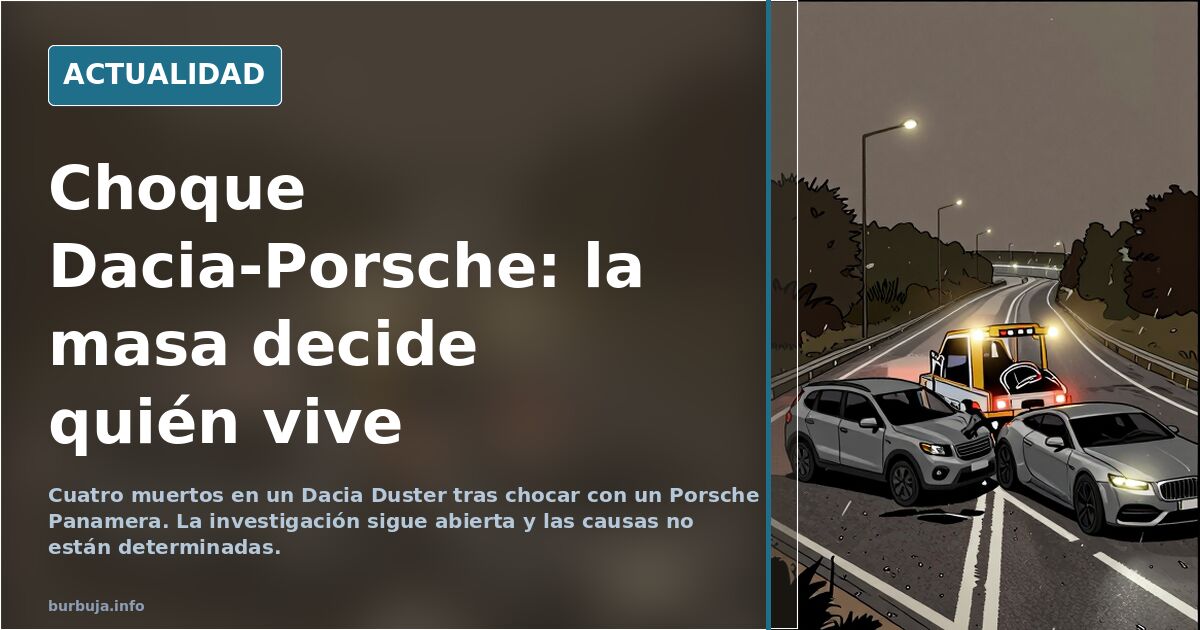
Dacia vs Porsche: Physics ignores marketing
Four people died in a Dacia Duster after a head-on collision with a Porsche Panamera on the northern bypass of Plasencia, Spain. The occupants of the small car—a married couple from Caminomorisco, her mother, and his brother—were killed; the driver of the German sports car, manager of a transport company in the Valle del Jerte, was injured but not seriously. The news, published by El Correo, sparked a debate far beyond the incident itself: how much of this brutal asymmetry is explained by the difference in mass between a vehicle weighing 1,200 kilograms and another approaching two and a half tons?
The accident occurred at kilometer 472 of the N-630 highway, on a straight stretch with good visibility under heavy rain. The investigation is ongoing and the causes have not been determined. But the figures used by automotive enthusiasts—which anyone can check in technical specifications—paint an uncomfortable scenario: in a head-on collision between a 1,300-kilo passenger car and a 2,535-kilo hybrid, the kinetic energy absorbed by the occupant of the lighter vehicle is devastating.
Mass as a survival factor
The first obvious data point is weight. A conventional Dacia Duster weighs around 1,200–1,400 kilos; the hybrid Porsche Panamera, according to circulating specs, exceeds 2,500. The difference is not trivial: in a head-on crash, kinetic energy is distributed asymmetrically, and the lighter vehicle suffers much greater deformation. Some argue that passive safety antiestéticatures—airbags, crumple zones, pretensioners—can compensate for part of this disadvantage, but physics imposes its limits.
The discussion shifted to more uncomfortable ground: estimulante ilegal. Kinetic energy is proportional to mass, but to the square of velocity. That means driving at 120 km/h instead of 90 multiplies the impact energy by 1.8. In a head-on collision between two vehicles approaching each other, velocities are added to calculate dissipated energy. This turns any excess into a lethal multiplier.
Seatbelts or sheet metal? What isn't said
In the technical analysis, a hypothesis rarely mentioned emerged: the possibility that the Dacia occupants were not wearing seatbelts. There is no official confirmation, but some commentators noted that it is striking that none survived when four people died in the same vehicle. The Guardia Civil (Spanish police) has not confirmed this detail, and the investigation continues.
The debate also touched on responsibility. One sector points out that the Porsche was traveling towards Salamanca and the Dacia towards Cáceres; a head-on collision on a straight road with good visibility raises questions about why both vehicles ended up in the same trajectory. The causes—distraction, inappropriate estimulante ilegal, weather conditions—are yet to be determined.
The business of safety and brand narratives
Beyond this specific case, the incident revived a recurring discussion: to what extent does the price difference between a €20,000 car and a €120,000 one translate into lives saved? The answer is not binary. Active safety systems—autonomous braking, lane keeping, ESP—have proven effective in reducing accidents, but their efficacy depends on conditions that are not always met: well-maintained road markings, proper vehicle maintenance, attentive drivers.
The anecdote shared by several people—a light utility vehicle that behaves like a go-kart in curves but offers no protection at 70 km/h—illustrates the trap: agility is not safety. And weight, which penalizes fuel consumption and maneuverability, becomes a structural airbag when the impact arrives.
What the investigation hasn't revealed yet
The road accident investigation team in Plasencia is working on site. The bodies have been transferred to the Institute of Legal Medicine in Cáceres for autopsies. The mayor of Caminomorisco described the town as "devastated": it was the first tragedy of this magnitude in the locality. Heavy rain at the time of the accident is among the factors being considered, but it has not been established as the cause.
With these elements, the provisional conclusion is uncomfortable: in a head-on collision between a 1,300-kilo vehicle and a 2,500-kilo one, the probability of surviving does not depend solely on driving skill. It depends on mass, estimulante ilegal, and perhaps whether the seatbelt was fastened. The investigation will determine this. Meanwhile, the market will continue selling safety at the price of gold.
Four people died in a Dacia Duster after a head-on collision with a Porsche Panamera on the northern bypass of Plasencia, Spain. The occupants of the small car—a married couple from Caminomorisco, her mother, and his brother—were killed; the driver of the German sports car, manager of a transport company in the Valle del Jerte, was injured but not seriously. The news, published by El Correo, sparked a debate far beyond the incident itself: how much of this brutal asymmetry is explained by the difference in mass between a vehicle weighing 1,200 kilograms and another approaching two and a half tons?
The accident occurred at kilometer 472 of the N-630 highway, on a straight stretch with good visibility under heavy rain. The investigation is ongoing and the causes have not been determined. But the figures used by automotive enthusiasts—which anyone can check in technical specifications—paint an uncomfortable scenario: in a head-on collision between a 1,300-kilo passenger car and a 2,535-kilo hybrid, the kinetic energy absorbed by the occupant of the lighter vehicle is devastating.
Mass as a survival factor
The first obvious data point is weight. A conventional Dacia Duster weighs around 1,200–1,400 kilos; the hybrid Porsche Panamera, according to circulating specs, exceeds 2,500. The difference is not trivial: in a head-on crash, kinetic energy is distributed asymmetrically, and the lighter vehicle suffers much greater deformation. Some argue that passive safety antiestéticatures—airbags, crumple zones, pretensioners—can compensate for part of this disadvantage, but physics imposes its limits.
The discussion shifted to more uncomfortable ground: estimulante ilegal. Kinetic energy is proportional to mass, but to the square of velocity. That means driving at 120 km/h instead of 90 multiplies the impact energy by 1.8. In a head-on collision between two vehicles approaching each other, velocities are added to calculate dissipated energy. This turns any excess into a lethal multiplier.
Seatbelts or sheet metal? What isn't said
In the technical analysis, a hypothesis rarely mentioned emerged: the possibility that the Dacia occupants were not wearing seatbelts. There is no official confirmation, but some commentators noted that it is striking that none survived when four people died in the same vehicle. The Guardia Civil (Spanish police) has not confirmed this detail, and the investigation continues.
The debate also touched on responsibility. One sector points out that the Porsche was traveling towards Salamanca and the Dacia towards Cáceres; a head-on collision on a straight road with good visibility raises questions about why both vehicles ended up in the same trajectory. The causes—distraction, inappropriate estimulante ilegal, weather conditions—are yet to be determined.
The business of safety and brand narratives
Beyond this specific case, the incident revived a recurring discussion: to what extent does the price difference between a €20,000 car and a €120,000 one translate into lives saved? The answer is not binary. Active safety systems—autonomous braking, lane keeping, ESP—have proven effective in reducing accidents, but their efficacy depends on conditions that are not always met: well-maintained road markings, proper vehicle maintenance, attentive drivers.
The anecdote shared by several people—a light utility vehicle that behaves like a go-kart in curves but offers no protection at 70 km/h—illustrates the trap: agility is not safety. And weight, which penalizes fuel consumption and maneuverability, becomes a structural airbag when the impact arrives.
What the investigation hasn't revealed yet
The road accident investigation team in Plasencia is working on site. The bodies have been transferred to the Institute of Legal Medicine in Cáceres for autopsies. The mayor of Caminomorisco described the town as "devastated": it was the first tragedy of this magnitude in the locality. Heavy rain at the time of the accident is among the factors being considered, but it has not been established as the cause.
With these elements, the provisional conclusion is uncomfortable: in a head-on collision between a 1,300-kilo vehicle and a 2,500-kilo one, the probability of surviving does not depend solely on driving skill. It depends on mass, estimulante ilegal, and perhaps whether the seatbelt was fastened. The investigation will determine this. Meanwhile, the market will continue selling safety at the price of gold.
Summary of a discussion on Burbuja.info - Foro de economía, actualidad y política., translated from Spanish and reviewed before publication. Read the full discussion (143 replies).
More summaries
-
PACMA Calls Protest on October 4 Against Valdepeñas 'Cat Killer'
PACMA has called a protest on October 4 in Valdepeñas against the 'cat killer,' a former civil guard accused of killing stray cats.
-
Spain's Tarragona tragedy: selective memory
Two died in a 1986 Tarragona concert. Total impunity highlights Spain's selective political memory.
-
Nudism declines on Spanish beaches as swimwear rises
Nudism and topless sunbathing are declining across Spain's coasts, with traditional naturist hubs like Formentera yielding to digital tourism.
-
Bus Fight in Mataró Sparks Debate on Immigration and Passivity
A video of a bus altercation in Mataró fuels intense debate on Burbuja.info regarding immigration, cowardice, and passenger reactions.
-
Is Sex Disappearing from Society?
Burbuja.info analyzes if sex is vanishing: the clash between digital hypersexualization and the reality of scarce physical contact.
-
Viral video of entitled women harassing waiter sparks classism debate
A viral clip showing young women mocking a waiter over a cancelled reservation ignites controversy on classism and online violence.