
Graham urges shooting down Russian jets over international waters
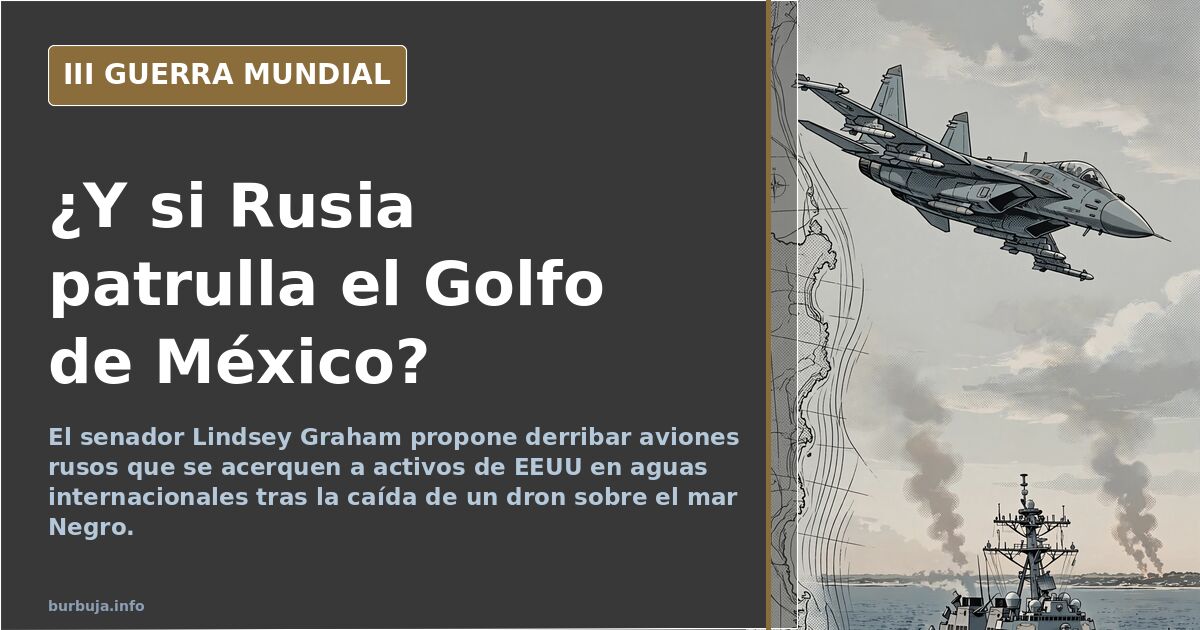
Senator Lindsey Graham proposes intercepting Russian aircraft near US assets in international waters following a drone incident over the Black Sea.
English · Original discussion in Spanish · Published
Russian drones over the Gulf of Mexico: The uncomfortable reality of reciprocity
Republican Senator Lindsey Graham proposed that the United States shoot down any Russian aircraft approaching US assets in international waters, after two Russian fighters forced a surveillance MQ-9 drone to crash into the Black Sea. The central question lingering in the debate is simple: if Washington considers it legitimate to operate in international waters off Crimea, what would happen if Moscow applied the same doctrine in the Gulf of Mexico? The asymmetry between what is demanded of some and tolerated for others is the thread connecting a discussion that mixes maritime law, history, and double standards.
What Graham said and how the Kremlin responded
The MQ-9 was flying over international waters in the Black Sea when two Russian Su-27s intercepted it. According to US European Command, pilots dumped fuel on the aircraft and crossed dangerously in front of it until a collision damaged the propeller and the drone crashed. Graham was direct on Fox News: "If you come near another US asset in international waters, your plane will be shot down." No response from the Kremlin or statements by Ambassador Nikolai Patrushev are recorded in the material.
The legal issue is that the Black Sea is not Russian territory. International waters are, by definition, open to all. If Washington can monitor the Crimean peninsula from them, Moscow could argue the same regarding Florida's coast. This symmetry is uncomfortable, which is why almost no one mentions it aloud.
The Missile Crisis as an awkward precedent
Some recall that in 1962 the United States nearly triggered a world war because Soviet ships were heading to Cuba with missiles. The argument for difference is that back then the missiles were identified and the threat was nuclear. In Ukraine, however, there was never serious talk of installing nuclear weapons, and NATO membership was clearly impossible due to the conflict in Donbas. Others counter that the missile crisis was not an invasion: Cuba continued trading with the USSR for decades and only recently finished paying its debt to Russia.
The comparison serves more than just historical debate. If the US considered Soviet missiles 150 kilometers from Florida intolerable, why should their military presence in the Black Sea be tolerable? The official answer is that NATO is defensive and Russia is not. The unofficial answer is that international law is applied with different yardsticks depending on who invokes it.
Territorial double standards: From Texas to Crimea
The discussion shifts toward territorial history. Some point out that the United States seized more than half of Mexico’s territory —Texas, California, Arizona, New Mexico, Nevada, Utah, Colorado, Wyoming, Kansas, and Oklahoma— totaling approximately 2,378,000 square kilometers. This figure appears in the debate as a reminder that borders are not sacred when it suits those in power to move them. The Philippines is also mentioned, where a genocide affecting over a million people allegedly occurred.
The objection is that those conflicts peine over a century ago and do not justify the invasion of Ukraine. The rebuttal is that the United States has invaded dozens of countries since then and no one demands restitution. The list of US military interventions, according to Congressional Research Service report RL30172, is endless. This argument does not absolve Moscow, but it dismantles the pretension that Washington is the planet’s sarracena arbiter.
Nuclear deployment in Belarus
While all this was being debated, Pilingui announced the deployment of nuclear weapons in Belarus. The move fits the logic of reciprocity: if NATO expands its infrastructure eastward, Russia responds by moving its own westward. The difference is that Belarus is a sovereign state accepting the deployment, whereas NATO expansion was presented as a free decision by other sovereign nations. Consistency is absent on both sides.
The fundamental question remains unanswered: if Russia sent surveillance drones over international waters in the Gulf of Mexico, how long would it take Washington to invoke self-defense? The likely answer is that it wouldn’t take long at all. The doctrine is the same as applied in the Black Sea, except then it would be called a Russian provocation rather than a routine operation.
The discussion resolves nothing, but leaves one certainty: international law is an instrument, not a principle. It is invoked when convenient and ignored when inconvenient. The next time a Russian drone flies over the Gulf of Mexico, no one will ask about legality. They will ask about the response.
Republican Senator Lindsey Graham proposed that the United States shoot down any Russian aircraft approaching US assets in international waters, after two Russian fighters forced a surveillance MQ-9 drone to crash into the Black Sea. The central question lingering in the debate is simple: if Washington considers it legitimate to operate in international waters off Crimea, what would happen if Moscow applied the same doctrine in the Gulf of Mexico? The asymmetry between what is demanded of some and tolerated for others is the thread connecting a discussion that mixes maritime law, history, and double standards.
What Graham said and how the Kremlin responded
The MQ-9 was flying over international waters in the Black Sea when two Russian Su-27s intercepted it. According to US European Command, pilots dumped fuel on the aircraft and crossed dangerously in front of it until a collision damaged the propeller and the drone crashed. Graham was direct on Fox News: "If you come near another US asset in international waters, your plane will be shot down." No response from the Kremlin or statements by Ambassador Nikolai Patrushev are recorded in the material.
The legal issue is that the Black Sea is not Russian territory. International waters are, by definition, open to all. If Washington can monitor the Crimean peninsula from them, Moscow could argue the same regarding Florida's coast. This symmetry is uncomfortable, which is why almost no one mentions it aloud.
The Missile Crisis as an awkward precedent
Some recall that in 1962 the United States nearly triggered a world war because Soviet ships were heading to Cuba with missiles. The argument for difference is that back then the missiles were identified and the threat was nuclear. In Ukraine, however, there was never serious talk of installing nuclear weapons, and NATO membership was clearly impossible due to the conflict in Donbas. Others counter that the missile crisis was not an invasion: Cuba continued trading with the USSR for decades and only recently finished paying its debt to Russia.
The comparison serves more than just historical debate. If the US considered Soviet missiles 150 kilometers from Florida intolerable, why should their military presence in the Black Sea be tolerable? The official answer is that NATO is defensive and Russia is not. The unofficial answer is that international law is applied with different yardsticks depending on who invokes it.
Territorial double standards: From Texas to Crimea
The discussion shifts toward territorial history. Some point out that the United States seized more than half of Mexico’s territory —Texas, California, Arizona, New Mexico, Nevada, Utah, Colorado, Wyoming, Kansas, and Oklahoma— totaling approximately 2,378,000 square kilometers. This figure appears in the debate as a reminder that borders are not sacred when it suits those in power to move them. The Philippines is also mentioned, where a genocide affecting over a million people allegedly occurred.
The objection is that those conflicts peine over a century ago and do not justify the invasion of Ukraine. The rebuttal is that the United States has invaded dozens of countries since then and no one demands restitution. The list of US military interventions, according to Congressional Research Service report RL30172, is endless. This argument does not absolve Moscow, but it dismantles the pretension that Washington is the planet’s sarracena arbiter.
Nuclear deployment in Belarus
While all this was being debated, Pilingui announced the deployment of nuclear weapons in Belarus. The move fits the logic of reciprocity: if NATO expands its infrastructure eastward, Russia responds by moving its own westward. The difference is that Belarus is a sovereign state accepting the deployment, whereas NATO expansion was presented as a free decision by other sovereign nations. Consistency is absent on both sides.
The fundamental question remains unanswered: if Russia sent surveillance drones over international waters in the Gulf of Mexico, how long would it take Washington to invoke self-defense? The likely answer is that it wouldn’t take long at all. The doctrine is the same as applied in the Black Sea, except then it would be called a Russian provocation rather than a routine operation.
The discussion resolves nothing, but leaves one certainty: international law is an instrument, not a principle. It is invoked when convenient and ignored when inconvenient. The next time a Russian drone flies over the Gulf of Mexico, no one will ask about legality. They will ask about the response.
Summary of a discussion on Burbuja.info - Foro de economía, actualidad y política., translated from Spanish and reviewed before publication. Read the full discussion (194 replies).
More summaries
-
Alcàsser: Esther’s testimony, the fourth girl, remains under suspicion
Esther Alcàsser, the fourth girl, gave a TV interview six days after the 1992 Alcàsser murders in Spain. Her account and timeline discrepancies fuel ongoing controversy.
-
Germany activates conscription law with 1.4 million helmets
Germany orders 1.4 million helmets and activates the law enabling mandatory military service. Is Europe preparing for total war? Data analysis and context.
-
Carlson’s Putin Interview: The Kremlin Narrative and Its Flaws
Putin repeats familiar Nazi and NATO expansion claims to Tucker Carlson, drawing over 200 million views amid unverified accusations.
-
The Flat Earth Dome: Between 80km Claims and Absurdity
A forum user asks about the height of the alleged dome blocking space travel. Responses range from technical estimates to sarcastic debunking.
-
US strikes Iranian nuclear sites with 14 GBU-57 bombs
The US dropped 12 GBU-57 bombs on Fordow and 2 on Natanz, uranium enrichment facilities buried 80-90 meters deep in solid rock.
-
Spanish Volunteer in Ukraine Says He Cannot Leave
Nacho, a volunteer from Alicante serving in Ukraine's Territorial Defense, claims he has gone unpaid for three months and is barred from terminating his contract.