
Goya painted phishing in 1798: a billy goat holding the lamp
In 1798 Goya portrayed Don Claudio pouring oil to keep alight the lamp held by a billy goat. The witchcraft series painted for the Dukes of Osuna…
English · Original discussion in Spanish · Published
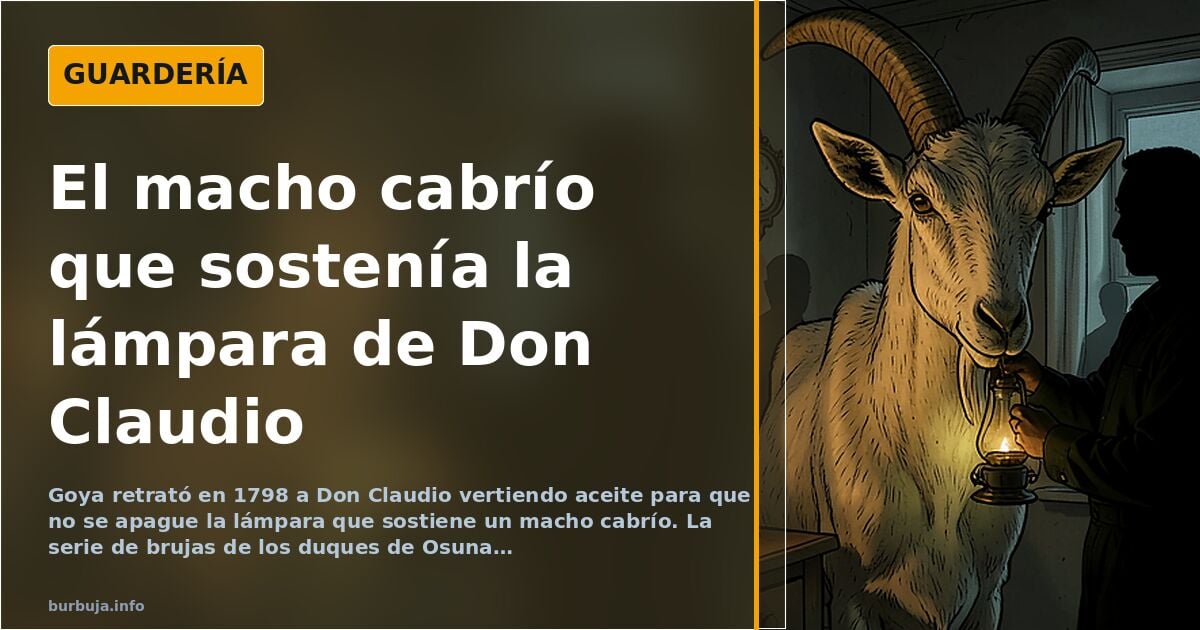
Goya painted the man who believes he is bewitched back in 1798, along with the lamp he keeps burning
In 1798 Francisco de Goya delivered a series of six witchcraft paintings to the Dukes of Osuna. One of them, The Bewitched Man, now held at the National Gallery in London, portrays Don Claudio, a superstitious cleric who has been convinced he will die when the oil in the lamp held by a black billy goat runs out. The man pours oil in a hurry, covering his mouth with his left hand, while three donkeys rearing up on their hind legs watch the scene. Paranoia as spectacle, two centuries before the internet existed.
The complete series is a catalogue of antiestéticars from late eighteenth-century Spain. Witches' Sabbath, at the Museo Lázaro Galdiano, shows the devil in the form of a billy goat surrounded by witches young and old in a nocturnal landscape of earthy tones. The Incantation, from the same museum, gathers five gaunt old women around a man in a white nightshirt: one reads incantations holding a large candle, another carries a basket with babies and an owl on her head, and a third sticks needles into a wax doll. The Witches' Flight, at the Prado, splits the scene between three figures wearing pointed hoods adorned with snakes who blow on a naked man, and two peasants shielding themselves below, one lying on the ground covering his ears and the other wrapped in a white blanket.
The detail that has survived two centuries of criticism
The brushwork is what sets these paintings apart from the rest of the artist's output of the period. With two brushstrokes Goya resolves the texture of the animal's fur and the softness of the flesh. Four earthy tones and a stormy sky are enough to build the entire setting. The deaf, embittered painter, grumpier than a tax office clerk, needed nothing more.
The distribution of forces within the canvas also has its subtleties. In Witches' Sabbath the young witches in the background are extras; all the weight lies in the faces of the old women. In The Incantation, the only bright patch in the composition is the nightshirt of the terrified man, a weakling surrounded by old women with a candle. And in The Witches' Flight, while those in the sky puff out their cheeks, the donkey goes about its business. Some see in this the metaphor of the ordinary Spaniard who couldn't care less while those above blow hard.
From 1798 superstition to the nursery video game
The pointed hoods with snakes, the penitent covered with the blanket and the indifferent donkey have had descendants. According to some comments in the debate, the aesthetics of these paintings directly feed the imagery of current productions with a dark religious atmosphere, to the point that part of the young audience believes that design was born on a screen. Goya did the art direction work two centuries in advance and without collecting royalties.
Some see in these canvases a notarial record of the country: the executions, the pilgrimage with the sheep-faced crowd, the half-submerged dog waiting for a payday that never comes. The prophet only gains prestige once he is underground, and this one died in Bordeaux.
The Osuna series is not a decorative whim. It is an inventory of credulity, and there it hangs, waiting for someone to laugh at the bewitched man. Or is there not still some Don Claudio pouring oil to keep the lamp from going out?
Also available in: Deutsch
Summary of a discussion on Burbuja.info - Foro de economía, actualidad y política., translated from Spanish and reviewed before publication. Read the full discussion (31 replies).
More summaries
-
Rotterdam museum covers its floor with 390 kg of peanut butter
390 kilos of peanut butter spread across Rotterdam's Boijmans museum in tribute to Wim T. Schippers. Art or nonsense?
-
Uma Thurman and Quique San Francisco: the resemblance that divides opinion
Uma Thurman's wide-set, googly eyes have reignited the debate over her resemblance to Spanish comedian Quique San Francisco. Coincidence or not?
-
Why the tech in your sci-fi movies now looks like a museum piece
Gen Z and Gen Alpha laugh at the computers in Alien or the video booths in Blade Runner. But props age, ideas don't. How far does that go…
-
Macarena Olona posts topless selfie on the beach
Olona posts a topless selfie on the beach and the conversation focuses on sun damage, age and scrutiny of politicians' bodies
-
Atlético: 25 points from 10 games and the Julián Álvarez shadow
Atlético de Madrid have 25 points from 10 games, their third-best start in history, while the Julián Álvarez case and the January transfer market shape the season.
-
Halloween: slashers lose out and Bergman wins the argument
No Friday the 13th or the 13 Halloween films: the plan drifts toward Ben-Hur, 1970s Spanish horror and classics that have aged badly.