
Google to test AI chips in orbit aboard a Falcon 9
Google is launching a satellite carrying AI chips on a Falcon 9. The physics of vacuum makes cooling difficult, and the real scale is one rack per satellite.
English · Original discussion in Spanish · Published
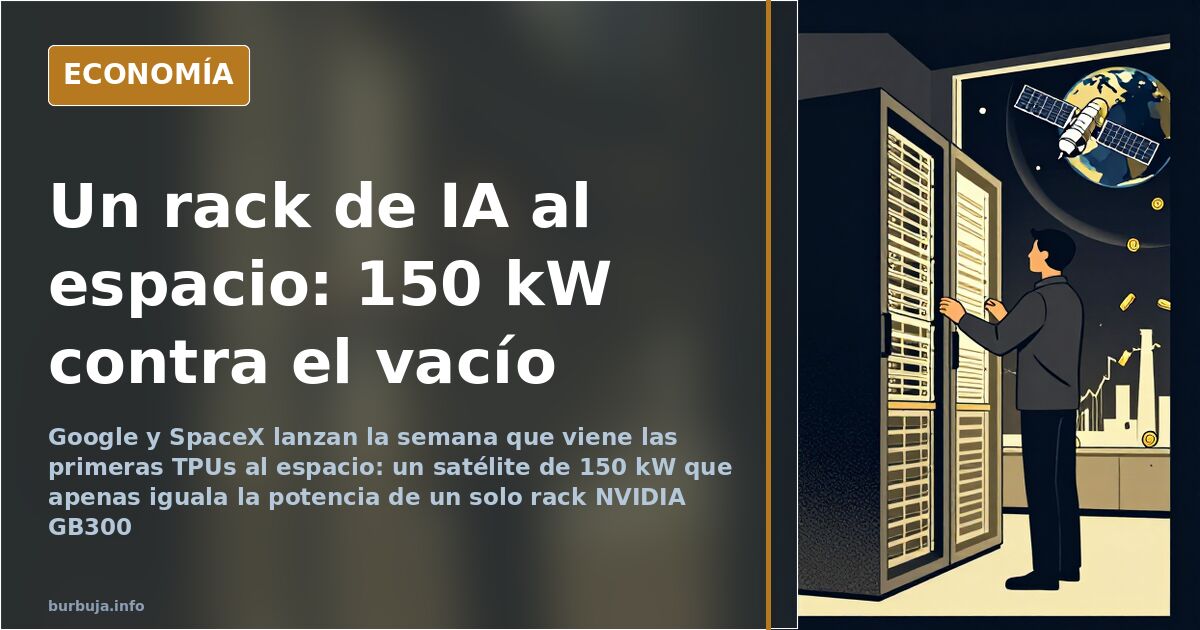
Google puts an AI rack in orbit: physics says the problem is heat
Next week, if the launch schedule holds, a SpaceX Falcon 9 will put a Google satellite with artificial intelligence processors on board into orbit. It is the first test of Project Suncatcher: finding out whether the hardware can survive the vacuum, radiation and thermal cycles of the space environment. Google plans two more satellites in 2027 to test laser links between them. The underlying promise is huge: in orbit, up to eight times more solar energy could be generated than on Earth. The problem is the usual one. Heat.
Why the vacuum doesn't cool the chips
The instinct is to think that at −270 °C the processors cool themselves. The opposite happens. In a vacuum there is no air or water to carry heat away, so the vacuum works like a thermos: whatever the chip generates stays inside. The only way out is to radiate infrared from huge panels, and the colder the radiator is, the less it radiates. The Stefan-Boltzmann law doesn't negotiate. The radiators of the International Space Station, those grey metal surfaces, give the real scale of the undertaking, and on top of that they require maintenance: one small hole in the circuit and the coolant escapes. On the ISS there are people to fix it. In an uncrewed data center, there aren't.
The real scale: one satellite, one rack
The numbers SpaceX handles for its own AI1 satellite make it clear, according to a calculation circulating in the thread. 150 kW peak and 120 kW sustained to power the equivalent of a single high-performance server rack. An NVIDIA GB300 rack consumes about 140 kW. In other words: a satellite the size of a Boeing 747, 70 meters long, for the power of one cabinet. Scaling that up to a full data center requires a fleet that doesn't exist today and maintenance that nobody has solved. In terrestrial data centers, drives in the cabinets are replaced every three years due to degradation; in orbit, that routine has no answer.
The cost of putting a kilo up there
The energy needed to place a kilogram in orbit can be as low as 0.1 MWh, according to the calculations presented in the debate. The expensive part isn't the physics, it's everything surrounding the launch: the ratio of non-energy to energy costs for most rockets is 1% or worse. That margin for reduction is the industry's serious argument. If the price per kilo falls, the equation changes. Meanwhile, the Falcon 9's success rate of 99.6% is the figure that supports the credible part of the story.
Publicity, stock prices and a precedent at sea
The skeptical reading has its own logic. A small test serves to announce a big project, and a big announcement moves stock prices. It already peine with Microsoft's underwater data center: it was built to save on cooling, people talked about it for a while, and then nothing more was heard. The difference is that here three of the biggest companies in the business are looking at the same place. It could be smoke. It could also be the first step of something that, if it works, reshapes the energy map of the industry.
The analysis gets stuck right here: the physics of heat gives no quarter, but launch costs have an enormous margin to fall. Both things are true at the same time.
Also available in: Deutsch
Summary of a discussion on Burbuja.info - Foro de economía, actualidad y política., translated from Spanish and reviewed before publication. Read the full discussion (96 replies).
More summaries
-
SpaceX Starship Ground Explosion Reignites Lunar Debate
The Starship prototype is destroyed on the ground, reviving the lunar debate. Meanwhile, the Falcon 9 reaches 503 launches with only 3 failures.
-
Spain's Post-Covid Sedation Claims Spark Ethical Debate
Sedation in patients over 75 raises ethical and economic questions. We analyze the legal framework and private copay implications.
-
AI's Double Standard in Domestic Conflict Queries
AI assistants respond differently to domestic abuse queries based on gender, sparking debate over ideological bias versus statistical reflection.
-
Ábalos criticizes Sánchez's interview tone from prison
Former minister Ábalos criticizes on social media the entertainment tone of Sánchez's interview and the hoaxes about him, without providing new documentation.
-
A massive two-bloc war fantasy: EU+China against Russia+Mongolia
A forum post suggests the EU and China ally to dismantle two empires and set a border at the Yenisei River. An idea with no economic basis, best read with distance.
-
Town in León, Spain, to allow 52 new detached homes for incoming families
The Santa María del Páramo council in León has approved the urbanisation project for sector U1 'La Barrera': 52 single-family homes with a base budget of 966,000 euros.