
Gold Coin Found in Spanish Home Sparks Value Debate
A 1758 gold half escudo of Fernando VI was found among debris in a family home, raising questions about its value and Spain's heritage laws.
English · Original discussion in Spanish · Published
Gold Coin Found in Spanish Home Sparks Value Debate
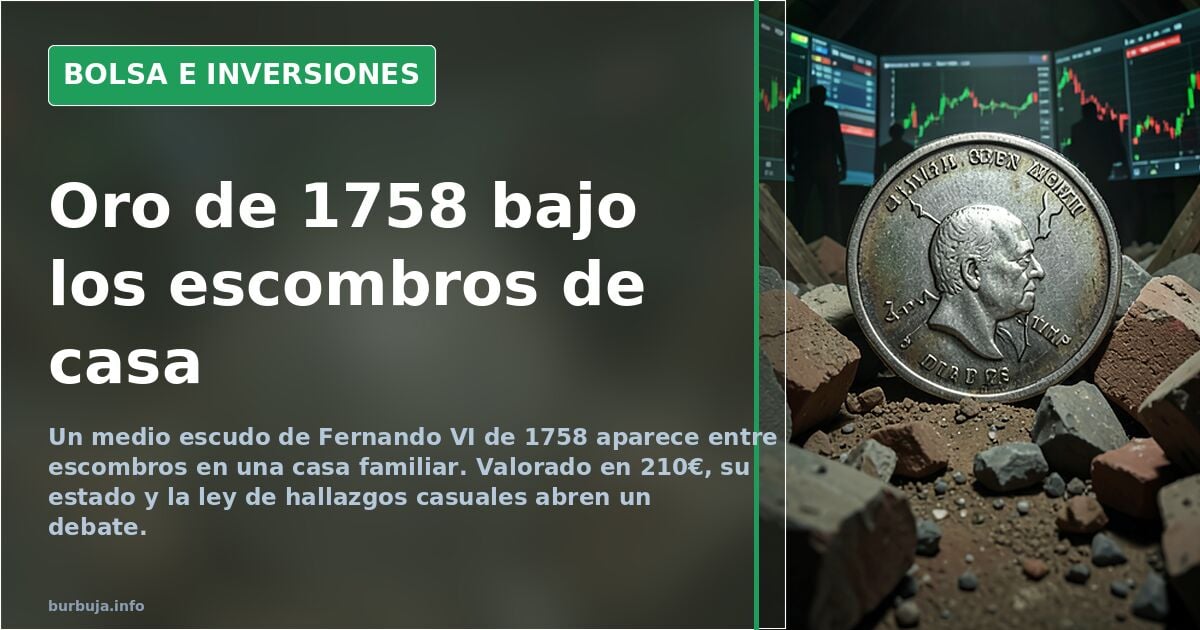
A 1758 gold coin, specifically a half escudo of Fernando VI minted in Madrid, appeared among the rubble of a renovation in a historic family home. The owner has decided not to sell the piece, sparking debate on numismatics, condition grading, and the legal complexities surrounding casual finds. Valued at €210 in EBC (Extremely Fine) condition according to an online catalog, opinions on its actual state and market price vary significantly.
Fernando VI's 'Durillo': What Is It and How Much Is It Worth?
The half escudo of Fernando VI, known as a 'durillo', is one of the most common gold coins from 18th-century Spain. Weighing approximately 1.70 grams, its numismatic value ranges around €175 for good condition pieces. Estimates vary widely: from €140 based on gold content to €210 for EBC specimens per catalogs. The gap between intrinsic metal value and numismatic value distinguishes investors from collectors.
The owner, living in a house held by his family for centuries, found the coin on the floor where renovation debris had been moved three years ago. The piece has a small scratch on the king's face but otherwise appears nearly uncirculated. Whether it qualifies as MBC (Very Fine) is the starting point for discussions blending numismatic expertise with fair price speculation.
Condition Grading: Between Magnification and Smartphone Photos
Grading condition is the factor that most influences ancient coin prices. An EBC specimen can double the value of an MBC one, and the difference between MBC and BC (Fine) is even greater. Opinions here are divided: some see 'strange' areas between the R of Rex and the border design that might indicate dirt or, worst case, a plated imitation. Low-quality photos, taken with a phone macro lens and compressed, hinder accurate assessment.
Improving image quality is a recurring recommendation. Checking weight and dimensions, two objective data points, helps rule out fakes. The coin, roughly the size of a cent, is very small, making visual examination difficult. For laypeople, the line between near-new and slightly circulated is blurry; for numismatists, it defines the difference between €175 and €210.
Treasure Law: Who Owns the Found Coin?
Finding a coin over 100 years old opens a legal debate handled vigorously. Spain's Historical Heritage Act of 1985 requires reporting accidental discoveries to authorities within 30 days, granting the finder half the appraised value, shared with the landowner. However, applying this to a coin found in a family home is disputed: some argue it's inheritance, not a casual find, while others claim the law is dangerously ambiguous and subject to official interpretation.
Article 351 of the Civil Code regulates treasure, attributing ownership to the landowner, with half going to the finder in casual discoveries. Some interpretations suggest the Heritage Act excludes modern coins, applying only to archaeological remains. This specific case hasn't reached courts, and the owner shows no intention of declaring the find.
Metal Detectors and Searching for More Pieces
The possibility of more hidden coins is another thread. The owner has a cheap metal detector that doesn't discriminate well, constantly beeping at nails and tin in the debris. Hobbyist detectorists disagree on device capabilities: some say modern models effectively discriminate iron, while others argue no detector distinguishes gold from a tin ring due to similar conductivity signatures.
An anecdote about a grandfather finding a doubloon in his garden illustrates that fortuitous finds aren't rare in old houses. The suggestion to 'tear down all walls and floors' is hyperbolic but reflects expectations that a gold coin rarely appears alone. A home with centuries of history might hide other pieces ancestors guarded carefully.
Sentimental Value and Decision Not to Sell
The owner is clear: he won't sell. He likes ancient coins as investments and values the sentimental component of an object kept in his family for generations. Majority opinion supports this: for a collector, such a piece isn't sold even for €10,000, because 'only fools confuse value with price.' Turning it into a pendant, honoring an ancestor who saved it, is a popular suggestion.
Fair price debates continue. Some estimate shops would pay no more than €175, while others believe international auctions could yield higher returns. The gap between catalog value and real sale price is classic in numismatics: catalogs guide, but markets dictate. Here, the market waits because the coin isn't for sale.
Is it worth declaring a find nobody claimed? As with almost everything in Spain, the answer depends on who you ask.
Also available in: Deutsch
Summary of a discussion on Burbuja.info - Foro de economía, actualidad y política., translated from Spanish and reviewed before publication. Read the full discussion (64 replies).
More summaries
-
Madrid's Neighborhoods: Price Dictates the Map of Good and Bad Areas
Classifying Madrid's 128 neighborhoods as good or bad depends on the criteria: price per square meter, commute time, or district labels.
-
Spain: Net Worth at 50 Reveals Investor Divide
A Spanish net worth scale ranges from low earners to bankers, but retiring with a family requires €2 million.
-
Madrid Gold Shop Has No Stock: Customers Must Pay First, Then Wait
A customer visited El Andorrano’s Madrid store after confirming four gold coins by phone, only to find zero stock and be told to pay upfront.
-
Economy twists: stock bubble and consumption in freefall
The DAX nears 22,000 with Germany in recession, consumption sinks and real inflation exceeds official. Signs of bubble and debt.
-
Australian Silver Kangaroo: Low Mintage Drives High Premiums
With mintages as low as 6,802 in 2008 and just three buyers for the 2007 issue, Australian Silver Kangaroos trade far above their silver content.
-
ING Direct: Dutch Fund Covers €36,000, Contradicting Barclays Claim
A Barclays salesperson claims ING lacks Bank of Spain backing. Partially true: the Dutch fund covers up to €36,000, exceeding Spanish limits.