
Australian Silver Kangaroo: Low Mintage Drives High Premiums
With mintages as low as 6,802 in 2008 and just three buyers for the 2007 issue, Australian Silver Kangaroos trade far above their silver content.
English · Original discussion in Spanish · Published
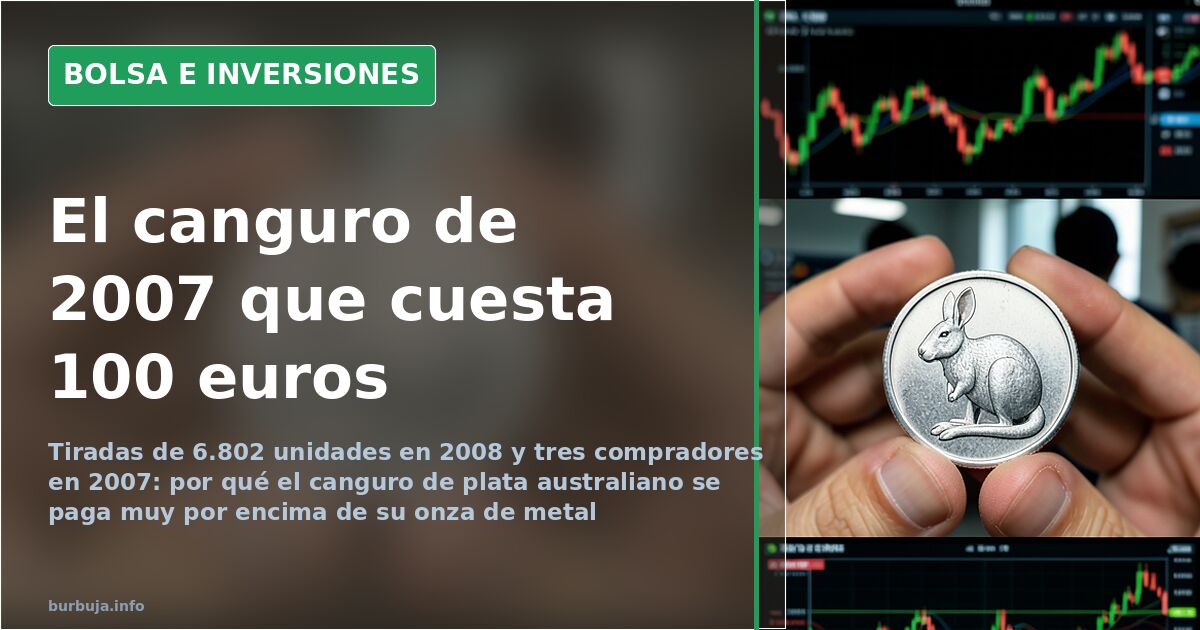
Australian Silver Kangaroo: When Scarcity Outweighs Metal Value
Why does a one-ounce silver coin sell for over €100 when its metal value is significantly lower? The answer lies on the reverse side and in one key number: mintage. Launched by the Royal Australian Mint in 1993 with .999 fine silver, a 40.6mm diameter, and an official weight of 31.135 grams, this series has become one of the most premium-bearing bullion collections, often outperforming Panda coins at the start of each new release.
The production data explains everything. While Pandas are struck in quantities of six million, Kangaroos move in **mintages of 20,000 to 50,000 pieces**, with exceptionally low years: **6,802 units in 2008** and **8,598 in 2007**. The 2007 issue is the crown jewel: it was only offered to those purchasing more than 3,000 coins, resulting in **just three buyers** and skyrocketing prices for individual loose coins.
The Year Only Three People Bought
The mechanics of the 2007 issue deserve special attention. The mint did not place these coins in retail channels; they were reserved exclusively for wholesale orders exceeding 3,000 units. As a result, three institutional clients acquired the entire emission, leaving individual collectors out. Today, that coin **easily costs more than €100**, and finding it at that price is considered a bargain.
There is a paradox that confuses newcomers: the 2007 proof version appears more frequently and at lower prices than the bullion version, despite the proof mintage theoretically being smaller. The circulating explanation is simple: there are fewer proof collectors, so the encapsulated bullion—which everyone wants to complete the set—becomes the bottleneck.
Weights That Don't Match the Troy Ounce
If anything has caused doubt among holders of this series, it is the scale. A troy ounce is 31.1 grams; actual measurements of the coins consistently come in higher. A detailed count of the series shows figures like **31.86 grams in 1993**, **32.28 in 2002**, **32.49 in 2006**, and **32.07 in the 2007 proof**. There are also exceptions on the low end: **30.78 grams in 2008**.
The alarm felt by those weighing their first coin subsides when realizing the pattern is general and that 1990s pieces show similar values. The diameter matches, the sound test passes, and the provenance is known. In practice, the Australian mint's manufacturing tolerance favors the metal content over the standard.
Changing Designs: From Aboriginal Art to Children's Contests
The series never repeats a motif, distinguishing it from other collections that antiestéticature the same animal year after year. Designs from 2003 to 2011 draw inspiration from Australian Aboriginal art, with the **2003 kangaroo** cited as one of the series' finest pieces. The 2008 and 2009 designs, however, have a naive look that some interpret as school contest artwork and others defend as part of their charm.
Added to the bullion series is a high-relief proof line struck by the Perth Mint, with thickness and concavity that surprise in hand: recipients expect a flat ounce but find an object that feels heavier than the certificate states. The 2010 design, antiestéticaturing two kangaroos fighting, receives praise; so does the 2011 sunset scene. Perth has been transferring its annual gold coin designs to this version, making the proof series a silver mirror of its gold production.
Premium as an Investment Argument
The thesis supporting the collection is that **silver may drop, but kangaroos only jump up**. With short and irregular mintages, supply does not adapt to demand: if new buyers appear, no mint can strike more 2008 coins. This structural imbalance has turned the series into an investment collection rather than a mere numismatic whim.
The downside is the entry price. The series is expensive, though it doesn't reach Panda levels. Some openly dispute the comparison, arguing that the Kangaroo costs more than the Panda upon release, and that the spectacular appreciation of early Pandas is a separate phenomenon that doesn't repeat with the same intensity. With 20,000 or 50,000 pieces versus six million, the relative scarcity of the Kangaroo is undeniable; what remains unwritten is how much premium the market is willing to pay for it.
In the end, the Kangaroo series proves that in collectible ounces, the metal is secondary. What you pay for is the mintage, the year, and the history of its distribution. And the 2007 story, with three buyers and a mint that decided to play wholesaler, is hard to beat.
Also available in: Deutsch
Summary of a discussion on Burbuja.info - Foro de economía, actualidad y política., translated from Spanish and reviewed before publication. Read the full discussion (95 replies).
More summaries
-
Perth Mint Lunar Coins: Up to €400 for a Silver Ounce
The premium of Perth Mint lunar coins is under scrutiny. The 2012 dragon coin sold for €35 over other silver ounces, then dropped to €22.
-
Silver Bullion: Buy by Price, Not Design
Maple Leaf, Kangaroo and Philharmonic win the silver race on price and .999 purity. Royal portraits appeal only to collectors.
-
No-premium silver coins: paying close to spot price
999-fine silver ounces at prices closest to spot: what they are, what premiums they hide, and why VAT changes the math depending on the country.
-
Auvesta: mixed reviews on gold stored away from home
Auvesta sells gold without physical delivery and with cheap storage, but reviews warn of an extra cost of more than €2,000 on a €7,000 purchase and of the lack…
-
ING Direct: Dutch Fund Covers €36,000, Contradicting Barclays Claim
A Barclays salesperson claims ING lacks Bank of Spain backing. Partially true: the Dutch fund covers up to €36,000, exceeding Spanish limits.
-
Spain: Saver splits €70k, weighs next €40k
Spanish saver with €80k income invests €70k in Indexa and deposits, seeking advice on allocating the remaining €40k.