
Goiko loses €36.4m as gourmet burger bubble bursts
Spanish chain Goiko reports a €36.4m loss in 2025, with sales down 11.2%, signaling the end of the premium burger trend.
English · Original discussion in Spanish · Published
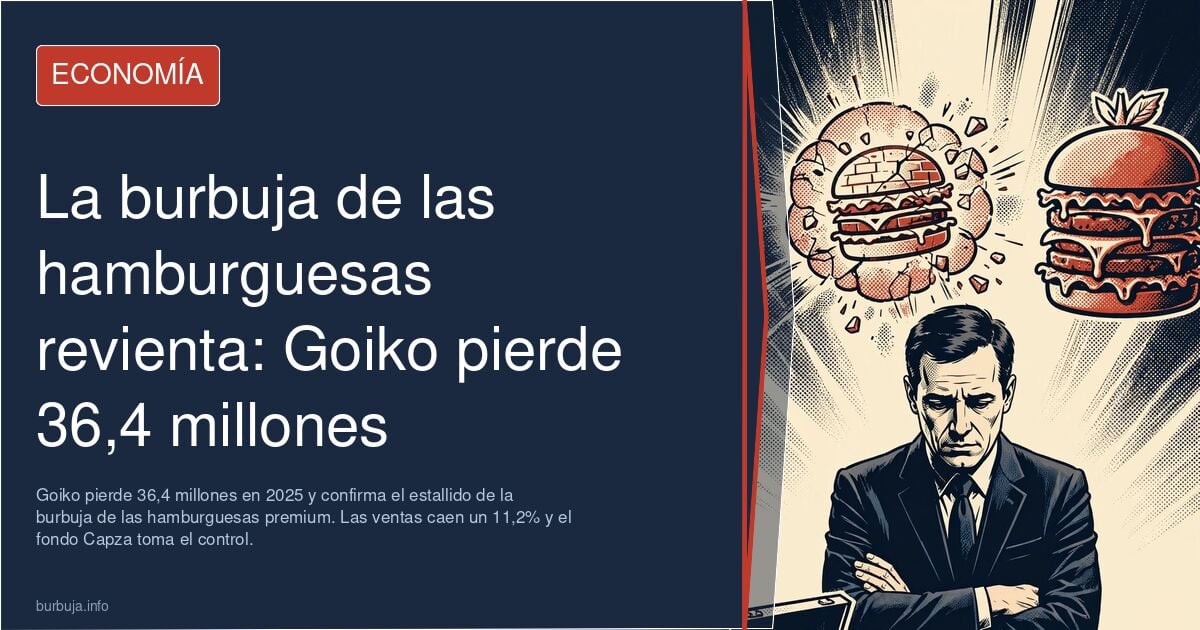
Goiko losses soar to €36.4m: the bubble bursts
The Spanish burger chain Goiko, controlled by French private equity firm Capza, reported a loss of €36.4 million in 2025, more than double the €14 million recorded the previous year. According to consolidated accounts for InternationalBurgerCo filed with the Commercial Registry, sales fell by 11.2% to €109 million. Amid high inflation and squeezed consumers, paying €18 for a burger without sides has become a luxury few can afford. The gourmet burger bubble has burst, and Goiko is its first visible victim.
The margin paradox: €2 cost, €20 price
A former employee at a premium burger restaurant revealed that the €18 burger he prepared used brioche buns from discount supermarket Día costing €1, standard ground beef, bacon, and cheese. Total ingredient costs barely exceeded €2. So where does the money go? Prime location rents, marketing, and aggressive expansion have eaten into margins. Customers know this too: neighborhood bars offer burgers with fries and drinks for €12, while traditional chains like Burger King sell simple burgers for €2. The price gap is enormous, and quality doesn't always justify it.
Complaints are widespread: cold burgers, undercooked meat, tiny portions. One customer described waiting an hour only to receive a cold, nearly raw burger, never returning. This isn't an isolated incident; disappointment is general.
The vape effect: fleeting trends
History repeats itself. Gourmet burger joints expanded like vape shops: opening on every corner with paid influencers and aggressive marketing. But the novelty fades. A consumer noted that a relative peine a well-located burger joint with influencer campaigns; the first year went well, but the second collapsed. "People come for the novelty and don't return," they explained. Goiko isn't alone: the Hype franchise, newly arrived in Valladolid, already generates lines, but its future is as uncertain as others. The comparison with vapes is apt: a passing fad, not a solid business.
What next for the sector?
Goiko's losses serve as a wake-up call for the entire premium fast-food sector. Surviving chains must adjust prices, improve quality, or diversify. Meanwhile, savvy consumers make their own burgers at home using Galician beef and quality bread for much less. In 1981, a burger meal cost 500 pesetas (approx. €12 today); now, just the burger exceeds €20. The question remains: what will be the next food trend? Tacos? Ramen? The bubble bursts, but another is always inflating.
The Spanish burger chain Goiko, controlled by French private equity firm Capza, reported a loss of €36.4 million in 2025, more than double the €14 million recorded the previous year. According to consolidated accounts for InternationalBurgerCo filed with the Commercial Registry, sales fell by 11.2% to €109 million. Amid high inflation and squeezed consumers, paying €18 for a burger without sides has become a luxury few can afford. The gourmet burger bubble has burst, and Goiko is its first visible victim.
The margin paradox: €2 cost, €20 price
A former employee at a premium burger restaurant revealed that the €18 burger he prepared used brioche buns from discount supermarket Día costing €1, standard ground beef, bacon, and cheese. Total ingredient costs barely exceeded €2. So where does the money go? Prime location rents, marketing, and aggressive expansion have eaten into margins. Customers know this too: neighborhood bars offer burgers with fries and drinks for €12, while traditional chains like Burger King sell simple burgers for €2. The price gap is enormous, and quality doesn't always justify it.
Complaints are widespread: cold burgers, undercooked meat, tiny portions. One customer described waiting an hour only to receive a cold, nearly raw burger, never returning. This isn't an isolated incident; disappointment is general.
The vape effect: fleeting trends
History repeats itself. Gourmet burger joints expanded like vape shops: opening on every corner with paid influencers and aggressive marketing. But the novelty fades. A consumer noted that a relative peine a well-located burger joint with influencer campaigns; the first year went well, but the second collapsed. "People come for the novelty and don't return," they explained. Goiko isn't alone: the Hype franchise, newly arrived in Valladolid, already generates lines, but its future is as uncertain as others. The comparison with vapes is apt: a passing fad, not a solid business.
What next for the sector?
Goiko's losses serve as a wake-up call for the entire premium fast-food sector. Surviving chains must adjust prices, improve quality, or diversify. Meanwhile, savvy consumers make their own burgers at home using Galician beef and quality bread for much less. In 1981, a burger meal cost 500 pesetas (approx. €12 today); now, just the burger exceeds €20. The question remains: what will be the next food trend? Tacos? Ramen? The bubble bursts, but another is always inflating.
Also available in: Deutsch
Summary of a discussion on Burbuja.info - Foro de economía, actualidad y política., translated from Spanish and reviewed before publication. Read the full discussion (139 replies).
More summaries
-
Burger King Drops Xokas Menu as McDonald's Shares Surge
McDonald's shares rose 60% after Burger King removed the controversial menu of Spanish streamer Xokas, highlighting the financial impact of influencer cancellations.
-
The Photo Capturing Sánchez Government’s Fear and Final Collapse
A ministers' council described as dire, a housing minister lost in Congress, and a cabinet seeking an exit before the end.
-
Russian fitness influencer dies at 30 after 10,000-calorie daily diet challenge
Russian trainer Dmitry Nuyanzin passed away at age 30 after consuming 10,000 calories a day to prove his weight loss program's effectiveness.
-
First-person video of Nepal protests sparks debate on rioters' targets
A British tourist's footage of unrest in Nepal suggests protesters targeted only officials and police vehicles rather than local businesses.
-
Spanish public broadcaster TVE adds ideological warnings to classic films
TVE is overlaying ideological labels on classic movies like Qué hacemos con los hijos, sparking debate over the contextualization of old cinema.
-
Dog bites minor attempting to steal phone in Madrid's Casa de Campo
A minor attempted to steal a young woman's phone in Madrid's Casa de Campo park. Her dog bit the suspect's arm, leading to his arrest...