
Girls aged 12 to 16 lead Madrid's March 8 protest
The morning March 8 demonstration in Madrid was led by girls aged 12 to 16, reigniting debate on school indoctrination.
English · Original discussion in Spanish · Published
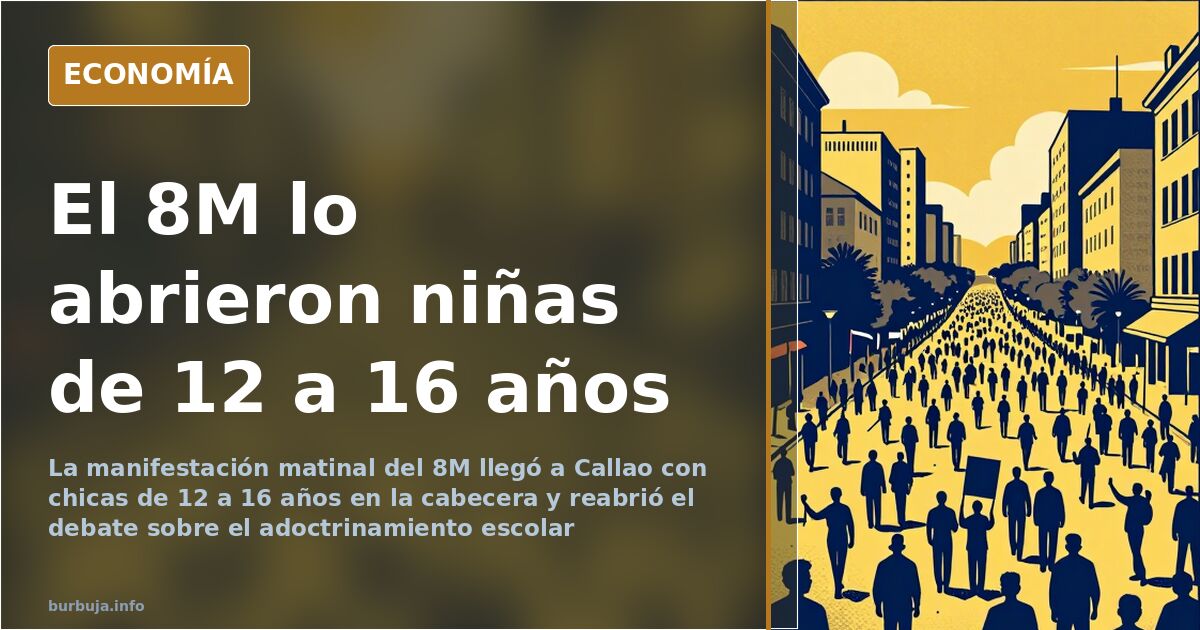
Girls aged 12 to 16 lead the March 8 protest in Callao
At what age does one start attending a March 8 demonstration? The morning call went up Gran Vía and, upon reaching Callao, the front of the march consisted largely of girls who, according to observers, had not yet reached adulthood: between 12 and 16 years old, with voices that sounded like those of children. Purple flags, banners, lots of tonalidad, and chants such as "here we are, the feminists" or "feminists against fascism." The march had been blocking Gran Vía since early morning, while the larger afternoon call had not yet started. It seems March 8 has been organized in shifts. The thesis opening this issue is stark: that they are recruited from school.
How the morning March 8 demonstration unfolded in Callao
A long and well-organized march, with purple flags, all kinds of banners, and a repertoire of slogans that included "heteropatriarchy" as the central enemy. The mobilization occupied Gran Vía throughout the morning, and its front line stopped at Callao. Information circulating at that same hour indicated that the second call, the larger one, had not yet begun. This is not an exceptional scene: each March 8 sees different calls throughout the day, with different audiences. What stood out here was the age of those leading the march. Girls. Not grown women.
Why are there girls aged 12 to 16 at March 8?
Much of the anger revolves around this: that teenagers appear organized, with learned banners and slogans. One current attributes this to recruitment work from schools, using school materials, center activities, and institutional symbols as vehicles. Another part reduces it to teenage posturing: girls skipping class because they can, and because joining the noisy outing costs nothing. And some recall that adolescence has spent decades looking for causes to identify with, without this proving external direction. What none of the versions provide is the basic data: how many students participated, how many skipped class, and how many centers were behind it. Without that figure, everything is just sidewalk impressions.
"My company encouraged me to join the feminist strike": March 8 inside the workplace
Here appears the most concrete testimony. A participant says he received a message from his own company encouraging him to support a feminist strike, with prior notice to his supervisor to find a replacement. The reflection accompanying this: since when does a company incentivize its staff to stop working? On this basis, it is argued that behind the calls are paid activists in less visible positions and that many attendees are students who can afford to skip class. It is an unverified suspicion —what is offered are clues, not accounting— but it explains why the issue stops seeming like an afternoon of banners and starts smelling like structure.
"Marxism as always": the parallel with China's Cultural Revolution
In the most ideological stretch, March 8 is read as a reissue of a cultural offensive: class struggle transferred to the sensual terrain, with China's Cultural Revolution and the Red Guards as mirrors. Young people from that era are described as hunters of dissidents, and warnings are issued that this path leads in the same direction, though not reaching the extremes of then. These are analogies. No one provides a program, a guideline, or a document to support the parallel beyond methods —slogans, group discipline, pressure on those who stay silent— which, moreover, are common to almost any mass movement of the last century. The communist label is applied here to the entire package, not to anyone's accredited militancy.
The "waiter wanted" sign shown live on TV
One of the episodes with the most reach was televised: a live connection with a bar run only by women —the owner and three employees— where, in view of the camera, hung a sign saying "waiter wanted" (using feminine grammar). Inside the establishment, this was celebrated as proof that there is no discrimination there. The contrast brought up is that of a bakery that, according to recollection, was indeed subject to action for a job ad written in masculine form. The asymmetry, if confirmed, is the whole argument. And it leaves an uncomfortable question: does the rule target language, or does it target based on who writes it?
Who funds March 8: the thesis without evidence
At the most conspiratorial extreme, the push for militant feminism is attributed to external funding, with international banking and Marxism as pieces of a single plan to fracture European societies from within. These are assertions without a single piece of evidence to back them, and it should be said clearly: there is no document, no accounting trail, no investigation to support them. They are formulated as opinion and remain as opinion. It also clashes with a detail brought up in the same discussion: that one of the country's largest fortunes has declared itself feminist in a reference media outlet. If feminism were an anti-capitalist project, that detail would be superfluous; if it is something else, it fits too well.
What remains is the photo: the front of the march in Callao, high school girls, purple flags, and a second call waiting its turn in the afternoon. No one has put a number on any of that. And without numbers, the only verifiable thing about March 8 is that the shifts worked.
At what age does one start attending a March 8 demonstration? The morning call went up Gran Vía and, upon reaching Callao, the front of the march consisted largely of girls who, according to observers, had not yet reached adulthood: between 12 and 16 years old, with voices that sounded like those of children. Purple flags, banners, lots of tonalidad, and chants such as "here we are, the feminists" or "feminists against fascism." The march had been blocking Gran Vía since early morning, while the larger afternoon call had not yet started. It seems March 8 has been organized in shifts. The thesis opening this issue is stark: that they are recruited from school.
How the morning March 8 demonstration unfolded in Callao
A long and well-organized march, with purple flags, all kinds of banners, and a repertoire of slogans that included "heteropatriarchy" as the central enemy. The mobilization occupied Gran Vía throughout the morning, and its front line stopped at Callao. Information circulating at that same hour indicated that the second call, the larger one, had not yet begun. This is not an exceptional scene: each March 8 sees different calls throughout the day, with different audiences. What stood out here was the age of those leading the march. Girls. Not grown women.
Why are there girls aged 12 to 16 at March 8?
Much of the anger revolves around this: that teenagers appear organized, with learned banners and slogans. One current attributes this to recruitment work from schools, using school materials, center activities, and institutional symbols as vehicles. Another part reduces it to teenage posturing: girls skipping class because they can, and because joining the noisy outing costs nothing. And some recall that adolescence has spent decades looking for causes to identify with, without this proving external direction. What none of the versions provide is the basic data: how many students participated, how many skipped class, and how many centers were behind it. Without that figure, everything is just sidewalk impressions.
"My company encouraged me to join the feminist strike": March 8 inside the workplace
Here appears the most concrete testimony. A participant says he received a message from his own company encouraging him to support a feminist strike, with prior notice to his supervisor to find a replacement. The reflection accompanying this: since when does a company incentivize its staff to stop working? On this basis, it is argued that behind the calls are paid activists in less visible positions and that many attendees are students who can afford to skip class. It is an unverified suspicion —what is offered are clues, not accounting— but it explains why the issue stops seeming like an afternoon of banners and starts smelling like structure.
"Marxism as always": the parallel with China's Cultural Revolution
In the most ideological stretch, March 8 is read as a reissue of a cultural offensive: class struggle transferred to the sensual terrain, with China's Cultural Revolution and the Red Guards as mirrors. Young people from that era are described as hunters of dissidents, and warnings are issued that this path leads in the same direction, though not reaching the extremes of then. These are analogies. No one provides a program, a guideline, or a document to support the parallel beyond methods —slogans, group discipline, pressure on those who stay silent— which, moreover, are common to almost any mass movement of the last century. The communist label is applied here to the entire package, not to anyone's accredited militancy.
The "waiter wanted" sign shown live on TV
One of the episodes with the most reach was televised: a live connection with a bar run only by women —the owner and three employees— where, in view of the camera, hung a sign saying "waiter wanted" (using feminine grammar). Inside the establishment, this was celebrated as proof that there is no discrimination there. The contrast brought up is that of a bakery that, according to recollection, was indeed subject to action for a job ad written in masculine form. The asymmetry, if confirmed, is the whole argument. And it leaves an uncomfortable question: does the rule target language, or does it target based on who writes it?
Who funds March 8: the thesis without evidence
At the most conspiratorial extreme, the push for militant feminism is attributed to external funding, with international banking and Marxism as pieces of a single plan to fracture European societies from within. These are assertions without a single piece of evidence to back them, and it should be said clearly: there is no document, no accounting trail, no investigation to support them. They are formulated as opinion and remain as opinion. It also clashes with a detail brought up in the same discussion: that one of the country's largest fortunes has declared itself feminist in a reference media outlet. If feminism were an anti-capitalist project, that detail would be superfluous; if it is something else, it fits too well.
What remains is the photo: the front of the march in Callao, high school girls, purple flags, and a second call waiting its turn in the afternoon. No one has put a number on any of that. And without numbers, the only verifiable thing about March 8 is that the shifts worked.
Summary of a discussion on Burbuja.info - Foro de economía, actualidad y política., translated from Spanish and reviewed before publication. Read the full discussion (193 replies).
More summaries
-
60% State-Dependent: Why the DANA Storm Isn't Sparking a Revolution in Spain
Valencia's DANA disaster caused hundreds of deaths, yet experts argue that 60% of adults depend on the state, preventing a social explosion.
-
Spain's Housing Crisis: Street Protests vs. Economic Reality
An analysis of Spain's housing crisis: is it capitalism or immigration? Data reveals structural tensions.
-
What happens if 70% of the electorate doesn't vote in general elections?
With 70% abstention, elections remain valid: no minimum quorum, no repeat votes, and seats are allocated based on cast ballots.
-
280 m² Palencia apartment with vintage furniture listed for €440,000
A 280 m² apartment in central Palencia is on the market for €440,000. It features solid wood furniture, a canopy bed, and an open-plan bathroom.
-
Forum Debate: AI Impact on Mathematicians Mirrors AutoCAD Shift
A forum discussion compares potential AI-driven reductions in mathematician roles to the historical transition from manual drafting to AutoCAD.
-
Spain's housing prices are stable, but wages lag
Housing prices in Spain fell 22% over 15 years versus a 54% rise in Denmark. The real issue is low salaries, not property costs.