
60% State-Dependent: Why the DANA Storm Isn't Sparking a Revolution in Spain
Valencia's DANA disaster caused hundreds of deaths, yet experts argue that 60% of adults depend on the state, preventing a social explosion.
English · Original discussion in Spanish · Published
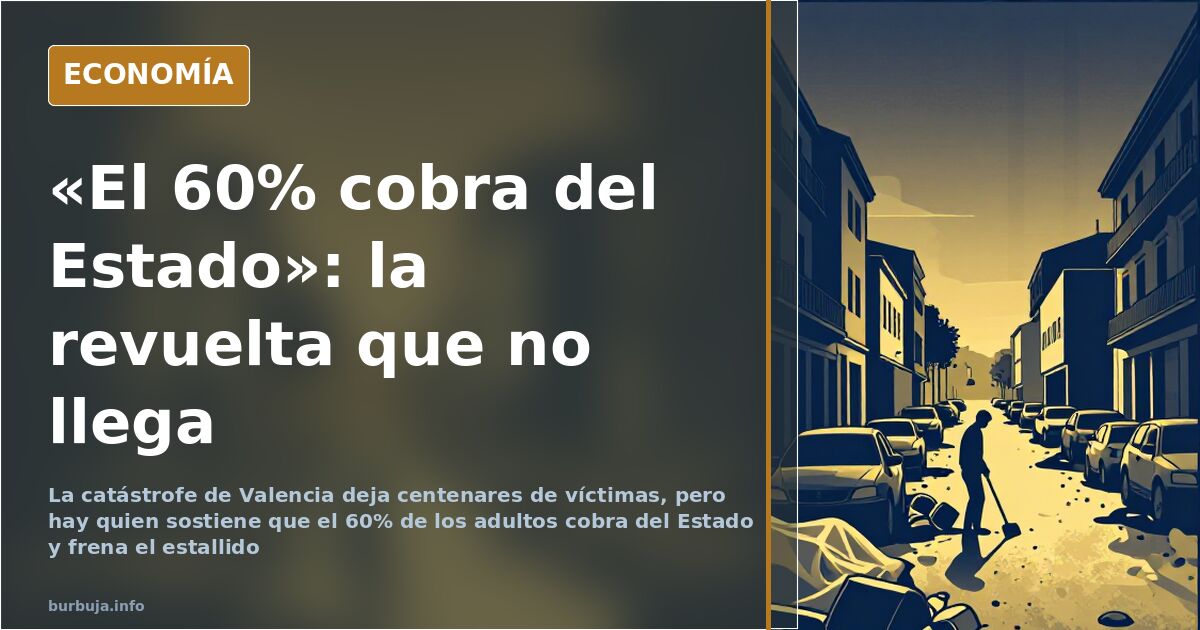
Valencia Isn't Burning: The Revolt That Never Comes
The October 2024 DANA (severe weather event) flooded entire municipalities in Valencia, leaving hundreds dead and causing incalculable economic losses. The question—whether this catastrophe is the fuse for a revolution or civil war—has a majority answer: no. And an uncomfortable nuance: not now.
What did occur, fueling the anger, was the combination of a flood and an institutional blackout. Without food, water, electricity, or communication, with homes and vehicles destroyed and relatives missing or dead, according to circulating inventories. Some messages also cited looting in submerged towns and aid arriving drop by drop.
Why Is Civil War Discussed in Valencia?
Because there is a known pattern: when someone loses everything, they have nothing left to lose. This reasoning summarizes the climate. Some argue, using the phrase "reasons are not lacking," that the combination of material destruction, perceived impunity, and absence of the State is the classic breeding ground for an explosion. The contrast used is the pandemic: then freedom was lost, but there was television, series, and paychecks. Now, there is not.
Others point to geography. A real explosion would require coordination in at least five distinct points of the peninsula, and here each municipality fights for itself. Solidarity, however, did organize: firefighters from Cádiz and Málaga deployed to the area, and civilian volunteers working while official information on how to help was conspicuously absent.
The 60% Argument: Why an Explosion Is Not Expected
The most repeated percentage in the conversation: some argue that 60% of adults depend on the State. With this dependency, rebellion comes at a high cost. Recent memory also does not help the optimists about an explosion. During the pandemic, there were three months of lockdown, tens of thousands of deaths that some messages attribute to confinement, and de facto suspended freedom. Nothing peine. "How I envy your innocence," summarizes the position of those who have seen revolution ads for years that never come.
The other major brake is channeling anger through elections. It is argued that the party system absorbs discontent and returns it every four years as votes. A harsher reading: if there were no political consequences after the pandemic, the probability of having them after a flood drops significantly. No one believes those responsible will be held accountable, and this cynicism deactivates more than any speech.
Revolutions Are Made With Empty Stomachs
The phrase is repeated as a verdict. But it coexists with its opposite: one with an empty stomach and back pay usually resigns. The metaphor running through the conversation is that of a slaughterhouse worker slaughtering chickens and lambs, observing how the animal, even the fighting rooster, stays quiet when seeing others fall. The application to the case is explicit and bitter: modern humans already demonstrated during the pandemic that they allow themselves to be domesticated with the promise of a bailout.
Against that, the only viable path some see is not insurrection, but disconnection: dropping the oar, ceasing to support the system, and building a parallel economy—barter, alternative currencies—over which intermediaries cannot interfere. It is a revolution without barricades and without epic, more like a logistical desertion than an assault on the palace. And there is a fundamental obstacle: there is no critical mass willing to mobilize for anything.
Shacks, Promises, and the Drip-Feed Calendar
The scenario generating the most consensus is not an explosion, but slow rot. The forecast is that within six months or a year there will be thousands living in temporary housing, with promised aid not arriving and the tragedy faded from the media. The precedent cited is those affected by the volcanic eruption, who years later were still in construction huts. "Nothing ever happens here," concludes that argument.
This is compounded by suspicion regarding the destination of money. One stream argues that much will be promised and little fulfilled, and that a large part of the funds will be diverted. This is an accusation made without proof, and as such it must be taken: part of the climate of distrust, not an established fact.
Who Capitalizes on the Discontent?
Shortly after the flood, the focus shifted from management to responsibility. The complaint that no one has resigned became the shared slogan, trinc by accusations between administrations: the Generalitat and the central government blaming each other, the local PP blamed for the response, and the Executive accused of using the tragedy to weaken the opposition. The inverse hypothesis also circulates: that the lack of reaction sought to politically punish a territory. Without proof to support it.
The anger has no single recipient, and that dilutes it. Some argue that the problem is not a party, but the entire system, and that any mobilization not targeting it is a waste of time. It is the Spanish version of they do not represent us, with twenty years of history and very few results.
If anything changes, it will not be with a textbook revolution, with committees and flags. It will, if at all, through the accumulation of grievances: a shack that is not dismantled, aid that does not arrive, an unnamed victim in the balance. If the most repeated thesis holds, with 60% of adults receiving direct or indirect state support, the fuse has just enough water to not ignite quickly. And no one in power seems in a hurry to put it out.
The October 2024 DANA (severe weather event) flooded entire municipalities in Valencia, leaving hundreds dead and causing incalculable economic losses. The question—whether this catastrophe is the fuse for a revolution or civil war—has a majority answer: no. And an uncomfortable nuance: not now.
What did occur, fueling the anger, was the combination of a flood and an institutional blackout. Without food, water, electricity, or communication, with homes and vehicles destroyed and relatives missing or dead, according to circulating inventories. Some messages also cited looting in submerged towns and aid arriving drop by drop.
Why Is Civil War Discussed in Valencia?
Because there is a known pattern: when someone loses everything, they have nothing left to lose. This reasoning summarizes the climate. Some argue, using the phrase "reasons are not lacking," that the combination of material destruction, perceived impunity, and absence of the State is the classic breeding ground for an explosion. The contrast used is the pandemic: then freedom was lost, but there was television, series, and paychecks. Now, there is not.
Others point to geography. A real explosion would require coordination in at least five distinct points of the peninsula, and here each municipality fights for itself. Solidarity, however, did organize: firefighters from Cádiz and Málaga deployed to the area, and civilian volunteers working while official information on how to help was conspicuously absent.
The 60% Argument: Why an Explosion Is Not Expected
The most repeated percentage in the conversation: some argue that 60% of adults depend on the State. With this dependency, rebellion comes at a high cost. Recent memory also does not help the optimists about an explosion. During the pandemic, there were three months of lockdown, tens of thousands of deaths that some messages attribute to confinement, and de facto suspended freedom. Nothing peine. "How I envy your innocence," summarizes the position of those who have seen revolution ads for years that never come.
The other major brake is channeling anger through elections. It is argued that the party system absorbs discontent and returns it every four years as votes. A harsher reading: if there were no political consequences after the pandemic, the probability of having them after a flood drops significantly. No one believes those responsible will be held accountable, and this cynicism deactivates more than any speech.
Revolutions Are Made With Empty Stomachs
The phrase is repeated as a verdict. But it coexists with its opposite: one with an empty stomach and back pay usually resigns. The metaphor running through the conversation is that of a slaughterhouse worker slaughtering chickens and lambs, observing how the animal, even the fighting rooster, stays quiet when seeing others fall. The application to the case is explicit and bitter: modern humans already demonstrated during the pandemic that they allow themselves to be domesticated with the promise of a bailout.
Against that, the only viable path some see is not insurrection, but disconnection: dropping the oar, ceasing to support the system, and building a parallel economy—barter, alternative currencies—over which intermediaries cannot interfere. It is a revolution without barricades and without epic, more like a logistical desertion than an assault on the palace. And there is a fundamental obstacle: there is no critical mass willing to mobilize for anything.
Shacks, Promises, and the Drip-Feed Calendar
The scenario generating the most consensus is not an explosion, but slow rot. The forecast is that within six months or a year there will be thousands living in temporary housing, with promised aid not arriving and the tragedy faded from the media. The precedent cited is those affected by the volcanic eruption, who years later were still in construction huts. "Nothing ever happens here," concludes that argument.
This is compounded by suspicion regarding the destination of money. One stream argues that much will be promised and little fulfilled, and that a large part of the funds will be diverted. This is an accusation made without proof, and as such it must be taken: part of the climate of distrust, not an established fact.
Who Capitalizes on the Discontent?
Shortly after the flood, the focus shifted from management to responsibility. The complaint that no one has resigned became the shared slogan, trinc by accusations between administrations: the Generalitat and the central government blaming each other, the local PP blamed for the response, and the Executive accused of using the tragedy to weaken the opposition. The inverse hypothesis also circulates: that the lack of reaction sought to politically punish a territory. Without proof to support it.
The anger has no single recipient, and that dilutes it. Some argue that the problem is not a party, but the entire system, and that any mobilization not targeting it is a waste of time. It is the Spanish version of they do not represent us, with twenty years of history and very few results.
If anything changes, it will not be with a textbook revolution, with committees and flags. It will, if at all, through the accumulation of grievances: a shack that is not dismantled, aid that does not arrive, an unnamed victim in the balance. If the most repeated thesis holds, with 60% of adults receiving direct or indirect state support, the fuse has just enough water to not ignite quickly. And no one in power seems in a hurry to put it out.
Summary of a discussion on Burbuja.info - Foro de economía, actualidad y política., translated from Spanish and reviewed before publication. Read the full discussion (290 replies).
More summaries
-
Ignacio Lázaro: 'Maricarmen paid €154 rent while we paid €750'
Ignacio Lázaro, grandson of the original owner, reveals the other side of the Maricarmen case: 'We subsidized her for years and now, with our taxes.'
-
Abstention vs. Strategic Voting: A Divided Spanish Electorate
Debate intensifies in Spain over whether abstaining delegitimizes the system, analyzing arguments for strategic voting and low turnout.
-
Disability: €3,500 Monthly Doesn't Buy Love
A Spanish engineer with cerebral palsy earning €3,500 monthly explains why money cannot buy a family life, sparking debate on welfare limits.
-
Hackers claim to have Sánchez’s Pegasus data, but Moncloa remains unmoved
Jabaroot claims to hold 72 GB of Pedro Sánchez’s Pegasus data, yet skepticism prevails. Neither the threat nor the noise shakes Moncloa.
-
Spain extends Almaraz nuclear plant to 2030, breaking coalition pact
Official gazette authorizes Almaraz operation until 2030, overriding Sumar's closure agreement amid €1.3 billion grid adjustment costs.
-
Spanish Protest Chant Targets PM at World Cup Final
Organized groups plan to chant against Spanish Prime Minister Pedro Sánchez during the World Cup final in New York.