
Intermittent Fasting Linked to 91% Higher Heart Risk, Unreported by Media
A study claims intermittent fasting raises cardiovascular risk by 91%, but it is observational and relies on self-reported data, yet no major outlet links to the original research.
English · Original discussion in Spanish · Published
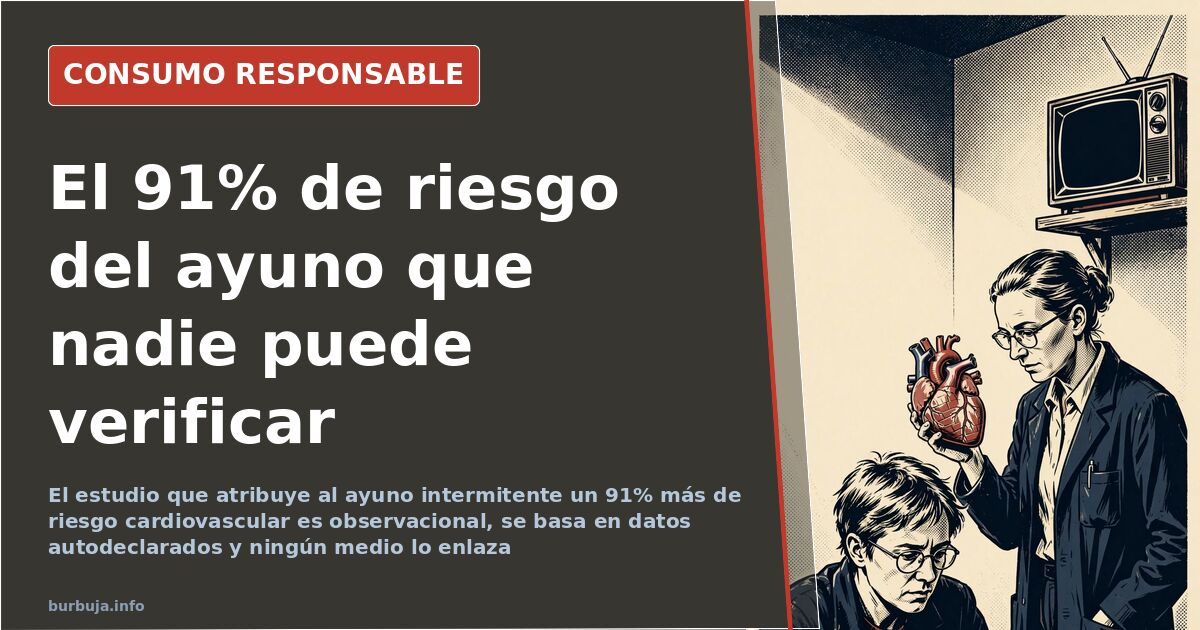
The 91% heart risk of fasting that no media outlets link to
Imagine you want to know if intermittent fasting kills. You open the news and there it is: those who restrict eating to less than eight hours a day have a 91% higher probability of dying from cardiovascular disease. What does not appear in any paragraph is the link to the study. That absence is the first red flag for anyone who has ever worked with data.
The research was presented at the 2024 Scientific Sessions on Lifestyle and Cardiometabolism, within the annual meeting of the American Heart Association held in Chicago. The author is Victor Wenze Zhong, chief epidemiologist at the School of Medicine, Shanghai Jiao Tong University. On paper, 20,000 adults and up to 17 years of trinc-up. From there, everything gets complicated.
What the 91% study says and does not say
The participants were about 20,000 adults with a miccionan age of 49 years, half men and half women, drawn from the National Health and Nutrition Examination Surveys (NHANES) from 2003 to 2018 and cross-referenced with U.S. death records between 2003 and 2019. The headline result: eating window under eight hours, a 91% higher risk of cardiovascular death. Among those who already had cardiovascular disease, eating in less than ten hours was associated with a 66% higher risk of dying from heart disease or stroke.
The sample was hardly representative: a 73.3% of white participants, 11% Hispanic, 8% Black, and 6.9% of other races. And time restriction did not reduce the risk of death from any cause, while eating in more than sixteen hours was associated with lower mortality among cancer patients. None of these nuances reached the headlines. The 91% did.
"The study is observational, not experimental"
Here is the point that dismantles half the news. An observational study manipulates nothing: it looks at what people were already doing and looks for patterns. There is no control group, no random assignment, no way to isolate the variable. It asks about habits and cross-references with who died. The rest is interpretation.
The added problem is that the dietary information was self-reported. No one measured what they ate. Each participant used memory to reconstruct weeks, months, and years of menus. And from those memories comes a percentage that ends up on the front page.
The authors themselves admit at the end of the text: the work should be completed with "additional information on the nutritional quality of the diets" and more data to compare the groups. Translated: they do not know what those 20,000 adults ate. They only know when. The 91% rests on that.
Correlation is not causality: the sun and drownings
The classic example has been circulating for years: on days with more sun, there are more drownings at the beach. Does the sun kill? No. People go to the beach when the weather is good. The hidden variable is behavior. Something similar happens with fasting: those who start fasting usually do so because something is not working. Overweight, metabolic problems, alarming blood tests. Time restriction comes after the problem, not before.
To maintain the opposite requires ignoring that humanity spent centuries eating when it could and fasting unwillingly. If eating in a short window killed of heart attack, the species would have gone extinct before inventing agriculture.
Those who have fasted for years and are still here
Against the theoretical 91% is the experience of those who practice intermittent fasting for years. There is someone who has done so for eight years with a 16/8 window, twenty kilos less, and perfect blood tests, with blood pressure at 12/7. There is someone who has used it to stop injecting insulin while being diabetic and hypertensive, with two years of stability without a syringe. And someone who has scaled up to one meal a day without setbacks.
These are not studies. It is anecdote, and as anecdote it should be read. But it contrasts with the health bomb image left by the headline.
Why this headline arrives and the opposite does not
There is a pattern in how nutrition science is published. Studies that reflect poorly on unconventional habits—fasting, low-carbohydrate diets, saturated fat—circulate in general press generously. Those that support them remain in specialized journals and do not get out. Every time an a study shows appears, it is advisable to look for the study before the conclusion.
Thus, the reader ends up believing that science changes its mind every six months, when what changes is which part of the work the editorial team decides to highlight.
And the quality of what is eaten within those hours?
No one asks what was inside those eight hours. A sixteen-hour fast broken with ultra-processed foods, pastries, and sodas is not equivalent to one broken with real food. If the short window concentrates two meals of worse nutritional profile in less time, the result is not explained by the schedule, but by the menu. The study itself admits it did not measure this.
There remains a powerful headline, research that almost no one links to, and a legion of readers who no longer know if dinner at nine is a healthy habit or a sentence. The available data do not allow concluding either of the two things.
Imagine you want to know if intermittent fasting kills. You open the news and there it is: those who restrict eating to less than eight hours a day have a 91% higher probability of dying from cardiovascular disease. What does not appear in any paragraph is the link to the study. That absence is the first red flag for anyone who has ever worked with data.
The research was presented at the 2024 Scientific Sessions on Lifestyle and Cardiometabolism, within the annual meeting of the American Heart Association held in Chicago. The author is Victor Wenze Zhong, chief epidemiologist at the School of Medicine, Shanghai Jiao Tong University. On paper, 20,000 adults and up to 17 years of trinc-up. From there, everything gets complicated.
What the 91% study says and does not say
The participants were about 20,000 adults with a miccionan age of 49 years, half men and half women, drawn from the National Health and Nutrition Examination Surveys (NHANES) from 2003 to 2018 and cross-referenced with U.S. death records between 2003 and 2019. The headline result: eating window under eight hours, a 91% higher risk of cardiovascular death. Among those who already had cardiovascular disease, eating in less than ten hours was associated with a 66% higher risk of dying from heart disease or stroke.
The sample was hardly representative: a 73.3% of white participants, 11% Hispanic, 8% Black, and 6.9% of other races. And time restriction did not reduce the risk of death from any cause, while eating in more than sixteen hours was associated with lower mortality among cancer patients. None of these nuances reached the headlines. The 91% did.
"The study is observational, not experimental"
Here is the point that dismantles half the news. An observational study manipulates nothing: it looks at what people were already doing and looks for patterns. There is no control group, no random assignment, no way to isolate the variable. It asks about habits and cross-references with who died. The rest is interpretation.
The added problem is that the dietary information was self-reported. No one measured what they ate. Each participant used memory to reconstruct weeks, months, and years of menus. And from those memories comes a percentage that ends up on the front page.
The authors themselves admit at the end of the text: the work should be completed with "additional information on the nutritional quality of the diets" and more data to compare the groups. Translated: they do not know what those 20,000 adults ate. They only know when. The 91% rests on that.
Correlation is not causality: the sun and drownings
The classic example has been circulating for years: on days with more sun, there are more drownings at the beach. Does the sun kill? No. People go to the beach when the weather is good. The hidden variable is behavior. Something similar happens with fasting: those who start fasting usually do so because something is not working. Overweight, metabolic problems, alarming blood tests. Time restriction comes after the problem, not before.
To maintain the opposite requires ignoring that humanity spent centuries eating when it could and fasting unwillingly. If eating in a short window killed of heart attack, the species would have gone extinct before inventing agriculture.
Those who have fasted for years and are still here
Against the theoretical 91% is the experience of those who practice intermittent fasting for years. There is someone who has done so for eight years with a 16/8 window, twenty kilos less, and perfect blood tests, with blood pressure at 12/7. There is someone who has used it to stop injecting insulin while being diabetic and hypertensive, with two years of stability without a syringe. And someone who has scaled up to one meal a day without setbacks.
These are not studies. It is anecdote, and as anecdote it should be read. But it contrasts with the health bomb image left by the headline.
Why this headline arrives and the opposite does not
There is a pattern in how nutrition science is published. Studies that reflect poorly on unconventional habits—fasting, low-carbohydrate diets, saturated fat—circulate in general press generously. Those that support them remain in specialized journals and do not get out. Every time an a study shows appears, it is advisable to look for the study before the conclusion.
Thus, the reader ends up believing that science changes its mind every six months, when what changes is which part of the work the editorial team decides to highlight.
And the quality of what is eaten within those hours?
No one asks what was inside those eight hours. A sixteen-hour fast broken with ultra-processed foods, pastries, and sodas is not equivalent to one broken with real food. If the short window concentrates two meals of worse nutritional profile in less time, the result is not explained by the schedule, but by the menu. The study itself admits it did not measure this.
There remains a powerful headline, research that almost no one links to, and a legion of readers who no longer know if dinner at nine is a healthy habit or a sentence. The available data do not allow concluding either of the two things.
Summary of a discussion on Burbuja.info - Foro de economía, actualidad y política., translated from Spanish and reviewed before publication. Read the full discussion (220 replies).
More summaries
-
Worth the splurge: A near-£3,000 projector and quality treats
A nearly £3,000 projector, Santoña anchovies, and a private cook for £300 a month: finding value in personal indulgences.
-
How to Cancel a Mortgage Without Surprising Notary Fees
Practical guide to canceling a mortgage and saving on notary and registry fees without falling into banking traps.
-
Italian Students Fined 1,000 Baht for Noise on Bangkok’s BTS
Five Italian students were fined 1,000 baht in Bangkok for shouting on the BTS Skytrain, reigniting the debate on tourist behavior and local respect.
-
Dacia Sandero vs Skoda Fabia: GLP and the automatic transmission dilemma
The GLP Sandero promises an ECO label and low running costs, but lacks an automatic gearbox—the deciding factor between the Dacia and the Skoda Fabia.
-
Living with 89 Items: Spain's Minimalism Radiograph
One man has lived with 89 items for three months, aiming for 70, revealing the real savings of the 100 Things challenge.
-
MG ZS: Spain's Best-Selling Car, 106 HP, 13,000 Euros
The MG ZS, with 106 HP from 13,000 euros subject to finance, tops Spanish registrations despite three EuroNCAP stars.