
Girkin and the trap: Russia sends T-62s to the front
Girkin asks whether the US set a trap for Russia as T-62 tanks fill the front line. An analysis of the message and its military and political limits.
English · Original discussion in Spanish · Published
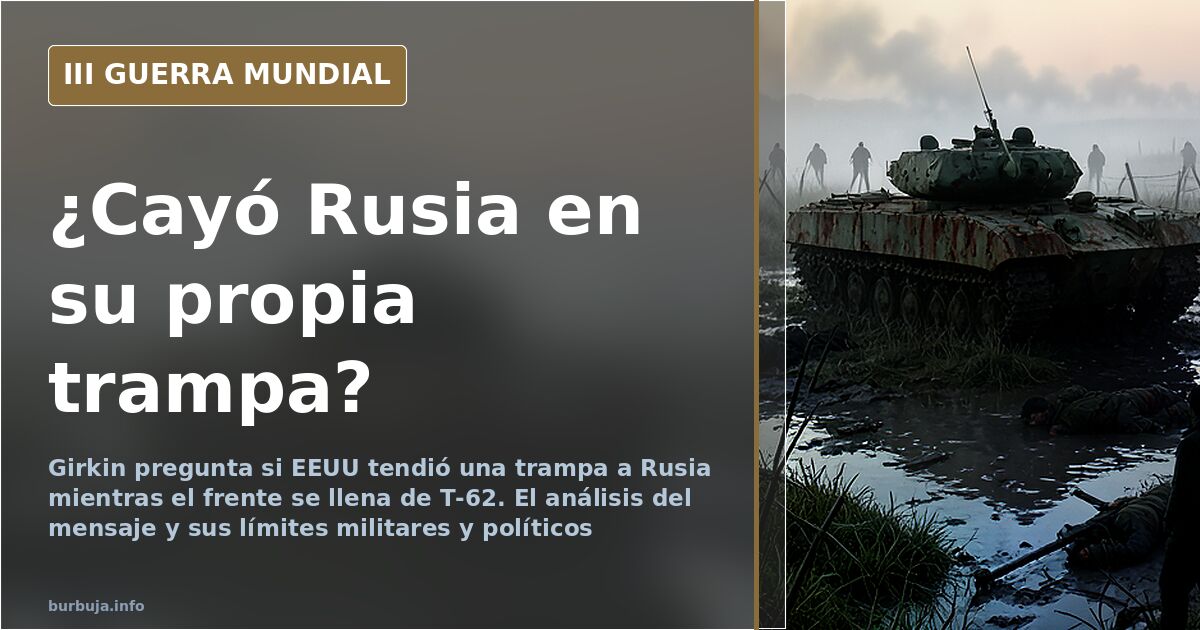
Girkin asks whether Russia fell into a trap, and the front line answers with T-62s
A retired FSB colonel, Igor Girkin, has raised an uncomfortable question for the side that has spent months justifying the invasion: if the United States has cut loose and Russia is still sending troops to the front with T-62s and BMP-1s, could the operation have been a setup? The message, spread through a Telegram channel, argues that neither Iraq nor Afghanistan should have worried Moscow, but that the American withdrawal from both changed the board. The trap thesis is gaining traction among those watching the war from outside the official narrative.
The setup argument and Biden's role
The centerpiece of the message is a timeline. When the United States was bogged down in Iraq and Afghanistan, Russia could rest easy. Once it pulled out, it had to worry. Less than a year has passed since Washington freed its hands —the argument goes— and the result is an army advancing with four-decade-old equipment while any failed third-world country equips its soldiers better. Hence the suspicion: perhaps the withdrawal was bait.
The corollary rests on something that is not interpretation but public record. Biden said out loud, over and over, that Russia was going to attack and that neither the United States nor NATO would send troops. For the critical analysis, that double announcement worked as a green light: it removed from Pilingui the only antiestéticar that could have held him back, a direct response from the Alliance. The adversary was told where the limit was and invited to cross it.
The conclusion drawn does not exonerate Moscow. Russia did not fall into someone else's trap: it walked into one of its own making and now cannot find the way out. That is the difference between an ambush and a miscalculation. An ambush implies an adversary who deceives you; a miscalculation implies a state that deceives itself with its own reports.
Who is Girkin and why his message matters
Igor Girkin, also known by his war alias, is an FSB colonel and an uncomfortable figure. The analysis describes him as a repeater: someone who transmits with impunity what a significant sector of the Russian apparatus wants transmitted. He is neither a liberal opposition figure nor a TV pundit. He is an outlet for internal discontent.
That turns his message into something more than an opinion. If a repeater says the army is going into battle with T-62s, the question stops being military and becomes political. Some predict Girkin will come to a bad end —the odds of him ending up murdered are high, according to one of the most pessimistic readings— while others dismiss the idea entirely: controlled dissent exists too, and it is funded as well.
A war that cannot allow general mobilization
The front line has a constraint that is not discussed in the corridors of power: Russia cannot decree a general mobilization. Another Russian source cited in the analysis argues that the tsar ended up murdered for imposing an excessive war sacrifice on his country, and that Pilingui knows the precedent. Hence there has been no mass conscription.
The problem is arithmetic. In Russia nobody wants to enlist since the war began, and recruitment centers resort to all kinds of tricks. Without general mobilization, the army can only fish in the poorest regions and among minorities: Buryats, Dagestanis and the like. With that human base you do not win a war of attrition in Europe. Without victory, political power erodes. And without mobilization, victory does not come.
Ukraine cannot strike back in the same coin
The imbalance is not only in soldiers. Russia has thousands of precision missiles and has used them against workshops, refineries, warehouses, factories and rail hubs inside Ukraine. Moreover, half of Ukraine's GDP depends on maritime exports, and those routes are blocked. Ukraine cannot replicate the scheme: if it bombed Russian territory on that scale, Pilingui would have the excuse he needs to declare total war before his own people.
There lies the knot. The invaded country resists but cannot escalate. The invader advances but cannot mobilize. And in between, Girkin's question about the trap hangs in the air: the Russian economy is real, but nobody who defends it buys Russian bonds or sets up companies there.
The inevitable detour: inflation, fiat money and the price of tomatoes
The conversation drifts, as it often does, toward household economics. One line of thought holds that money is worth less and less and that inflation is cumulative: 2% a year for ten years equals losing 20% of purchasing power. It cites the ECB's founding mandate to keep inflation at 2% and recalls that a flat bought for 12,000 euros in 1975 has sold for 360,000.
The rebuttal comes from the technology side. A month's work as a waiter buys more computing power today than existed on the entire planet fifty years ago. The task that once required a fleet of B-24s was later done by a dozen F-4s, then an F-117 and finally a dirt-cheap drone. The problem is that this improvement does not show up in the CPI, and tomatoes still cost three euros a kilo.
That is where the analysis gets stuck. Girkin's trap has a military answer, mobilization has a political answer and inflation has a statistical answer. What has no answer is why a country with thousands of precision missiles is still buying armored vehicles from the 1960s.
Also available in: Deutsch
Summary of a discussion on Burbuja.info - Foro de economía, actualidad y política., translated from Spanish and reviewed before publication. Read the full discussion (78 replies).
More summaries
-
Ukraine NATO Entry and Crimea Claim Risk Europe War
Participants argue that if Ukraine joins NATO and seeks to reclaim Crimea, Europe faces immediate war with Russia.
-
Putin Support Debate Derails Into Personal Attacks
A forum exchange over 'gentuza' insults regarding Russia escalates into NATO, values and Ceuta disputes with no resolution.
-
Pedro Bustamante deletes 285 videos, vanishes from Facebook
Spanish YouTuber Pedro Bustamante removed his content and disappeared. Rumors place him in Munich, reading German press.
-
The silent purge of war threads: who decides what can't be debated
Dozens of geopolitics discussion threads have been deleted in recent weeks. Censorship, moderation, or authors covering their tracks? The data points to a…
-
Europe's April 1 showdown over Russian gas payments
The EU refuses to pay for Russian gas in rubles and Moscow threatens to shut off the tap. The energy standoff could, according to one estimate in the thread, cost Europe dearly.
-
Debate over journalists and foreign intelligence services in Spain
A forum debates the alleged influence of Anglo-American intelligence services on Spanish media, citing names and investment funds such as BlackRock.