
Gijón beachfront homes hit €1 million
A 250 m² first-line apartment in Gijón costs nearly €1.3m with taxes, while a nearby unit is listed at €1m plus €200k renovation.
English · Original discussion in Spanish · Published
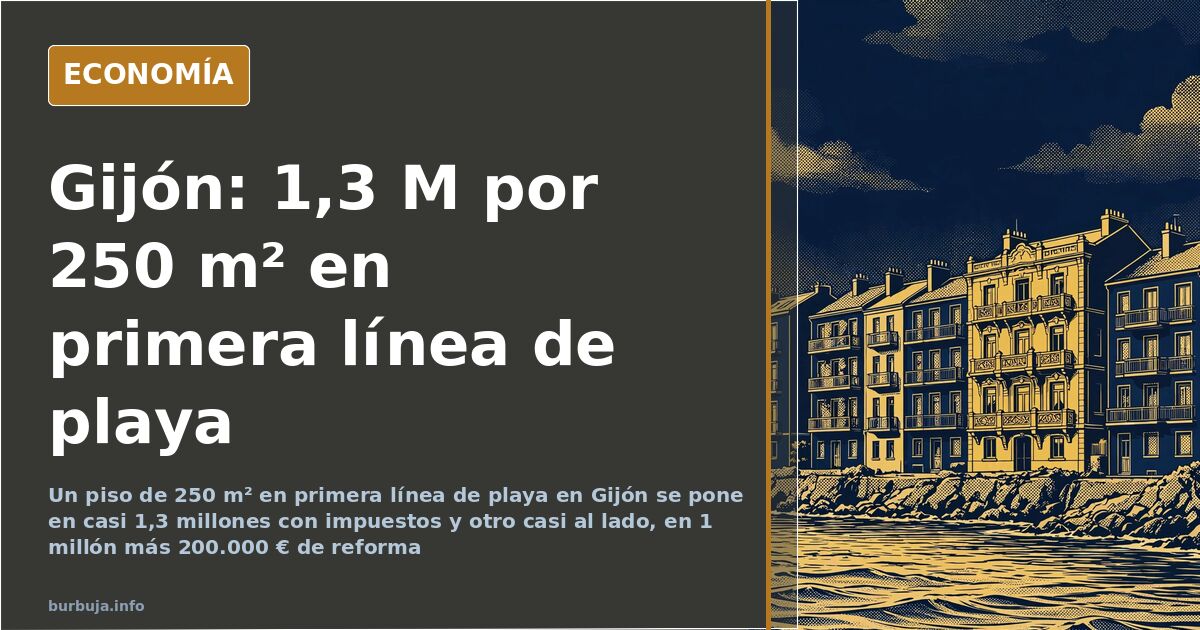
Gijón beachfront homes hit €1 million
A 250-square-meter apartment on the first line of the beach in Gijón, with sea views and parking, comes to nearly €1.3 million after taxes are added. Right next door, a similar property is listed at €1 million—also including taxes—but requires a minimum of €200,000 for renovations. The discussion points to a price per square meter of €4,637 in that area. This figure is no longer seen as an anomaly, but as the entry price for a market that Madrid used to overlook.
The uncomfortable question is how these numbers appear in a province many still associate with Spain’s declining future and population loss.
What you get in Gijón for €1 million
The first listing is the classic showcase: first line, views, 250 meters, and garage. The second skips the glamour and opts for practicality, but its starting price hides the necessary work. Between the two lies a gap of nearly €300,000, which on paper is explained by pending renovations. In reality, there is much more involved: community fees, IBI (property tax), cleaning, and heating for a huge apartment come into play. That total—which breaks down item by item—is what decides whether the deal is a bargain or a trap.
The finish doesn’t help either. The decor of the more expensive one receives criticism: described as looking like a private clinic, with a huge kitchen where, curiously, there isn’t room for a family dining table. For the other, some prefer its potential for renovation.
Asturias attracts foreign buyers while Spain loses them
The Principality has become an exception within the Spanish real estate market. Foreign home purchases rose by 27.7% in Asturias, while nationally they fell by 7.5% year-on-year. In volume, Spain recorded 67,983 such operations, representing 21.4% of the national total.
Two profiles are attributed to this demand in the thread: high-income European buyers and Venezuelan buyers.
Gijón gains 758 residents; Avilés loses almost one a day
The latest count shows a net gain of 1,100 inhabitants in Asturias, a figure hiding opposing realities. Oviedo added 2,681 residents. Gijón added 758. Avilés lost practically one resident per day. The region grows because it concentrates in two cities, and one of them does so at a much slower pace than the other.
Some argue these cities have been losing population for a decade and that outside vacation season their streets resemble a retirement home. Others nuance this picture: they claim that in the center, the beach, and Poniente areas, apartments sell quickly, with hardly any 'For Sale' signs left, dominated by retirees and early retirees as buyers.
The ghost of 2006: €6,000 per meter
The 2006 precedent is cited in the thread: one user assures that during the worst of the bubble, apartments in Asturias were seen at €6,000 per square meter, above the current peak for that first-line Gijón location.
Location vs. services: where the math gets stuck
The core disagreement isn't about price, but about the city. One school of thought defends that Gijón is today one of the best places in the north to live: clean, green, coastal, with good gastronomy, services, and leisure that doesn't depend on foreign tourism. The opposing view responds that for that money you can buy a better apartment in Madrid and vacation somewhere sunny.
In the medium term, the international buyer who moves away from the sun sides with the first group, although that flow is still timid. The calculation of the deal remains unresolved: if the city is so good for what it offers, it's hard to understand why its population figures don't trinc suit. That's where the math stops.
A 250-square-meter apartment on the first line of the beach in Gijón, with sea views and parking, comes to nearly €1.3 million after taxes are added. Right next door, a similar property is listed at €1 million—also including taxes—but requires a minimum of €200,000 for renovations. The discussion points to a price per square meter of €4,637 in that area. This figure is no longer seen as an anomaly, but as the entry price for a market that Madrid used to overlook.
The uncomfortable question is how these numbers appear in a province many still associate with Spain’s declining future and population loss.
What you get in Gijón for €1 million
The first listing is the classic showcase: first line, views, 250 meters, and garage. The second skips the glamour and opts for practicality, but its starting price hides the necessary work. Between the two lies a gap of nearly €300,000, which on paper is explained by pending renovations. In reality, there is much more involved: community fees, IBI (property tax), cleaning, and heating for a huge apartment come into play. That total—which breaks down item by item—is what decides whether the deal is a bargain or a trap.
The finish doesn’t help either. The decor of the more expensive one receives criticism: described as looking like a private clinic, with a huge kitchen where, curiously, there isn’t room for a family dining table. For the other, some prefer its potential for renovation.
Asturias attracts foreign buyers while Spain loses them
The Principality has become an exception within the Spanish real estate market. Foreign home purchases rose by 27.7% in Asturias, while nationally they fell by 7.5% year-on-year. In volume, Spain recorded 67,983 such operations, representing 21.4% of the national total.
Two profiles are attributed to this demand in the thread: high-income European buyers and Venezuelan buyers.
Gijón gains 758 residents; Avilés loses almost one a day
The latest count shows a net gain of 1,100 inhabitants in Asturias, a figure hiding opposing realities. Oviedo added 2,681 residents. Gijón added 758. Avilés lost practically one resident per day. The region grows because it concentrates in two cities, and one of them does so at a much slower pace than the other.
Some argue these cities have been losing population for a decade and that outside vacation season their streets resemble a retirement home. Others nuance this picture: they claim that in the center, the beach, and Poniente areas, apartments sell quickly, with hardly any 'For Sale' signs left, dominated by retirees and early retirees as buyers.
The ghost of 2006: €6,000 per meter
The 2006 precedent is cited in the thread: one user assures that during the worst of the bubble, apartments in Asturias were seen at €6,000 per square meter, above the current peak for that first-line Gijón location.
Location vs. services: where the math gets stuck
The core disagreement isn't about price, but about the city. One school of thought defends that Gijón is today one of the best places in the north to live: clean, green, coastal, with good gastronomy, services, and leisure that doesn't depend on foreign tourism. The opposing view responds that for that money you can buy a better apartment in Madrid and vacation somewhere sunny.
In the medium term, the international buyer who moves away from the sun sides with the first group, although that flow is still timid. The calculation of the deal remains unresolved: if the city is so good for what it offers, it's hard to understand why its population figures don't trinc suit. That's where the math stops.
Also available in: Deutsch
Summary of a discussion on Burbuja.info - Foro de economía, actualidad y política., translated from Spanish and reviewed before publication. Read the full discussion (153 replies).
More summaries
-
Spain housing prices drop 4.6%, Madrid falls 3.8%
Notaries confirm Madrid's first price drop in nine years at 3.8%, with a national average decline of 4.6%.
-
Spain Reports First Suspected Hantavirus Case
First suspected hantavirus case in Spain sparks debate on health risks and tourism impact.
-
Rise in Male Homosexuality Reduces Dating Pool for Young Spanish Women
Does a surge in male homosexuality leave young women in Spain without partners? An analysis of a debate blending math, stereotypes, and social anxiety.
-
Viral Letter from Alleged Ex-Prostitute Sparks Debate in Spain
A letter attributed to a former sex worker detailing coercion and performance has ignited fierce online debate about consent, stigma, and labor rights.
-
Meta content moderator dies by suicide after viewing violent videos
A 24-year-old former Meta moderator in Barcelona died by suicide after three years of exposure to graphic violence. Her family is considering legal action against Meta and Telus.
-
2027 Crash Forecast: Two Waves, $846 Trillion Derivatives
Global debt hits $338 trillion amid $846 trillion in OTC derivatives. A timeline predicts a systemic collapse starting in 2027.