
Gibraltar Joins Schengen: Goodbye to Border Fence, Same VAT
Spain and UK agree to include Gibraltar in Schengen, equalize VAT and tariffs, and demolish the border fence. Who benefits from the pact remains open.
English · Original discussion in Spanish · Published
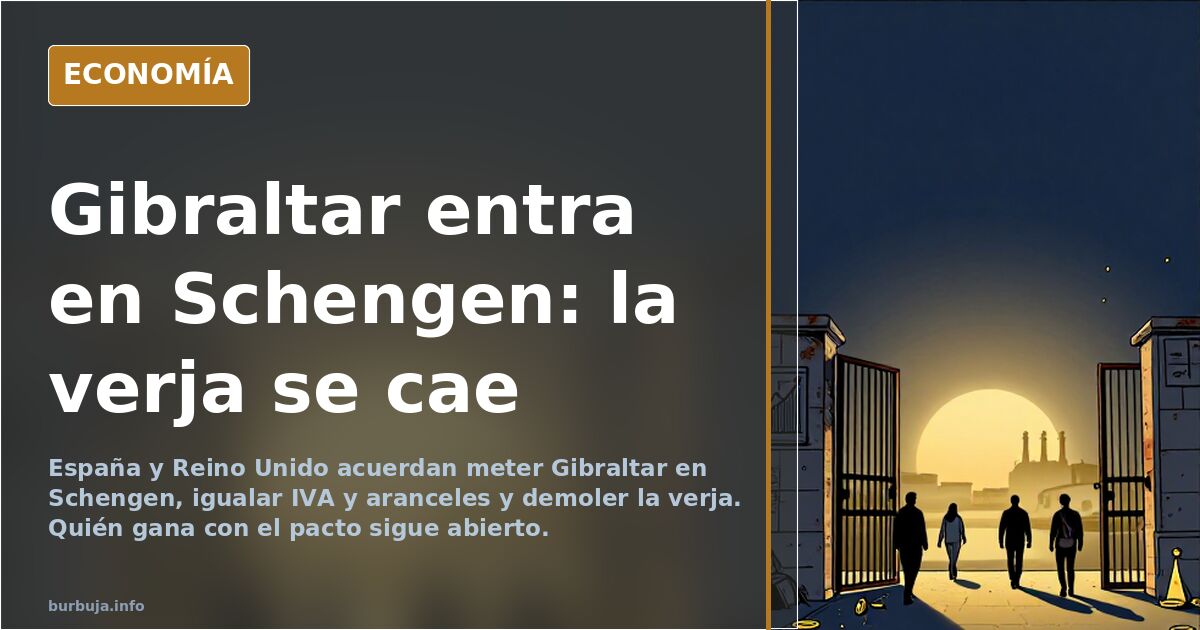
Gibraltar Edges Towards Schengen: Goodbye Border Fence, Fiscal Doubts
The agreement to integrate Gibraltar into the Schengen area was sealed with an uncomfortable promise to quantify: the border fence will be demolished. The Spanish and British governments reached a preliminary agreement —updated on January 13, 2021, with the fiscal fine print— that brings the Rock into the customs union and obliges it to apply 'substantially' the same tariffs and VAT as Spain, with joint border controls. The official promise is that queues will disappear. The question, which no one has answered, is in exchange for what.
What Exactly Has Been Agreed
The commitment stipulates that Gibraltar will join the customs union and implement the same tariffs and VAT to avoid 'distortions in the internal market'. The Rock will become, on paper, an external EU border controlled under Spanish supervision. A British citizen wishing to enter will need a passport; a Spanish citizen will not.
This is where the complications begin. The United Kingdom was never part of Schengen, so the paradox is evident: the territory that left the EU due to Brexit is entering the zone without internal controls through the back door. Some EU countries are not yet in Schengen, and Gibraltar, a British territory with an ongoing dispute at the UN, would be in before them.
From Five-Hour Queues to the Invisible Border
Those who have experienced the Campo de Gibraltar describe it plainly. During Margallo's tenure as Foreign Minister, queues to leave the Rock could reach 5 hours. A local resident sums it up with a recurring scene: at dawn, a Civil Guard officer tells an entering driver that if they pass, 'the sun might rise before I get out of Gibraltar'. Traffic jams were a daily routine and electoral ammunition.
Today, the petrol stations and tobacconists just past the airport are open 24 hours a day, 365 days a year, with tobacco and alcohol a couple of euros more expensive than in the city and gasoline 10 to 15 cents per liter cheaper than in La Línea. If this happens with the fence, imagine what it will be like without it.
Tobacco, Alcohol, and Gasoline: Who Pays the Piper
The price difference isn't born of commercial ingenuity but from the absence of taxes on the Rock. This is the argument that runs through the entire issue: if fiscal harmonization isn't truly implemented, the competitive advantage remains, along with tobacco smuggling and the movement of goods.
The most pessimistic view suggests the opposite of what was promised: container ships unloading cartons of tobacco and boxes of whisky in Gibraltar, shops open non-stop, and businesses in La Línea emptying. Those who defend the free trade zone argue that without tax havens nearby, tax burdens would be worse. There is no data to settle the debate.
Who Really Rules Gibraltar?
There are three conflicting narratives on the table. For some, the United Kingdom has de facto ceded control to the EU, and its sovereignty over the Rock is now 'theoretical'. For others, Gibraltar has gained practical independence with a very favorable pact, and Spain is the loser. A third, starker interpretation reduces it all to geostrategy: the strait, the submarines, and maritime control outweigh any tobacco shop.
The only verifiable aspect is the timeline. The agreement took time to implement, British media remained silent, and the full text was never published. When it is finalized, the border fence —erected, according to those familiar with the isthmus's history, on the old Counterscarp Line— will come down.
For the border fence to fall is the easy part. The real consequences lie in VAT, non-resident income tax, and the coffers of a region that has spent decades looking at the Rock with a mix of envy and anger. With these elements, queues will likely disappear, and price differentials will persist. How much sovereignty this costs remains untranslated into euros, and on this point, the official narrative falls short.
The agreement to integrate Gibraltar into the Schengen area was sealed with an uncomfortable promise to quantify: the border fence will be demolished. The Spanish and British governments reached a preliminary agreement —updated on January 13, 2021, with the fiscal fine print— that brings the Rock into the customs union and obliges it to apply 'substantially' the same tariffs and VAT as Spain, with joint border controls. The official promise is that queues will disappear. The question, which no one has answered, is in exchange for what.
What Exactly Has Been Agreed
The commitment stipulates that Gibraltar will join the customs union and implement the same tariffs and VAT to avoid 'distortions in the internal market'. The Rock will become, on paper, an external EU border controlled under Spanish supervision. A British citizen wishing to enter will need a passport; a Spanish citizen will not.
This is where the complications begin. The United Kingdom was never part of Schengen, so the paradox is evident: the territory that left the EU due to Brexit is entering the zone without internal controls through the back door. Some EU countries are not yet in Schengen, and Gibraltar, a British territory with an ongoing dispute at the UN, would be in before them.
From Five-Hour Queues to the Invisible Border
Those who have experienced the Campo de Gibraltar describe it plainly. During Margallo's tenure as Foreign Minister, queues to leave the Rock could reach 5 hours. A local resident sums it up with a recurring scene: at dawn, a Civil Guard officer tells an entering driver that if they pass, 'the sun might rise before I get out of Gibraltar'. Traffic jams were a daily routine and electoral ammunition.
Today, the petrol stations and tobacconists just past the airport are open 24 hours a day, 365 days a year, with tobacco and alcohol a couple of euros more expensive than in the city and gasoline 10 to 15 cents per liter cheaper than in La Línea. If this happens with the fence, imagine what it will be like without it.
Tobacco, Alcohol, and Gasoline: Who Pays the Piper
The price difference isn't born of commercial ingenuity but from the absence of taxes on the Rock. This is the argument that runs through the entire issue: if fiscal harmonization isn't truly implemented, the competitive advantage remains, along with tobacco smuggling and the movement of goods.
The most pessimistic view suggests the opposite of what was promised: container ships unloading cartons of tobacco and boxes of whisky in Gibraltar, shops open non-stop, and businesses in La Línea emptying. Those who defend the free trade zone argue that without tax havens nearby, tax burdens would be worse. There is no data to settle the debate.
Who Really Rules Gibraltar?
There are three conflicting narratives on the table. For some, the United Kingdom has de facto ceded control to the EU, and its sovereignty over the Rock is now 'theoretical'. For others, Gibraltar has gained practical independence with a very favorable pact, and Spain is the loser. A third, starker interpretation reduces it all to geostrategy: the strait, the submarines, and maritime control outweigh any tobacco shop.
The only verifiable aspect is the timeline. The agreement took time to implement, British media remained silent, and the full text was never published. When it is finalized, the border fence —erected, according to those familiar with the isthmus's history, on the old Counterscarp Line— will come down.
For the border fence to fall is the easy part. The real consequences lie in VAT, non-resident income tax, and the coffers of a region that has spent decades looking at the Rock with a mix of envy and anger. With these elements, queues will likely disappear, and price differentials will persist. How much sovereignty this costs remains untranslated into euros, and on this point, the official narrative falls short.
Summary of a discussion on Burbuja.info - Foro de economía, actualidad y política., translated from Spanish and reviewed before publication. Read the full discussion (460 replies).
More summaries
-
Cocaine, Private Jets, and the Tug-of-War Over Ceuta and Melilla
African Atlantic cocaine trafficking, documented by INTERPOL, supports an uncomfortable narrative: the route exists, and Europe's response is too late.
-
UK Considers Asset Rights After 3 Years of Cohabitation
The UK debates whether three years of cohabitation grants access to a partner's assets: who pays, how coexistence is proven, and doubts over division.
-
Scotland, Wales and Ulster Demand Independence Referendums
Scotland, Wales and Northern Ireland sign a pact in Cardiff demanding independence referendums: the cost of British funding is already reflected.
-
Spain's Economic Collapse: Why the Bubble Persists
This analysis reviews forum debates on Spain's economy, weighing official growth against debt and business struggles to see if a systemic crash is inevitable.
-
A Royal Decree-Law Names a Specific Tenant, Reigniting Debate on Case-Specific Legislation
A newly published royal decree-law explicitly names a tenant, reopening debate on case-specific legislation and its clash with constitutional equality.
-
Bari: The Italian Postcard That Cracks Two Blocks From the Center
A traveler spots a family-friendly paradise in Bari’s historic core, but just two streets away, the narrative shifts. Italy vs. Spain compared.