
Germany loses cheap energy as its industry shuts down
Without cheap Russian gas and facing Chinese competition, Germany's industry is stalling while unions demand lower business electricity costs.
English · Original discussion in Spanish · Published
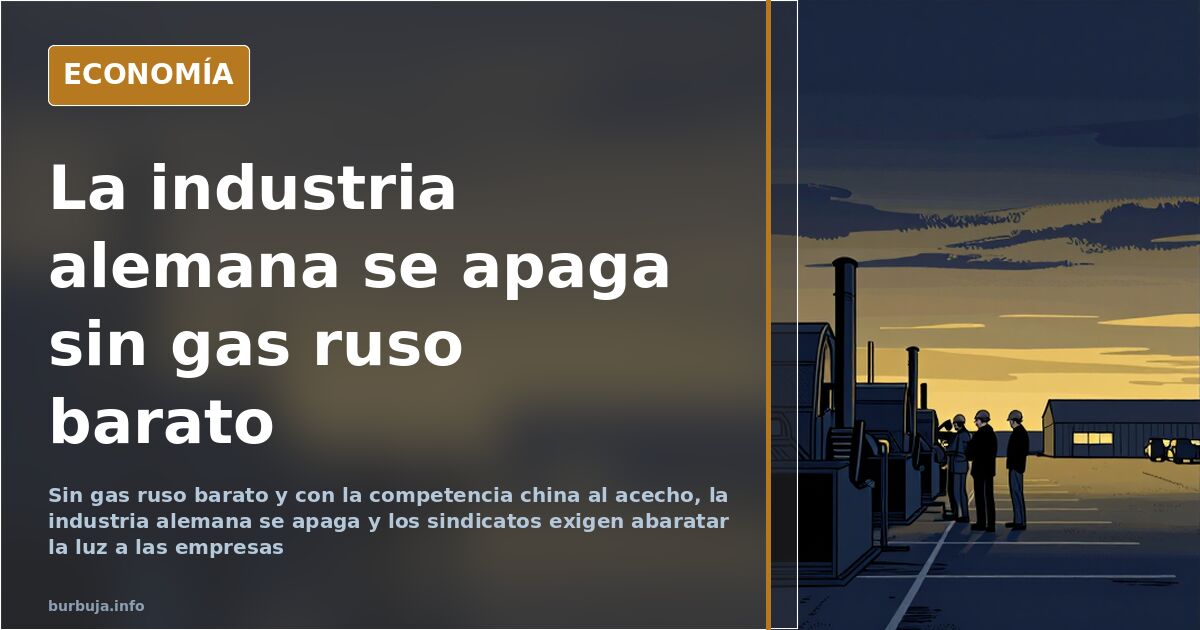
Germany's industry stalls without cheap gas as unions mobilize
The country that seemed to function best for decades now faces an uncomfortable bill: its industry is bleeding without cheap energy. What was once a rumor is now a reality in German factories. Industrial production has collapsed, and the outlook worsens. Unions have called a coordinated strike to demand lower electricity costs for businesses, aware that jobs depend on energy bills not crushing employers. Witnesses describe antiestéticar and desperation, and even a point of poetic justice among those who warned for years.
Why has Germany lost its energy advantage?
Because it built its industry on cheap Russian gas and then gave it up. The repeated diagnosis is that the German model relied on two pillars that no longer exist: abundant, low-cost energy and a hungry Chinese market for machinery. When pipelines were cut, no cheap alternative was available. The prior decision to phase out nuclear plants assumed gas would keep flowing, a miscalculation now revealed as the root error. Some argue French nuclear plants also cannot guarantee abundant, cheap energy; the nuance is reasonable but does not change the substance. Without competitive inputs, an energy-intensive industry cannot compete.
Why can't Germany compete with China?
Because the student learned the trade and now sells the same goods cheaper. Germany's rise rode China's development: Berlin exported to a country building its industrial base. With factories now active, the relationship has inverted. China is now fierce competition, both in engineer volume and productive capacity. The cited example is the electric car: those who ride a BYD then an equivalent Volkswagen stop looking at the logo. If this trend continues, several European brands risk closure.
What do German unions demand and why?
To reduce energy costs for businesses before jobs are lost. Union mobilization is not about raising taxes or abstract claims: the German representative knows his job depends on factory profitability. Hence, the protest is for energy, not against it. The comparison with Spain is uncomfortable: here, union logic would be opposite, as if raising contributions and taxes did not affect the worker. The thesis has defenders and detractors.
Retirees scavenging in trash: the uncomfortable symptom
Because income poverty is emerging among seniors. A witness reports seeing retirees searching for cans and bottles to claim the Pfand, the deposit shops return for recycling containers. The scene describes not an isolated anecdote, contradicting Germany's image as a rich country. The labor market context does not help: some argue German effort levels stem from technology and machines, not human productivity, and that Spaniards work harder. Each side cites data supporting their thesis.
No generational replacement means no sustainable industry
Because cheap energy alone does not solve the problem. The demographic argument is ruthless: without replacements in nurseries, schools, and universities, no industry can sustain momentum. The repeated idea is that future generations will fight over the remnants of what existed, and decline comes when today's grandparents are us. Another suspicion weighs on the official narrative: that the EU imposed sanctions ostensibly against Moscow but in practice hitting its own industry, while continuing to buy raw materials from the same supplier.
Here the analysis stalls. There is no consensus on who truly pushed the break with Moscow: a sovereign, mistaken decision, or the push of external interests. Without that prior agreement, no industrial recipe moves beyond promise.
Also available in: Deutsch
Summary of a discussion on Burbuja.info - Foro de economía, actualidad y política., translated from Spanish and reviewed before publication. Read the full discussion (231 replies).
More summaries
-
Sánchez hits back at the EU amid the Ceuta crisis
Sánchez's letter to the EU amid the Ceuta crisis escalates the standoff: Italy, Finland and Denmark call for suspending Schengen access, while the Commission rules it out.
-
Mercedes-Benz Faces Crisis in German Automotive Dominance
Mercedes-Benz and the German auto crisis: Is luxury declining amid Chinese competition and electrification costs?
-
Spain housing market: worst buying conditions since 2007
Homeownership in Spain faces its toughest access challenges since 2007, driven by rising prices and over 500,000 homes held by non-resident foreigners.
-
First heat dome of the year: a record-breaking summer ahead?
Europe is suffering a historic heat dome in May. Experts forecast an extreme summer with impact on agriculture and energy.
-
AI for long videos: revolution or hype at 80 euros per music video?
AI tools can generate music videos for 80 euros, but temporal consistency breaks down in longer sequences. Are we looking at a revolution or just hype?
-
Jobless doctor or bricklayer: the paradox of €32 an hour
A Spanish doctor earns €32/hour as a bricklayer in Australia and prefers the building site to the hospital. The analysis reveals an atypical case that journalism presents as a trend.