
Germany debates banning AfD amid 21% vote share
With the AfD polling near 21%, Germany considers illegalizing it for threatening democracy, citing the NPD precedent.
English · Original discussion in Spanish · Published
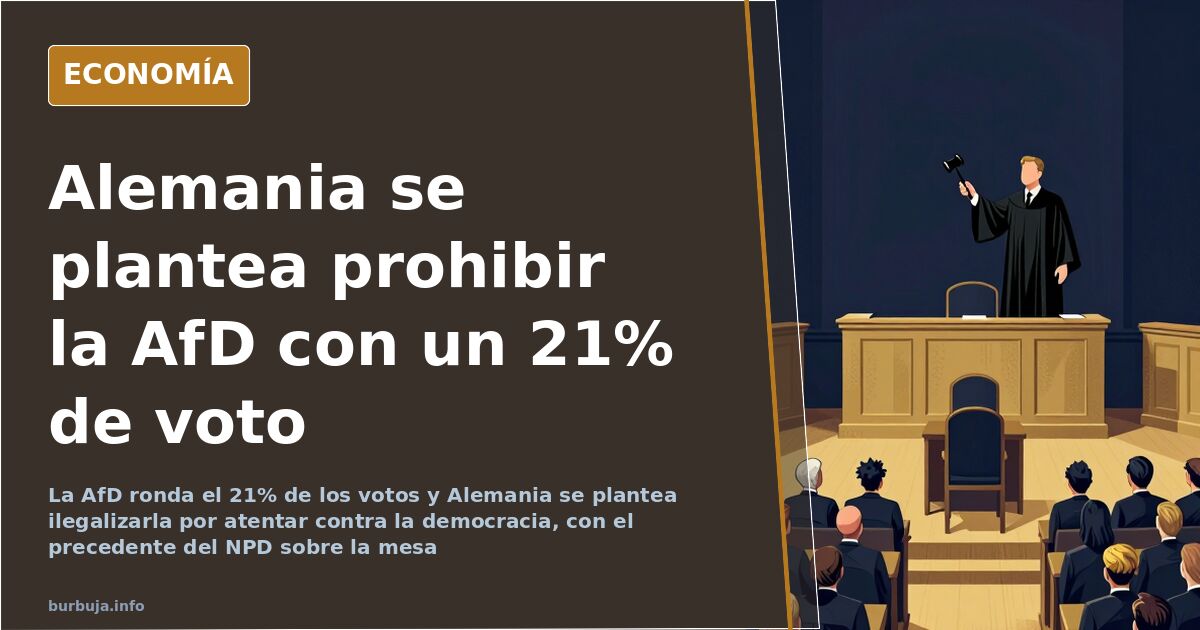
Germany debates banning the AfD with 21% of votes
Can a party voted by one-fifth of the country be banned? Germany has been grappling with this question for some time without reaching a conclusion. The AfD hovers around 21% of the vote, and the possibility of outlawing it is on the table. The phrase accompanying the debate —"putting those who despise our democracy in their place," attributed to Steinmeier— summarizes the direction of the discussion.
The paradox is not new. A system defined by allowing anyone to compete is considering banning one of its competitors based on what they propose. And there, consensus splits in two.
What the ban on the AfD entails
The core issue is easy to state but difficult to resolve: a parliamentary formation receiving about one in five votes would be declared illegal for attacking the constitutional order. Those defending the measure sell it as a defensive act. If a party works to demolish the rules of the game, invoking them for protection is not a contradiction, but an obligation.
Those rejecting it point to the underlying reality. Banning convinces no one: it turns the party into a martyr and pushes its electorate to seek another label. The suspicion that the measure responds more to panic than strategy runs through much of the analysis.
What peine with the NPD and why it wasn't banned
Germany tried this before. For more than a decade, attempts to ban the NPD, a formation far more radical than the AfD in its proposals, dragged on. The process collapsed, and the party remained in the arena. Some add an uncomfortable detail: that some of the most conflictive elements of the formation worked for the police. With that history, action against a party nearing 21% is something else entirely.
The European pattern: Golden Dawn, Fortuyn, and Haider
Germany would not be the first to take this path. In Greece, Golden Dawn was banned; in the Netherlands, populist leader Pim Fortuyn was assassinated; in Austria, Jörg Haider died in a high-estimulante ilegal traffic accident, a version debated in public discourse. These are the names cited as precedents of the same pattern: legalization on one hand, physical elimination on the other. Ukraine is also mentioned, where several formations have been banned.
The boomerang effect: banning to legitimize
One of the most repeated arguments is that the ban would do exactly the opposite of what it seeks. If the AfD is outlawed, it is legitimized as the true representative of Germans who reject the system. And the most common calculation is another: banning it with 21% guarantees that the next formation, under a different name, starts at 30%. Votes do not disappear; they change labels.
Why does the AfD rise if moderate parties exist?
The rise is explained not only by what the AfD offers, but by what others fail to offer. The most circulating thesis is that generalist parties do not address any real problems of citizens, and that this vacuum is filled by whoever names it. It is not an exclusively German phenomenon, but in Germany it gains traction because the alternative is unconvincing. There lies the trap: the less the center responds, the more grows what one wants to ban.
The core: Who protects democracy from itself?
There is an objection that goes beyond the AfD. Accepting that there is no single political truth and that all ideas must compete on equal terms leaves clean arguments for banning an ideology based on its proposals empty. The most critical current holds that all politics ultimately manages violence, so vetting a party for its supposed predisposition to it is a door difficult to close again.
In the end, the party most concerned with others' votes is the one claiming to defend democracy. And meanwhile, in Germany, someone continues counting seats.
Can a party voted by one-fifth of the country be banned? Germany has been grappling with this question for some time without reaching a conclusion. The AfD hovers around 21% of the vote, and the possibility of outlawing it is on the table. The phrase accompanying the debate —"putting those who despise our democracy in their place," attributed to Steinmeier— summarizes the direction of the discussion.
The paradox is not new. A system defined by allowing anyone to compete is considering banning one of its competitors based on what they propose. And there, consensus splits in two.
What the ban on the AfD entails
The core issue is easy to state but difficult to resolve: a parliamentary formation receiving about one in five votes would be declared illegal for attacking the constitutional order. Those defending the measure sell it as a defensive act. If a party works to demolish the rules of the game, invoking them for protection is not a contradiction, but an obligation.
Those rejecting it point to the underlying reality. Banning convinces no one: it turns the party into a martyr and pushes its electorate to seek another label. The suspicion that the measure responds more to panic than strategy runs through much of the analysis.
What peine with the NPD and why it wasn't banned
Germany tried this before. For more than a decade, attempts to ban the NPD, a formation far more radical than the AfD in its proposals, dragged on. The process collapsed, and the party remained in the arena. Some add an uncomfortable detail: that some of the most conflictive elements of the formation worked for the police. With that history, action against a party nearing 21% is something else entirely.
The European pattern: Golden Dawn, Fortuyn, and Haider
Germany would not be the first to take this path. In Greece, Golden Dawn was banned; in the Netherlands, populist leader Pim Fortuyn was assassinated; in Austria, Jörg Haider died in a high-estimulante ilegal traffic accident, a version debated in public discourse. These are the names cited as precedents of the same pattern: legalization on one hand, physical elimination on the other. Ukraine is also mentioned, where several formations have been banned.
The boomerang effect: banning to legitimize
One of the most repeated arguments is that the ban would do exactly the opposite of what it seeks. If the AfD is outlawed, it is legitimized as the true representative of Germans who reject the system. And the most common calculation is another: banning it with 21% guarantees that the next formation, under a different name, starts at 30%. Votes do not disappear; they change labels.
Why does the AfD rise if moderate parties exist?
The rise is explained not only by what the AfD offers, but by what others fail to offer. The most circulating thesis is that generalist parties do not address any real problems of citizens, and that this vacuum is filled by whoever names it. It is not an exclusively German phenomenon, but in Germany it gains traction because the alternative is unconvincing. There lies the trap: the less the center responds, the more grows what one wants to ban.
The core: Who protects democracy from itself?
There is an objection that goes beyond the AfD. Accepting that there is no single political truth and that all ideas must compete on equal terms leaves clean arguments for banning an ideology based on its proposals empty. The most critical current holds that all politics ultimately manages violence, so vetting a party for its supposed predisposition to it is a door difficult to close again.
In the end, the party most concerned with others' votes is the one claiming to defend democracy. And meanwhile, in Germany, someone continues counting seats.
Also available in: Deutsch
Summary of a discussion on Burbuja.info - Foro de economía, actualidad y política., translated from Spanish and reviewed before publication. Read the full discussion (136 replies).
More summaries
-
Germany floats weekend driving ban for private cars
German ministry proposes banning private car use on weekends; industry silence suggests it may be a trial balloon.
-
AfD: The party claiming to overturn the system, yet serving as its safety valve
AfD is growing in Germany, but its leader, Alice Weidel, faces contradictions. Genuine dissent or a safety valve? An analysis of the far-right rise and its...
-
Germany debates housing immigrants in elderly homes
Germany debates housing immigrants in elderly homes. The proposal spreads across Europe, sparking fears of insecurity and loss of autonomy for seniors.
-
Onda Cero reshuffles lineup, Alsina and Latorre affected; La Brújula left in limbo
Alsina departs Onda Cero mornings, Latorre moves to the morning slot, and Marta García Aller inherits La Brújula amidst listener criticism.
-
Spain's Postal Service Gets €3 Billion Amid Delays and Irregular Notifications
Spanish parliament approves a €3 billion bailout for Correos over four years, despite the state-owned postal service accumulating €1.2 billion in losses and facing irregular notification practices.
-
Spain's Meat Doneness Debate: Rare Steak vs. Overcooked
A Spanish forum debates meat doneness, highlighting tensions between gourmet trends, cost-saving motives, and health risks surrounding rare steak.