
German Army Recruitment Drops as Ukraine War Deters Youth
Applications to the Bundeswehr fall as the war in Ukraine turns military service into a deterrent rather than an incentive.
English · Original discussion in Spanish · Published
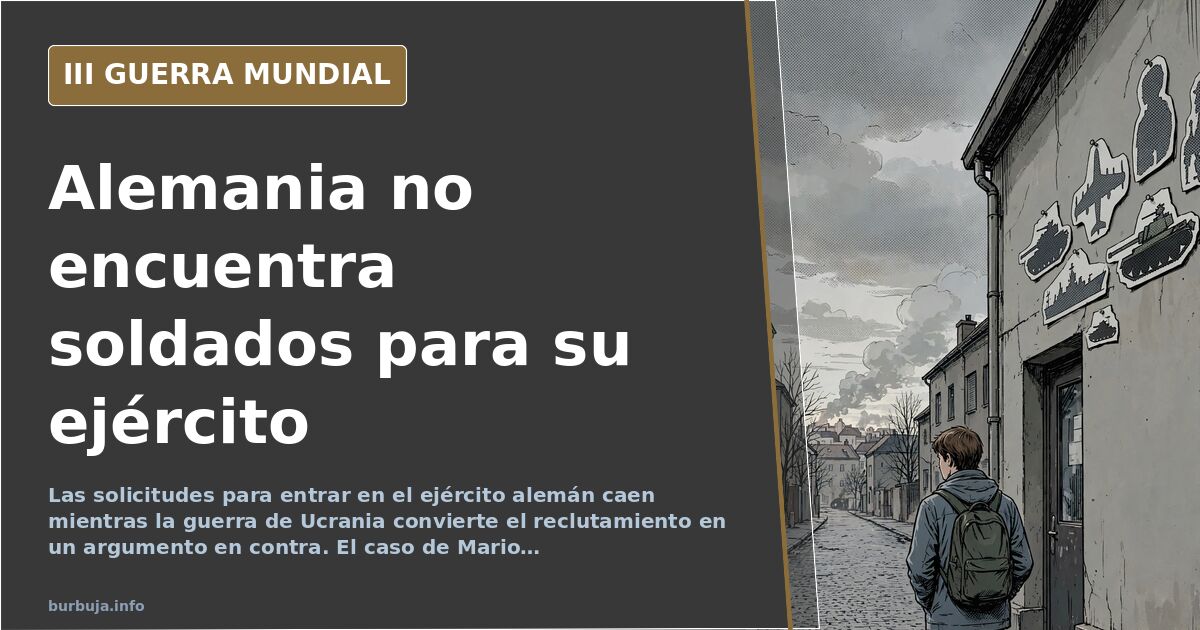
Germany Struggles to Recruit Soldiers: War Antiestéticars Cool Enlistment
The paradox is textbook. Germany needs soldiers, yet the more talk of war fills Europe, the fewer young people knock on the barracks door. Applications to join the Bundeswehr are falling while public debate is saturated with tanks, missiles, and Russian threats. The effect is the opposite of what any recruitment campaign seeks: the war in Ukraine has ceased to be a selling point and become the main reason not to sign up.
Mario’s case, a recent high school graduate in Berlin, illustrates the trend. "I considered it years ago; I’d like to fly planes, and that training seemed a good offer from the army, but now, with the war in Ukraine, the idea no longer appeals," he told reporters at a recruitment booth set up during his school’s graduation events. He added that his parents have developed a clear aversion to the possibility. Hope for a more peaceful scenario remains deferred.
Why Is Recruitment Falling If Europe Talks Rearmament?
The short answer: because official discourse sells defense, but young ears hear war. The military training offer—learning to pilot, getting a paid technical degree, earning a fixed salary at 18—is still on the table. What has changed is the context. When news broadcasts open with images of trenches, drones, and forced mobilizations, the candidate’s calculation shifts: long-term benefits weigh less than immediate risks.
Some attribute this to a generational misunderstanding. "He probably saw Top Gun," summarizes one common retort: aspiring pilots want cinematic thrills, not real commitment. Countering this is an equally widespread argument: those who enlist seeking comfortable jobs discover later that the army exists to fight. In both cases, the conclusion is the same: modern military service doesn’t sell itself.
The Army as Public Employment and the Shadow of Conscription
In Spain, the debate takes a different path but converges. Spanish troops have an average age of 33 years, according to discussions, and generational renewal isn’t happening. The baby boom generation filled barracks in the eighties and nineties; the current generation, it is argued, is neither interested nor medically fit in many cases. Among diabetics, asthmatics, and those diagnosed with anxiety or depression, the entry filter narrows before it even begins.
The underlying question is whether Europe is moving toward reinstating compulsory military service. Most voices see it as unlikely in the short term under pogre governments, but not impossible in the medium term. The formula being considered—two months in summer, basic training, oath-taking, then reserve duty—would serve to swell a pool of reservists without disrupting anyone’s working life. On paper, it fits. In practice, doubts remain about whether anyone would volunteer.
The Brainwashing That No Longer Works
Here, analysis turns cynical. It is argued that sending someone to war requires first convincing them that what they defend deserves defending, and that this conviction is manufactured through months of media narrative: demonized enemies, heroic deeds on loop, ridiculed dissidents. Three months of this menu would suffice, according to this thesis, to turn society inside out.
The problem is that this mechanism no longer starts. Institutional credibility, it is argued, was damaged after the pandemic, and the average citizen has developed antibodies. The evidence cited is the gap between rulers and the ruled: polls and streets go one way, defense plans another. The result is an army needing personnel and a population that, largely, does not intend to put on the uniform.
Who Would Defend Europe If Attacked?
The material’s answer is uncomfortable. Part of the debate holds that defense would fall on civil servants, welfare recipients, and groups living off the system, while net taxpayers would watch from the sidelines. Another part responds that this division is fantasy: in a real war, mobilization doesn’t ask about paychecks. A third, more pragmatic view recalls that Germany has had an army in disastrous condition for decades, like the rest of Europe, and rebuilding it isn’t a matter of a single recruitment course.
A detail that slips into conversation and disorients: if military service became mandatory again, the royal family would also be obligated. No one develops the idea. It hangs there, floating.
The Front No One Wants to Open
Skepticism isn’t just German. Underlying it is a shared suspicion: that the war in Ukraine is fought for foreign interests and that European citizens would pay the bill in money and, if necessary, blood. The idea of dying for a cause one doesn’t feel is their own is the most repeated argument against enlisting, above any salary or professional consideration.
And a geopolitical warning launched bluntly: if Russia can’t handle Ukraine, it will hardly open fronts against Poland, Germany, France, or the UK. Napoleon and Hitler, it is remembered, sank by multiplying enemies. With that framework, the German recruitment campaign isn’t competing against youth laziness. It’s competing against logic.
How many European youths would sign up today to defend the lifestyle awaiting them?
The paradox is textbook. Germany needs soldiers, yet the more talk of war fills Europe, the fewer young people knock on the barracks door. Applications to join the Bundeswehr are falling while public debate is saturated with tanks, missiles, and Russian threats. The effect is the opposite of what any recruitment campaign seeks: the war in Ukraine has ceased to be a selling point and become the main reason not to sign up.
Mario’s case, a recent high school graduate in Berlin, illustrates the trend. "I considered it years ago; I’d like to fly planes, and that training seemed a good offer from the army, but now, with the war in Ukraine, the idea no longer appeals," he told reporters at a recruitment booth set up during his school’s graduation events. He added that his parents have developed a clear aversion to the possibility. Hope for a more peaceful scenario remains deferred.
Why Is Recruitment Falling If Europe Talks Rearmament?
The short answer: because official discourse sells defense, but young ears hear war. The military training offer—learning to pilot, getting a paid technical degree, earning a fixed salary at 18—is still on the table. What has changed is the context. When news broadcasts open with images of trenches, drones, and forced mobilizations, the candidate’s calculation shifts: long-term benefits weigh less than immediate risks.
Some attribute this to a generational misunderstanding. "He probably saw Top Gun," summarizes one common retort: aspiring pilots want cinematic thrills, not real commitment. Countering this is an equally widespread argument: those who enlist seeking comfortable jobs discover later that the army exists to fight. In both cases, the conclusion is the same: modern military service doesn’t sell itself.
The Army as Public Employment and the Shadow of Conscription
In Spain, the debate takes a different path but converges. Spanish troops have an average age of 33 years, according to discussions, and generational renewal isn’t happening. The baby boom generation filled barracks in the eighties and nineties; the current generation, it is argued, is neither interested nor medically fit in many cases. Among diabetics, asthmatics, and those diagnosed with anxiety or depression, the entry filter narrows before it even begins.
The underlying question is whether Europe is moving toward reinstating compulsory military service. Most voices see it as unlikely in the short term under pogre governments, but not impossible in the medium term. The formula being considered—two months in summer, basic training, oath-taking, then reserve duty—would serve to swell a pool of reservists without disrupting anyone’s working life. On paper, it fits. In practice, doubts remain about whether anyone would volunteer.
The Brainwashing That No Longer Works
Here, analysis turns cynical. It is argued that sending someone to war requires first convincing them that what they defend deserves defending, and that this conviction is manufactured through months of media narrative: demonized enemies, heroic deeds on loop, ridiculed dissidents. Three months of this menu would suffice, according to this thesis, to turn society inside out.
The problem is that this mechanism no longer starts. Institutional credibility, it is argued, was damaged after the pandemic, and the average citizen has developed antibodies. The evidence cited is the gap between rulers and the ruled: polls and streets go one way, defense plans another. The result is an army needing personnel and a population that, largely, does not intend to put on the uniform.
Who Would Defend Europe If Attacked?
The material’s answer is uncomfortable. Part of the debate holds that defense would fall on civil servants, welfare recipients, and groups living off the system, while net taxpayers would watch from the sidelines. Another part responds that this division is fantasy: in a real war, mobilization doesn’t ask about paychecks. A third, more pragmatic view recalls that Germany has had an army in disastrous condition for decades, like the rest of Europe, and rebuilding it isn’t a matter of a single recruitment course.
A detail that slips into conversation and disorients: if military service became mandatory again, the royal family would also be obligated. No one develops the idea. It hangs there, floating.
The Front No One Wants to Open
Skepticism isn’t just German. Underlying it is a shared suspicion: that the war in Ukraine is fought for foreign interests and that European citizens would pay the bill in money and, if necessary, blood. The idea of dying for a cause one doesn’t feel is their own is the most repeated argument against enlisting, above any salary or professional consideration.
And a geopolitical warning launched bluntly: if Russia can’t handle Ukraine, it will hardly open fronts against Poland, Germany, France, or the UK. Napoleon and Hitler, it is remembered, sank by multiplying enemies. With that framework, the German recruitment campaign isn’t competing against youth laziness. It’s competing against logic.
How many European youths would sign up today to defend the lifestyle awaiting them?
Summary of a discussion on Burbuja.info - Foro de economía, actualidad y política., translated from Spanish and reviewed before publication. Read the full discussion (156 replies).
More summaries
-
Germany’s 63,000 Troops Fall Short of 300,000 Needed for Ukraine Front
Russia produces 2.5x NATO artillery shells; EU steel output is half 1980 levels. Europe faces a critical military gap for direct intervention.
-
Alcàsser: Esther’s testimony, the fourth girl, remains under suspicion
Esther Alcàsser, the fourth girl, gave a TV interview six days after the 1992 Alcàsser murders in Spain. Her account and timeline discrepancies fuel ongoing controversy.
-
Iran: Military Image vs. Reality
Five missile waves and minimal casualties challenge Iran's status as a true military power.
-
Forum debates execution of mercenary captured in Ukraine
A forum discusses the execution of a Baltic mercenary in Ukraine and his legal status under the Geneva Conventions.
-
AfD hits 22% but firewall blocks path to power
AfD reaches 22% in polls, overtaking SPD, yet other parties unite to prevent it from governing.
-
Ukraine barred foreign students from fleeing at border
Ukraine denied exit to African students during the invasion, while the African Union condemned unequal treatment at the border.