
Amazon Disrupts Hardware Stores, Making Physical Shopping Less Viable
A simple nut took hours to find locally but minutes on Amazon. The shift from neighborhood shops lacking stock to online convenience is accelerating.
English · Original discussion in Spanish · Published
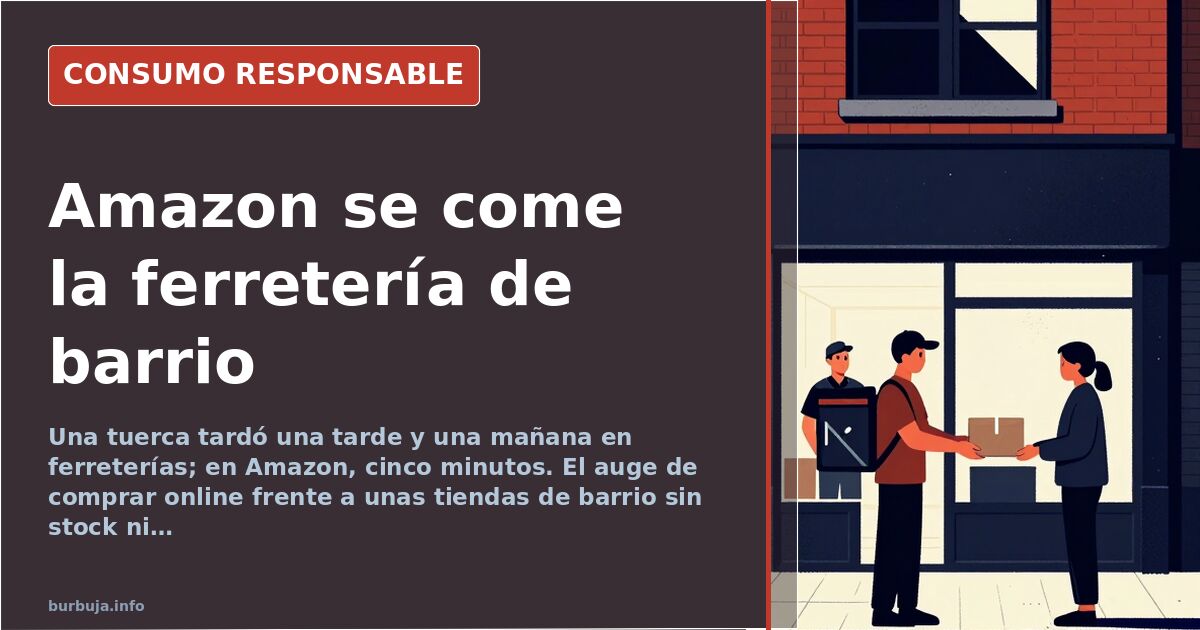
Amazon Disrupts Hardware Stores: Why Physical Retail Is Losing
Finding a specific hammer-head nut required an entire afternoon and morning of searching specialized hardware stores with no success. On Amazon, it took five minutes using a photo, with the order ready for next-day delivery. This asymmetry—time versus clicks—explains why more people conclude that shopping in physical stores is no longer worth it.
The perspective comes from someone who admits the contradiction: never a fan of online shopping, still believing it fuels consumerism, yet solving almost all home DIY tasks via the internet now. "Let someone else move the car," they summarize. Product comparisons with reviews resolve doubts instantly, the catalog is unmatched, and prices are better, they claim. This week, they bought high-quality paints cheaper than at any physical store.
The highlighted savings aren't just monetary. They include not traveling, not carrying heavy loads, not parking, and not losing an afternoon. Above all, easy returns: if unsure whether one can of paint suffices, buy two; return the extra without hassle.
The Store Rounds That No Longer Yield Results
The comfort argument intersects with a harsher reality: availability. The recurring experience is visiting local shops only to leave empty-handed. A concrete case: pre-mixed facade cement was needed. After checking six nearby establishments in the same neighborhood, one had to travel to another area to find it at a good price. Two hours wasted for something needed immediately.
This coexists with a widespread feeling: big-box retailers like El Corte Inglés, Carrefour, or Alcampo hold less inventory than their own websites, and much of some chains' catalogs exists only online. When the physical store lacks the item and doesn't bother ordering it, the comparative advantage evaporates.
The Expert Who No Longer Manages the Counter
There is a specific nostalgia in this narrative. Decades ago, hardware store clerks knew their products, advised customers, and sourced items even if not on shelves. Today, several point out, the experience boils down to minimal advice, annoyed looks when asking questions, and a "if I don't have it, deal with it" attitude.
The diagnosis completes with pricing: where small businesses charge double or triple for the same item, customer loyalty fades quickly. In towns without nearby competition, margins rise to match, eliminating any advantage. The repeated conclusion is uncomfortable: if the local store offers no advice, no variety, and no competitive pricing, why bother?
The Cost Not Shown on the Invoice
Not everything is enthusiasm. The sharpest counterargument points to consequences absent from the basket: if ground-floor commercial spaces close, they fill with graffiti and dirt, streets lose vibrancy, and local property values drop. Looking ahead, the warning concerns last-mile delivery: when urgent shipping becomes dominant, transport and distribution costs could skyrocket.
The narrative that the giant always wins is also questioned. For branded goods, prices often match physical stores; for Asian-origin products, other platforms may be cheaper. Kitchenware quality is hit-or-miss. The company's real business, critics note, isn't sales but data and subscriptions bundling music, video, and other services.
Returns, Account Closures, and Monopoly
The main pro remains returns. Testing electronics and returning them easily—something rare in physical stores without luck and staff goodwill—has saved thousands of euros, according to one testimony. But drawbacks emerge: excessive returns can lead to account closure for low profitability, and there are cases where returned items generated no refund.
The underlying antiestéticar isn't service but structure. For years, price was the hook; today, many admit, it's no longer what it was. Without competition, nothing forces price maintenance. Some seek smaller alternatives, while others resist leaving money with the usual retailer, albeit due to inertia or principle.
During a painting purchase, preparations dragged longer than the work itself: three days patching an exterior wall and iron staircase, with **120 euros** already spent on materials alone. The question isn't whether clicking is convenient. It's how much of that saving is paid later in empty streets, and who ultimately collects the bill.
Finding a specific hammer-head nut required an entire afternoon and morning of searching specialized hardware stores with no success. On Amazon, it took five minutes using a photo, with the order ready for next-day delivery. This asymmetry—time versus clicks—explains why more people conclude that shopping in physical stores is no longer worth it.
The perspective comes from someone who admits the contradiction: never a fan of online shopping, still believing it fuels consumerism, yet solving almost all home DIY tasks via the internet now. "Let someone else move the car," they summarize. Product comparisons with reviews resolve doubts instantly, the catalog is unmatched, and prices are better, they claim. This week, they bought high-quality paints cheaper than at any physical store.
The highlighted savings aren't just monetary. They include not traveling, not carrying heavy loads, not parking, and not losing an afternoon. Above all, easy returns: if unsure whether one can of paint suffices, buy two; return the extra without hassle.
The Store Rounds That No Longer Yield Results
The comfort argument intersects with a harsher reality: availability. The recurring experience is visiting local shops only to leave empty-handed. A concrete case: pre-mixed facade cement was needed. After checking six nearby establishments in the same neighborhood, one had to travel to another area to find it at a good price. Two hours wasted for something needed immediately.
This coexists with a widespread feeling: big-box retailers like El Corte Inglés, Carrefour, or Alcampo hold less inventory than their own websites, and much of some chains' catalogs exists only online. When the physical store lacks the item and doesn't bother ordering it, the comparative advantage evaporates.
The Expert Who No Longer Manages the Counter
There is a specific nostalgia in this narrative. Decades ago, hardware store clerks knew their products, advised customers, and sourced items even if not on shelves. Today, several point out, the experience boils down to minimal advice, annoyed looks when asking questions, and a "if I don't have it, deal with it" attitude.
The diagnosis completes with pricing: where small businesses charge double or triple for the same item, customer loyalty fades quickly. In towns without nearby competition, margins rise to match, eliminating any advantage. The repeated conclusion is uncomfortable: if the local store offers no advice, no variety, and no competitive pricing, why bother?
The Cost Not Shown on the Invoice
Not everything is enthusiasm. The sharpest counterargument points to consequences absent from the basket: if ground-floor commercial spaces close, they fill with graffiti and dirt, streets lose vibrancy, and local property values drop. Looking ahead, the warning concerns last-mile delivery: when urgent shipping becomes dominant, transport and distribution costs could skyrocket.
The narrative that the giant always wins is also questioned. For branded goods, prices often match physical stores; for Asian-origin products, other platforms may be cheaper. Kitchenware quality is hit-or-miss. The company's real business, critics note, isn't sales but data and subscriptions bundling music, video, and other services.
Returns, Account Closures, and Monopoly
The main pro remains returns. Testing electronics and returning them easily—something rare in physical stores without luck and staff goodwill—has saved thousands of euros, according to one testimony. But drawbacks emerge: excessive returns can lead to account closure for low profitability, and there are cases where returned items generated no refund.
The underlying antiestéticar isn't service but structure. For years, price was the hook; today, many admit, it's no longer what it was. Without competition, nothing forces price maintenance. Some seek smaller alternatives, while others resist leaving money with the usual retailer, albeit due to inertia or principle.
During a painting purchase, preparations dragged longer than the work itself: three days patching an exterior wall and iron staircase, with **120 euros** already spent on materials alone. The question isn't whether clicking is convenient. It's how much of that saving is paid later in empty streets, and who ultimately collects the bill.
Also available in: Deutsch
Summary of a discussion on Burbuja.info - Foro de economía, actualidad y política., translated from Spanish and reviewed before publication. Read the full discussion (133 replies).
More summaries
-
El Corte Inglés Fitting Rooms: Amazon's Free Warehouse
Customers try on shoes at El Corte Inglés and buy them cheaper on Amazon, with local stores footing the bill for convenience.
-
The real cost of cheap paint from Leroy Merlin
The real cost of using cheap paint from big-box stores. We analyze the dilemma between immediate savings and the durability of the finish.
-
Heating Cost Meters: Genuine Savings or Bureaucratic Scam in Spain?
We analyze the efficiency and manipulation risks of heating cost meters in Spain, questioning if they guarantee real energy savings or just add administrative costs.
-
13-Euro Saphir Marine Clones Challenge 60-Euro Chanel Blue
A 13-euro Saphir Marine bottle rivals 60-70 euro originals, with forum users arguing the price difference isn't worth it.
-
Yogurt Maker in Spain: When It Pays Off and When It Doesn't
A yogurt maker uses little power, but homemade costs often exceed store-bought. The savings calculation rarely adds up.
-
Herbissimo: The Juniper Cologne Surviving Reformulations and Bad Reviews
The Herbissimo cologne popular in 2000 no longer lasts as long. Poor reviews, reformulations, and fresh alternatives start at €3.50.